Assembly Magazine logo
search
Ask ASSEMBLY AI
cart
facebook twitter linkedin youtube
  • Sign In
  • Create Account
  • Sign Out
  • My Account
Assembly Magazine logo
  • TRENDS
    • Ask ASSEMBLY AI
    • Trends
    • News
    • New Products
  • INDUSTRIES
    • Aerospace
    • Appliance
    • DFMA Assembly
    • Medical Devices
    • Green Manufacturing
    • Lean Manufacturing
    • Machinery Assembly
    • Electronics Assembly
    • Automotive
  • TECHNOLOGIES
    • Adhesives & Dispensing
    • Assembly Presses
    • Automated Assembly Systems
    • Manufacturing Management
    • Manufacturing Software
    • Motion Control
    • Screwdriving & Riveting
    • Robotics
    • Test & Inspection
    • Plastics & Metal Welding
    • Wire Processing
    • Workstations
  • AUTONOMOUS & ELECTRIC MOBILITY
    • AEM Magazine Archives
    • Autonomy
    • Electrification
    • Mobility Services
    • Assembly & Testing
    • AV/EM News
  • MEDIA
    • Ask ASSEMBLY AI
    • Podcasts
    • Assembly News Now
    • Assembly TV
    • Webinars
    • eBooks
  • EVENTS
    • Calendar
    • The ASSEMBLY Show
  • MORE
    • Exclusives >
      • Plant of the Year
      • Capital Spending
    • Buyers Guide >
      • Supplier Insights
    • Classifieds
    • Featured Products
    • Newsletters
    • Store
    • White Papers
    • Columns
    • Sponsor Insights
  • INFOCENTER
    • Assembly & Test Solutions
  • EMAGAZINE
    • eMagazine
    • Archive Issues
    • Advertise
    • Contact Us
    • Sign Up
Columns

Station to Station: Robots Lend Flexibility to Automated Assembly Line
By John Sprovieri
September 28, 2007
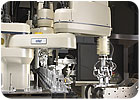
Guided by machine vision, this SCARA robot retrieves a syringe needle from pocketed tape. Photo courtesy Integrated BioSciences Inc.

The central challenge of high-mix, high-volume manufacturing is how to maximize the return on investment in automated assembly systems. There is no magic machine that can assemble everything, and even repurposed assembly systems require some customization for a new product. Nevertheless, manufacturers can lower lead times and decrease development costs by basing production on flexible automation systems that can be easily rebuilt, rearranged and reprogrammed to assemble families of similar products.

This is exactly the strategy pursued by Integrated BioSciences Inc. (IBS, Lewisberry, PA), a contract manufacturer of class I and II medical devices and a builder of custom automation systems. Two years ago, the company set out to design a standardized, flexible assembly platform that could accommodate a variety of medical products with minimal effort.

“We wanted a platform that we could configure in different shapes and sizes to handle different process flows and operations, such as dispensing, press-fit assembly, ultrasonic welding-any operation that might be needed to assemble rubber, plastic and metal parts,” explains Keith Bocchicchio, director of technology for IBS. The chassis had to be clean-room compatible, and it had to interface with standard feeding systems, including vibratory bowls, centrifugal feeders and belt feeders. The goal was a system that could output 30 million to 40 million assemblies per year while tended by just one or two operators.

The end result is a high-speed indexing chassis that can transfer pallets from one station to another in 200 milliseconds. Robots, inspection stations and process modules, such as ultrasonic welders, can be added, removed or repositioned as needed.

“This isn’t the fastest machine we’ve worked on, but that wasn’t our goal,” says Bocchicchio. “The idea was to lower time to market and minimize labor input.”

The workhorse of the system is the Cobra i600 vision-guided SCARA robot from Adept Technology Inc. (Livermore, CA). The robot is self-contained, so it’s easily integrated into workcells where space is at a premium. The amplifiers and motion controller are built into the robot-no external electronics are needed. Installing the robot takes four steps: supply power; attach the emergency stop; plug in digital I/O cables to interface with peripherals; and add tooling and vacuum lines. Programming is done through a PC, which can be removed once the system is running. The robot has a maximum reach of 600 millimeters and a maximum payload of 5.5 kilograms. Repeatability in the X-Y plane is ±0.017 millimeter.

“The good thing about the Adept Cobra is that it doesn’t have a big footprint and it’s easy to integrate,” says Bocchicchio. “We may eventually run into situations that require more complex motion than what a SCARA can offer, but mostly we can work around that or engineer it out.”

In the IBS system, SCARAs are used primarily for pick-and-place operations: taking a part from an escapement and placing it on a pallet; transferring a subassembly from one section of a pallet to another; or unloading finished assemblies into sterile packaging. Pneumatic, vacuum-powered and servo-driven end-effectors handle parts, and IBS engineers design products and pallets to facilitate top-down, or additive, assembly.

Vision guidance keeps fixturing costs low by enabling engineers to use simple, inexpensive methods to present parts for pickup by the robots. For example, the first task for the IBS system is production of a family of safety syringes in 1-, 5- and 10-milliliter sizes. Needles for the syringes are fed in pocketed tape. Vision guidance gives the robot the exact location and orientation of the needle within the pocket.

For more information on contract assembly of medical devices, contact IBS at 800-324-7674 or visit www.ibiosci.com. For more information on robots and vision, contact Adept at 800-292-3378 or visit www.adept.com.

Share This Story

Looking for a reprint of this article?
From high-res PDFs to custom plaques, order your copy today!

John has been with ASSEMBLY magazine since February 1997. John was formerly with a national medical news magazine, and has written for Pathology Today and the Green Bay Press-Gazette. John holds a B.A. in journalism from Northwestern University, Medill School of Journalism.

Recommended Content

JOIN TODAY
To unlock your recommendations.

Already have an account? Sign In

  • Made in the U.S.A.

    Consumer Products Manufacturing: Made in the USA

    Supply chain lessons learned during the coronavirus...
    Automated Assembly Systems
    By: Austin Weber
  • Best Practices for Press-Fit Assembly

    Best Practices for Press-Fit Assembly

    In manufacturing, ironclad formulas for success are hard...
    Assembly Presses
    By: Jim Camillo
  • aem0523leader-tesla1.jpg

    Tesla Rethinks the Assembly Line

    Engineers at Tesla Inc. have developed a new process that...
    Automotive Assembly
    By: Austin Weber
Manage My Account
  • eMagazine Subscription
  • Assembly Newsletters
  • Online Registration
  • Subscription Customer Service
  • Manage My Preferences

More Videos

Sponsored Content

Sponsored Content is a special paid section where industry companies provide high quality, objective, non-commercial content around topics of interest to the ASSEMBLY audience. All Sponsored Content is supplied by the advertising company and any opinions expressed in this article are those of the author and not necessarily reflect the views of ASSEMBLY or its parent company, BNP Media. Interested in participating in our Sponsored Content section? Contact your local rep!

close
  • ultrasonic welding
    Sponsored bySonobond Ultrasonics

    Engineering Efficiency in High-Performance Assembly: How Ultrasonic Welding Enhances Throughput, Reliability and Quality

  • UV curing system
    Sponsored byDymax

    Why UV Intensity Alone Doesn’t Define Curing Performance

  • wooden pallets
    Sponsored byLEAN Manufacturing Products

    Eliminating Waste on the Shop Floor: Applying Lean Principles to Improve Manufacturing Efficiency

Popular Stories

ASSEMBLY News Now, episode-30: Volvo Redesigns EV Manufacturing

Volvo Redesigns EV Manufacturing

Boeing CEO Kelly Ortberg announces 1 billion investment

Boeing Plans $1 Billion Wichita Investment, Workforce Training Center

GE Appliances Worker on Line

GE Appliances Expands Factory AI With 800 Gemini Enterprise Agents

Watch the latest episode of ANN now!

Events

July 24, 2025

From Shop Floor to CFO: How Manufacturers Are Closing the Loop Between Operations and Finance

On Demand Learn how manufacturers are bridging the gap between the shop floor and ERP systems to gain real-time visibility, streamline operations, and kick-start digital transformation—without waiting years.

Sponsored by:

PicoStratusGreen
July 30, 2025

Buffer Analysis and Design Fundamentals for Manufacturing Excellence

On Demand In this presentation, Dr. Herman Tang shares practical insights from his industry experience and research on buffer management in manufacturing operations.

View All Submit An Event

Poll

Difficult Assembly Processes

Which assembly process gives you the most difficulty?
View Results Poll Archive

Products

Manufacturing Cost Policy Deployment (MCPD) Profitability Scenarios: Systematic and Systemic Improvement of Manufacturing Costs

Manufacturing Cost Policy Deployment (MCPD) Profitability Scenarios: Systematic and Systemic Improvement of Manufacturing Costs

See More Products
Register for webinar - Modernizing Automotive Assembly: Why Upgrading Legacy MES is a Business Imperative

Related Articles

  • Station to Station: Buffers Maximize Uptime in Automated Assembly

    See More
  • Vision Systems Lend Flexibility to Assembly Robots

    See More
  • custom, mobile workstation

    Modular Components Lend Flexibility to Assembly Lines

    See More

Related Products

See More Products
  • Kaizen Assembly: Designing, Constructing, and Managing a Lean Assembly Line

  • foreman.jpg

    The Foreman on the Assembly Line

  • pocket.jpg

    How To Implement Lean Manufacturing, Second Edition

See More Products

Events

View AllSubmit An Event
  • March 10, 2026

    Design for Flexibility: How to Assemble More With Less

    On Demand Whether you are specifying new equipment or improving existing processes, this session will provide practical insight into building adaptable assembly strategies that support growth, reliability, and continuous improvement. Sponsored by:
View AllSubmit An Event

Related Directories

  • Automated Assembly Corp.

    Automated Assembly Corporation stands at the forefront of the manufacturing industry, specializing in roll-to-roll assembly capabilities that range from low to high-volume production. Our advanced automation systems are engineered to handle diverse production requirements with precision and efficiency, making us the ideal partner for businesses needing scalable assembly solutions.
  • HowToRobot

  • Glide-Line by NCC Automated Systems

    Glide-Line designs and manufactures modular conveyor and panel/pallet handling systems for assembly automation, packaging, and material handling. Its products include timing belt conveyors, twin-strand pallet systems, multi-strand configurations, vertical transfer units, stackers and custom transfer solutions—engineered for flexibility, precision, and efficiency across industries from electronics and medical devices to consumer goods and automotive manufacturing.
×

Never miss the latest news and trends driving the manufacturing industry

Stay in the know on the latest assembly trends.

JOIN TODAY!
  • RESOURCES
    • Advertise
    • Contact Us
    • Directories
    • Manufacturing Division
    • Store
    • Want More?
  • SIGN UP TODAY
    • Create Account
    • eMagazine
    • Newsletters
    • Customer Service
    • Manage Preferences
  • SERVICES
    • Marketing Services
    • Reprints
    • Market Research
    • List Rental
    • Survey/Respondent Access
  • STAY CONNECTED
    • LinkedIn
    • Facebook
    • Instagram
    • YouTube
    • X (Twitter)
  • PRIVACY
    • PRIVACY POLICY
    • TERMS & CONDITIONS
    • DO NOT SELL MY PERSONAL INFORMATION
    • PRIVACY REQUEST
    • ACCESSIBILITY

Copyright ©2026. All Rights Reserved BNP Media, Inc. and BNP Media II, LLC.

Design, CMS, Hosting & Web Development :: ePublishing