Technologies for Joining and Splicing Wires

Sooner or later, every wire needs to be attached to something. Whether joining two wires together or attaching multiple wires directly to a terminal or assembly, engineers must choose between resistance welding, soldering and ultrasonic welding. Each joining process has pros and cons that should be carefully considered.
Soldering is a well-understood process and is a practical alternative in certain applications, such as terminating tin-plated wires. It is typically used for low-volume production, or for applications where field repair is expected, such as audio cabling and multipin connectors.
Soldering is often used to seal a wire into a housing, where the solder joint creates both a moisture-tight seal and an electrical connection. But, soldering cannot be used if the joint temperature in service will approach the melting point of the solder.
“Soldering is used in many places where a repair is being made or a single wire must be joined to a component,” says Tony DiFinizio, engineering manager at SonicSolution Systems Inc. “If quality control and assurance is not needed, then soldering can provide an inexpensive joining method.”
However, because wires are typically soldered manually, it can be a messy, time-consuming process. “Care must be taken to balance cost with quality, weld strength, the use of lead-based materials, fume extractors and operator safety,” warns DiFinizio.
“Soldering is very operator-dependent,” adds Janet Devine, president of Sonobond Ultrasonics. “But, when well made, the resultant joint between wire and terminal will have good peel strength and tensile strength.”
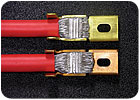
Ultrasonic welding was used to attach these 70 square millimeter aluminum wires to brass and copper terminals.
Welding Options
While soldering is commonly used in the electronics industry to attach wires, welding is the preferred method among many automotive, aerospace and appliance manufacturers.“Ultrasonic metal welding is the most popular process for splicing copper and aluminum wires,” claims Tim Frech, senior engineer for ultrasonics at the Edison Welding Institute (EWI). “Resistance welding is used for splicing and compacting stranded wires, and is better for less-conductive materials like stainless steel and nickel.”
However, the heat generated during resistance welding can anneal the wire, which can reduce the tensile strength of the wire strands adjacent to the weld. “Electrode wear in resistance welders is high, due to the current density, and [electrodes] require constant dressing,” warns Mike Patrikios, worldwide manager of metal welding products at Sonics & Materials Inc.
Laser welding is another option, but it’s difficult to apply when attaching round wire to flat terminals. “[Therefore], it is primarily used for sensors,” says Frech. “They typically use very small wire and offer access from only one side, making it difficult to use resistance or ultrasonic welding.
“Ultrasonic and resistance welding both work well for terminating wires,” adds Frech. “The selection process [should be] based on the materials. If the terminal is tin-plated brass, which is typical in automotive electronics, resistance welding is used. If resistance welding is chosen, a wire is inserted into a hole or other type of self-fixturing terminal design.”
Although many engineers are comfortable with older, traditional wire joining techniques, such as soldering and resistance welding, ultrasonic welding has become more popular, especially in the auto industry. Frech estimates that at least two-thirds of the cabling used in cars is ultrasonically welded.
Ultrasonic metal welding was first used in the auto industry 30 years ago for splicing wires. It is a mechanical process where wire strands are vibrated together under pressure at a frequency from 15 to 40 kilohertz. The vibrational energy disperses surface oxides to create a galling on the strands to form a metallurgical bond.
“Ultrasonic welding uses much less energy than resistance welding, does not require any water cooling, and does not need flux or filler materials,” explains Devine. “The metals do not melt, so there are no significant changes in material properties, unlike resistance welding. Ultrasonic welding is also able to weld oxidized wires and terminals.”
Despite those benefits, ultrasonic welding may not be ideal for all wire applications. “An ultrasonic joint has good tensile strength, but low peel strength, so more consideration needs to be given to the strain relief procedures,” says Devine. “Wire bundles smaller than 1 square millimeter are difficult to weld without damage, and wires with high strand count and extremely fine individual wires may encounter wire breakage from ultrasonic welding.”
In addition, because ultrasonic welding requires an overlap, butt joints are not always possible. “Overlap joints work better for multiple wire materials or sizes,” explains Frech. “End-to-end welding (butt joints) work well for solid wires. Percussion welding can be used for welding wires to terminals or butt welding.”
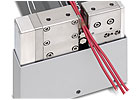
This splicing system features smart controls that automatically set up for wire size and monitor weld quality.
Material Matters
The type of material that a wire or terminal is made out of plays a key role in determining the correct type of welding process to use. Conductive materials, such as aluminum, brass, copper, gold, nickel and silver, are typically ultrasonically welded. Hard, ferrous materials, such as carbon steel and stainless steel, are better candidates for resistance welding.“The materials weldable by ultrasonics are preferably nonferrous, so some applications are not possible,” Devine points out. “[For instance], pre-tinned wire often presents a challenge.”
Tin-plating is typically used in applications where corrosion is a concern. “Plating such as tin or lead creates a problem for ultrasonic welding, because these materials act as a lubricant during the weld and prevent effective galling,” says Patrikios. Tinning does not transmit sound as well as bare wire, so vibration is dampened. “In small amounts, the plating can be dispersed, but it does cause a variable that is a challenge to control,” adds Patrikios.
Engineers should always pay attention to the type of material used in wires before choosing a welding process. For example, copper-to-copper can be welded with processes that melt the metals, but a copper-to-stainless steel pin must be done with a solid-state welding process, such as resistance welding.
“Material makes a big difference in the welding process,” claims Frech. “[That’s why] ultrasonic welding is preferred for more ductile, electrically conductive wires like copper and aluminum.
“Laser welding is more difficult if dissimilar materials are to be welded, such as copper to steel or nickel to aluminum,” warns Frech. “In these cases, a solid-state process [such as resistance welding or ultrasonic welding] must be used to avoid formation of brittle alloys in the weld. Percussion welding can also be applied to dissimilar material joints, since the rapid solidification of the melted metal does not contain brittle intermetallic compounds.”
In addition, wire size affects welding parameters, such as the amount of energy that is required. Larger wires require more energy than fine wires. When high-conductivity metals, such as copper and aluminum, are involved, welding time becomes a critical factor.
“Since electrically conductive metals are thermally conductive, welding times need to be short in order to not heat adjacent components or lose energy from conduction of heat away from the joint,” explains Frech. “Resistance welding of copper wires is usually done in less than 30 milliseconds.”
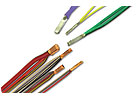
Traditional splicing used to max out at about 35 to 40 square millimeters.
New Challenges
As the auto industry ramps up production of hybrid and electric vehicles, there’s a growing need for larger and more complex wiring harnesses. Many manufacturers are turning to aluminum wire to save weight and reduce cost, especially in big, load-carrying cables.According to Frech, aluminum is a good candidate for anything requiring high current, such as large cables under the hood. “Cables that attach batteries to starters is a good example,” he points out. “We’re also seeing more aluminum wiring used in lighting applications.”
“Copper is easier to weld than aluminum,” says John Wnek, product development manager at Branson Ultrasonics Corp. “Aluminum is weldable, but special tooling and weld parameters must be used. When you compare aluminum to copper, you do not get the same strength and current-carrying capabilities with the same gauge size. When converting from copper to aluminum, you usually have to double the size of the wire to get the same properties.”
“The advent of aluminum wire is a growing trend,” adds DiFinizio. “Everyone in the auto industry is trying to adapt it. However, aluminum wire creates some unique welding challenges.” For instance, aluminum tends to stick to steel tips. Special coatings and tooling inserts are required to prevent material from adhering to the tooling.
“We are currently working on a number of projects that involve aluminum wire,” says Patrikios. “Things are looking very promising; we should be making an official announcement about our breakthrough by the end of the year. We’ve already exceeded the requirement on pull strength, but we’re still working on some tooling issues.”
The ongoing electrification of the auto industry is also forcing engineers to use larger cables. Electric vehicles have high-current applications that require large cable terminations and better interconnections.
“As a result, splices are growing in size by leaps and bounds,” explains DiFinizio. “The increasing use of electric motors and batteries in hybrid and electric cars is creating a demand for larger and larger splices.
“Typical splices used to max out at about 35 to 40 square millimeters,” adds DiFinizio. “We are now seeing requirements of 120 square millimeters and more.”
That growing demand is forcing welding equipment suppliers to create products with advanced tooling techniques. For instance, Sonobond recently unveiled a double-headed splicing system that can weld wire bundles up to 100 square millimeters.
The Dual Head SpliceRite features a welding head on each side of the weld area. It boasts a 4,500-watt power supply and a microprocessor controller that can store up to 250 jobs. Welds can be automatically controlled by height, energy and time.
“In addition to extended capability in wire bundle sizes, end users are looking for simpler tooling changes and consistency in weld quality, even when wire characteristics change, such as when wire oxidation varies between lots or vendors,” says Devine. A
Looking for a reprint of this article?
From high-res PDFs to custom plaques, order your copy today!