Leak Testing Aluminum Castings
Next to the engine, the automatic transmission may be the most important subsystem of an automobile. It plays a key role in handling, performance and fuel economy.
Since automatic transmissions rely on fluid couplings to transmit rotating mechanical power, it’s vital that they don’t leak. Detecting component leaks at the earliest stages of manufacturing—after casting and before assembly—saves transmission manufacturers significant expense and headaches.
KUKA Assembly and Test Corp. is a systems integrator specializing in assembly and test systems for major automotive subsystems, such as engines, transmissions, axles, suspension components and steering components. Our customers include Ford Motor Co., Borg Warner Inc., Harley-Davidson Inc. and Caterpillar Inc.
We use helium leak detectors to assist in the production of advanced automatic transmissions, such as the new nine- and 10- speed transmissions developed to help improve fuel economy. Historically, many leaks are discovered at or after final assembly. Our fixtures and jigs are equipped with helium leak detectors from Inficon. This enables us to detect most leaks soon after the parts are cast, reducing cost by eliminating defective castings early in the assembly process.
Testing Trannies
KUKA’s leak-test processes use part-specific fixtures and automation. After casting and machining, transmission housings are robotically loaded into the test chamber. Inside the chamber, the “worm trail” and other cavities are sealed with a part-specific fixture machined to tight dimensional tolerances.
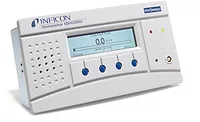
Once the part has been clamped and sealed, the chamber is evacuated. Helium is then injected into the enclosure, which is connected to an Inficon LDS3000 helium leak detector. Fans agitate the air inside the enclosure to create a uniform mixture of 1 percent helium and air.
The leak detector is connected to the test part through a valve and tooling on the worm trail. When the valve is opened, helium surrounding the exterior of the part can migrate into the interior of the part through porosity leaks, cracks, thread leaks and other pathways. It will move through the housing and into the transmission, where it will be detected and quantified by the leak detector. At that point, a pass-fail decision based on standardized leak rates can be made, and data can be collected for traceability. All passages are individually tested.
“The Inficon helium leak detector is more accurate than air or underwater testing for detecting porosity leaks,” notes Thomas Parker, Inficon’s automotive sales manager for North America. “For example, an area just 1 inch in diameter on an aluminum casting might have up to a trillion holes that helium molecules can migrate through. Porosity of this kind would never be detected by air or underwater testing.
“Leaks don’t necessarily look like cracks or perfect circular holes. They may resemble a cave-like system of microscopic cracks and pockets within the metal. With air pressure testing, the required time to detect a pressure drop (which is needed to measure the low leak rates now required by automakers) might be days.”
Helium leak detection takes seconds, with a total part-to-part test time of roughly 30 to 40 seconds. This short interval makes leak detection as timely as any production process.
A standard industry-permissible leak rate is approximately 1 standard cubic centimeter per minute (sccm). As transmissions have become more complex, so, too, have the fluids inside them. Performance requirements are higher, and leak rates are lower. For instance, newer nine-speed and 10-speed transmissions may have leak rate requirements of 0.1 sccm or lower.
Final Check
Near the end of the assembly line, transmissions are often leak-tested again, this time from the inside-out. Instead of pulling a vacuum on the part and filling the test chamber with helium, the procedure is reversed. A vacuum is pulled in the test chamber, and the transmission is filled with helium.
The process works like this: The fully assembled transmission is placed in the chamber and sealed. The transmission and test chamber are then evacuated simultaneously, and the transmission is backfilled with helium. Because the pressure differential on the transmission seals cannot exceed 4 psi, the transmission is internally pressurized with 100 percent helium at approximately 3 psi.
If a leak is present, helium will migrate out of the transmission housing and into the test chamber, where it will be detected by the Inficon LDS3000 instrument.
The inside-out test is performed because manufacturers prefer to test within the design criteria of the item being tested. For an automatic transmission, fluid pressures are exerted from interior to exterior. The inside-out test with helium replicates those operational conditions. If, under pressure, passageways are squeezed or joints expanded, helium can escape in the same manner fluids might leak. Despite the complexity of a transmission—with its solenoid valves, torque converters, worm trails and other pathways—helium can pass rapidly into the vacuum if there are leaks.
“The helium process is a more repeatable test when compared to other test methods, and it’s not temperature-dependent,” explains Parker. “Helium leak detection takes many variables out of the test equation, achieving high gauge repeatability and reproducibility.”
Compared with air-testing methods, helium testing offers several advantages. For one, air testing is significantly affected by temperature. Hot parts or cooling parts can cause a mass-flow test to be inaccurate and unrepeatable. Second, tracer-gas leak tests are not dependent on the volume of the part. Air test methods, such as mass flow and pressure decay, are influenced by part volume. Larger volumes equal longer test times and reduced sensitivity.
Pressure-decay testing requires stabilization time. In some cases, the pressure in the part might need to be “topped off” multiple times. However, adding pressure also adds heat, which can affect the accuracy of the test.
Helium leak detection takes place at lower pressures. That saves time and improves safety. Because of the sensitivity of Inficon helium leak detectors, only a small amount of helium is required to test a part. Depending on the part, a typical helium test costs approximately $0.09 per part. Even at low pressures, helium can reveal time-based leaks, such as stringers and porosity, which might be missed with mass-flow and pressure-decay tests.
“If you have a porosity condition in which there are a trillion tiny holes, tracer gas is the only method that can find the leak,” says Parker. “You may miss a leak with pressure-decay or mass-flow testing, because they are not going to find…millions of near-molecular sized leaks. Defects are often at the gusset points of a casting. The casting process causes inclusions in the aluminum, which creates a leak pathway. Weight-saving thin walls also can create potential porosity problems.”
Another issue with testing aluminum castings is dirt. Even though the parts are cast to near net shape, they may still require some machining. Machining is a dirty process, and dirty parts are not conducive to pressure-decay or mass-flow testing. When testing with those methods, parts must be cleaned with a solvent to remove the cutting fluids.
Part cleaning adds a step to the process, not to mention concerns related to solvent itself, such as recovery, emissions and recycling. In some instances, the parts also need to spend time in an oven to bake off residual solvent and moisture, since water and humidity affect test results.
Helium leak detection is less affected by cutting fluids and other residuals. Minimal cleaning of the parts is required, simplifying the testing operation.
For more information on leak testing equipment, visit www.inficon.com.
For more information on automated assembly and test systems, visit www.kuka-at.com.
Looking for a reprint of this article?
From high-res PDFs to custom plaques, order your copy today!