Assembly Magazine logo
search
Ask ASSEMBLY AI
cart
facebook twitter linkedin youtube
  • Sign In
  • Create Account
  • Sign Out
  • My Account
Assembly Magazine logo
  • TRENDS
    • Ask ASSEMBLY AI
    • Trends
    • News
    • New Products
  • INDUSTRIES
    • Aerospace
    • Appliance
    • DFMA Assembly
    • Medical Devices
    • Green Manufacturing
    • Lean Manufacturing
    • Machinery Assembly
    • Electronics Assembly
    • Automotive
  • TECHNOLOGIES
    • Adhesives & Dispensing
    • Assembly Presses
    • Automated Assembly Systems
    • Manufacturing Management
    • Manufacturing Software
    • Motion Control
    • Screwdriving & Riveting
    • Robotics
    • Test & Inspection
    • Plastics & Metal Welding
    • Wire Processing
    • Workstations
  • AUTONOMOUS & ELECTRIC MOBILITY
    • AEM Magazine Archives
    • Autonomy
    • Electrification
    • Mobility Services
    • Assembly & Testing
    • AV/EM News
  • MEDIA
    • Ask ASSEMBLY AI
    • Podcasts
    • Assembly News Now
    • Assembly TV
    • Webinars
    • eBooks
  • EVENTS
    • Calendar
    • The ASSEMBLY Show
  • MORE
    • Exclusives >
      • Plant of the Year
      • Capital Spending
    • Buyers Guide >
      • Supplier Insights
    • Classifieds
    • Featured Products
    • Newsletters
    • Store
    • White Papers
    • Columns
    • Sponsor Insights
  • INFOCENTER
    • Assembly & Test Solutions
  • EMAGAZINE
    • eMagazine
    • Archive Issues
    • Advertise
    • Contact Us
    • Sign Up
IndustriesAutomotive AssemblyMedical Devices AssemblyAdhesives & Dispensing Assembly

3D Printing With Silicone

By Ingird Ostermeier
October 2, 2015

The marathon, a race of 26.2 miles, is always a challenge for Maximilian Peter, Ph.D., a process engineer at Wacker Chemie. Besides being physically fit, it’s also necessary to have the right gear, in particular well-fitting running shoes. That gave him an idea: shock-absorbing insoles, custom-made to conform to his feet. “There’s nothing like that available yet,” says Peter.

So, together with his colleagues at Wacker Silicones and engineers at Enders Ingenieure GmbH, a product development and prototyping company based in southern Germany, Peter developed a solution: 3D printing of silicone.

“Until now, it had been impossible to print elastomers or rubbery materials. There were just no suitable processes,” explains Bernd Pachaly, Ph.D., head of silicones research at Wacker Silicones.

Traditionally, silicone parts are produced by injection molding. However, because of the costs of custom-making the molds, the process is only worthwhile for large production runs—not for a single pair of insoles.

“Injection molding is the established process for series production, and will remain so,” says Pachaly. “But people who design prototypes or who only want to make a few copies of a part can now very rapidly and flexibly produce such small series, modifying them constantly to meet changing demands. That is the unique advantage of the 3D printing process.”

With this new technology, silicone joins a growing list of materials for additive manufacturing, including ABS, polycarbonate, nylon, stainless steel, titanium and ceramics.

A New Approach

From the outset, it was clear that 3D printing of silicone would require a fundamentally new approach.

Looking for quick answers on assembly and manufacturing topics? Try Ask ASM, our new smart AI search tool. Ask ASM →

Silicone is not melted by heat in the same way as thermoplastics or metals. It cannot be applied layer by layer as a powder, and melted by laser beam to the desired three-dimensional shape.

Instead, Peter and his development team developed a system involving high-speed dispensing and robotics. The process took approximately a year develop.

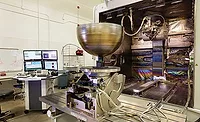
The system consists of a Cartesian robot equipped with a dispensing nozzle that rapidly deposits one droplet of silicone at a time on a base surface. Just like inkjet printing on paper, the robot follows a path governed by a CAD file of the part.

The developers couldn’t use off-the-shelf software to control the robot. “A key step in the development work was to write a custom program,” says Florian Ganz, CEO of Enders.

“It is the first really user-friendly software in this field,” adds Pachaly.

The robot regularly pauses and a beam of ultraviolet light scans over the tiny drops, which have merged into a fine line. The UV light vulcanizes the silicone then in less than a second, crosslinking the molecules into an elastomeric material. The robot then applies the next layer of silicone droplets.

Thanks to the vulcanization, a homogeneous object is formed. Once it’s applied, the viscous material immediately bonds to the layers adjacent to or below it.

The process doesn’t take very long. After 15 minutes, the device can print a small part approximately 1 centimeter wide and several millimeters thick. Eventually, the developers expect the machine to be able to process about 100 grams of silicone per hour—fast enough for any conceivable application.

Since the structures generated by the robot are extremely fine, the precision is impressive. With each pass, the nozzle can dispense a silicone strip approximately 0.6 millimeter wide and 0.3 millimeter thick. That makes it possible to produce precise contours and results in a surface that is almost smooth and is pleasant to the touch.

“The roughness may be even better than 100 microns,” says Pachaly. That is hardly a hair’s breadth, and significantly smoother than printed thermoplastics.

The pieces look almost like injection moldings rather than parts made by additive manufacturing. To achieve that, Ernst Selbertinger, Ph.D., a silicone developer at Wacker, had to create a formulation that could be dosed as tiny liquid droplets that immediately remain stationary at the place they were deposited.

“Think of toothpaste. It flows under pressure as you squeeze it from the tube, but it is firm when on the brush,” explains Selbertinger.

Besides being formulated for 3D printing, the silicone contains a platinum catalyst that is responsible for crosslinking the molecules under UV light.

3D Printing Applications

Pachaly sees immediate applications for the technology in the
automotive industry. Because 3D printing is much faster than conventional technologies for manufacturing small runs and one-off articles, Pachaly expects the technology to be used to make prototypes and spare parts for various silicone car parts, such as plugs and hoses. “In the auto sector, it will no longer be necessary to keep costly and complex stocks of silicone parts,” he says.

The medical sector is also interested in the material for its biocompatibility. For example, implants could be custom-made for the patient—even during an operation—based on data provided by technologies such as magnetic resonance imaging.

Custom-made silicone respirator masks and hearing aids will soon be manufactured by 3D printing. And, every wearer of eyeglasses will welcome nose pads that really fit. The optician will only need to scan the three-dimensional contour of the nose and send the data to a 3D printer, which will then produce a perfectly fitting pad.

In the home, it will be possible to produce baking molds in any conceivable shape. Silicone is famously heat resistant. Because it is also valued for its transparency, the researchers are also devising optical applications, such as lenses printed to order. And last but not least, the researchers believe the technology can be used to make individually tailored insoles for running shoes.

 “We have a lot of ideas, and we want to provide our customers with much more than just silicone for additive manufacturing,” says Pachaly.  

KEYWORDS: additive manufacturing silicone adhesives

Share This Story

Looking for a reprint of this article?
From high-res PDFs to custom plaques, order your copy today!

Ingrid Ostermeier Corporate Communications Wacker Chemie AG Munich

Recommended Content

JOIN TODAY
To unlock your recommendations.

Already have an account? Sign In

  • Made in the U.S.A.

    Consumer Products Manufacturing: Made in the USA

    Supply chain lessons learned during the coronavirus...
    Automated Assembly Systems
    By: Austin Weber
  • Best Practices for Press-Fit Assembly

    Best Practices for Press-Fit Assembly

    In manufacturing, ironclad formulas for success are hard...
    Assembly Presses
    By: Jim Camillo
  • aem0523leader-tesla1.jpg

    Tesla Rethinks the Assembly Line

    Engineers at Tesla Inc. have developed a new process that...
    Automotive Assembly
    By: Austin Weber
Manage My Account
  • eMagazine Subscription
  • Assembly Newsletters
  • Online Registration
  • Subscription Customer Service
  • Manage My Preferences

More Videos

Sponsored Content

Sponsored Content is a special paid section where industry companies provide high quality, objective, non-commercial content around topics of interest to the ASSEMBLY audience. All Sponsored Content is supplied by the advertising company and any opinions expressed in this article are those of the author and not necessarily reflect the views of ASSEMBLY or its parent company, BNP Media. Interested in participating in our Sponsored Content section? Contact your local rep!

close
  • ultrasonic welding
    Sponsored bySonobond Ultrasonics

    Engineering Efficiency in High-Performance Assembly: How Ultrasonic Welding Enhances Throughput, Reliability and Quality

  • UV curing system
    Sponsored byDymax

    Why UV Intensity Alone Doesn’t Define Curing Performance

  • wooden pallets
    Sponsored byLEAN Manufacturing Products

    Eliminating Waste on the Shop Floor: Applying Lean Principles to Improve Manufacturing Efficiency

Popular Stories

ASSEMBLY News Now, episode-30: Volvo Redesigns EV Manufacturing

Volvo Redesigns EV Manufacturing

Boeing CEO Kelly Ortberg announces 1 billion investment

Boeing Plans $1 Billion Wichita Investment, Workforce Training Center

GE Appliances Worker on Line

GE Appliances Expands Factory AI With 800 Gemini Enterprise Agents

Watch the latest episode of ANN now!

Events

July 24, 2025

From Shop Floor to CFO: How Manufacturers Are Closing the Loop Between Operations and Finance

On Demand Learn how manufacturers are bridging the gap between the shop floor and ERP systems to gain real-time visibility, streamline operations, and kick-start digital transformation—without waiting years.

Sponsored by:

PicoStratusGreen
July 30, 2025

Buffer Analysis and Design Fundamentals for Manufacturing Excellence

On Demand In this presentation, Dr. Herman Tang shares practical insights from his industry experience and research on buffer management in manufacturing operations.

View All Submit An Event

Poll

Difficult Assembly Processes

Which assembly process gives you the most difficulty?
View Results Poll Archive

Products

Manufacturing Cost Policy Deployment (MCPD) Profitability Scenarios: Systematic and Systemic Improvement of Manufacturing Costs

Manufacturing Cost Policy Deployment (MCPD) Profitability Scenarios: Systematic and Systemic Improvement of Manufacturing Costs

See More Products
Register for webinar - Modernizing Automotive Assembly: Why Upgrading Legacy MES is a Business Imperative

Related Articles

  • 3D Printing With Metal

    3D Printing With Metal

    See More
  • Does 3D Printing Work with Wiring?

    See More
  • how-to-produce-feat.jpeg

    How to Produce Impossible Objects with 3D Printing

    See More

Related Products

See More Products
  • 0001219.jpeg

    3D Printing 2E, Understanding Additive Manufacturing

  • Designing with Plastics

  • reducing.jpg

    Reducing Process Costs with Lean, Six Sigma, and Value Engineering Techniques

See More Products

Related Directories

  • 3D Infotech

  • Carbide 3D

  • 3D Systems

×

Never miss the latest news and trends driving the manufacturing industry

Stay in the know on the latest assembly trends.

JOIN TODAY!
  • RESOURCES
    • Advertise
    • Contact Us
    • Directories
    • Manufacturing Division
    • Store
    • Want More?
  • SIGN UP TODAY
    • Create Account
    • eMagazine
    • Newsletters
    • Customer Service
    • Manage Preferences
  • SERVICES
    • Marketing Services
    • Reprints
    • Market Research
    • List Rental
    • Survey/Respondent Access
  • STAY CONNECTED
    • LinkedIn
    • Facebook
    • Instagram
    • YouTube
    • X (Twitter)
  • PRIVACY
    • PRIVACY POLICY
    • TERMS & CONDITIONS
    • DO NOT SELL MY PERSONAL INFORMATION
    • PRIVACY REQUEST
    • ACCESSIBILITY

Copyright ©2026. All Rights Reserved BNP Media, Inc. and BNP Media II, LLC.

Design, CMS, Hosting & Web Development :: ePublishing