Assembly Magazine logo
search
Ask ASSEMBLY AI
cart
facebook twitter linkedin youtube
  • Sign In
  • Create Account
  • Sign Out
  • My Account
Assembly Magazine logo
  • TRENDS
    • Ask ASSEMBLY AI
    • Trends
    • News
    • New Products
  • INDUSTRIES
    • Aerospace
    • Appliance
    • DFMA Assembly
    • Medical Devices
    • Green Manufacturing
    • Lean Manufacturing
    • Machinery Assembly
    • Electronics Assembly
    • Automotive
  • TECHNOLOGIES
    • Adhesives & Dispensing
    • Assembly Presses
    • Automated Assembly Systems
    • Manufacturing Management
    • Manufacturing Software
    • Motion Control
    • Screwdriving & Riveting
    • Robotics
    • Test & Inspection
    • Plastics & Metal Welding
    • Wire Processing
    • Workstations
  • AUTONOMOUS & ELECTRIC MOBILITY
    • AEM Magazine Archives
    • Autonomy
    • Electrification
    • Mobility Services
    • Assembly & Testing
    • AV/EM News
  • MEDIA
    • Ask ASSEMBLY AI
    • Podcasts
    • Assembly News Now
    • Assembly TV
    • Webinars
    • eBooks
  • EVENTS
    • Calendar
    • The ASSEMBLY Show
  • MORE
    • Exclusives >
      • Plant of the Year
      • Capital Spending
    • Buyers Guide >
      • Supplier Insights
    • Classifieds
    • Featured Products
    • Newsletters
    • Store
    • White Papers
    • Columns
    • Sponsor Insights
  • INFOCENTER
    • Assembly & Test Solutions
  • EMAGAZINE
    • eMagazine
    • Archive Issues
    • Advertise
    • Contact Us
    • Sign Up
IndustriesAppliance Assembly

ASSEMBLY: One Goal, One Part
By Karen Buscemi
July 28, 2004
Compliant mechanisms make Design for No Assembly a reality.

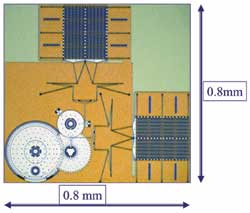
Micro Engine Compliant mechanisms integrated with two electrostatic linear actuators that are 90 degrees out of phase to drive a gear train.
"For a wide variety of manufacturing industries, assembly accounts for more than 50 percent of the total manufacturing cost of a product and more than 40 percent of the labor force."

This statistic is from the book, Assembly Automation and Product Design, by Geoffrey Boothroyd, published in 1991. The numbers are still valid today, and an approach called Design for No Assembly (DNA) has researchers working toward reducing the cost of assembly and labor by moving toward single part manufacturing that offers compliant structures that are reliable, with a higher fatigue life.

Ten years ago, Sridhar Kota, professor with the College of Mechanical Engineering at the University of Michigan, began researching how to get mechanical motion without requiring any joints or assembly. He became interested in Micro-electromechanical Systems (MEMS)-devices containing extremely small mechanical elements, sensors and actuators that are integrated with electronic processing circuitry. Developing compliant mechanisms that were well suited for MEMS applications was just around the corner for Kota.

"I wanted to take advantage of compliant structures that deform, that work like a mechanism to do a function, like a half gallon of milk in a cardboard container," Kota says. "The spout is one piece-no gears, no joints. Same thing with the lid of a shampoo bottle."
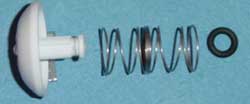
The coffeemaker's check valve was redesigned from three parts to one.
A compliant mechanism is a flexible structure that elastically deforms without joints to produce a desired force or displacement. A compliant system consists of one or more compliant mechanisms that are integrated with actuators. Materials that can be used to create compliant mechanisms include polysilicon, aluminum, steel, titanium, polymers and composites. They can be created through various methods: wire EDM, water-jet cutting, injection molding and stamping.

Though compliant systems are difficult to design and are limited to applications with small rotations and displacements, the benefits outweigh the disadvantages, eliminating assembly requirements and joint friction while creating motions for shape changing structures that are scalable and material-friendly. These lightweight, low cost systems also offer excellent precision and repeatability.

Compliant systems can be carried over to the appliance industry, Kota says, since, anytime there is an electromechanical assembly, the idea of Design for No Assembly can be applied to drastically reduce the number of parts.

In fact, Kota teaches a class at the university called Design Products for Global Markets, where students from around the world work together to create products with fewer parts. Projects have included a blender, coffeemaker, humidifier and juice extractor.

Designed by students Konstantinos Boukouris, Bradford Lamiman, Edward Moradian and Adam Ouimet, the coffeemaker was redesigned to be more cost-efficient, while maintaining high quality. Using snap fits and compliant mechanisms, the number of parts was reduced. The compliant mechanism is a one-part check valve in the coffee ground holder that was originally three parts.

Looking for quick answers on assembly and manufacturing topics? Try Ask ASM, our new smart AI search tool. Ask ASM →

Kota compared compliant mechanisms to designs in nature, saying that in nature, designs are strong and compliant, not stiff. He says that nature relies on compliance for motion and force transmission. "Look at the hummingbird flapping its wing as fast as it does," Kota says. "Grasshoppers store energy in their joints before they hop. Starfish make their motions by exploiting elasticity. These are examples of how nature takes advantage of elastic deformation."
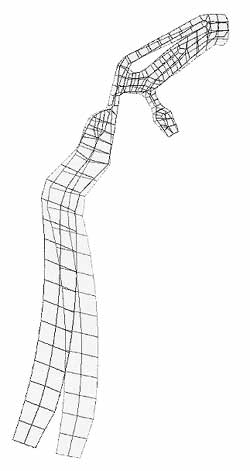
This single-piece device is a simple example of a compliant mechanism. The device snap fits to a spray can and is operated by squeezing the large lever.
Kota secured a small business contract with the Air Force in 2000, and with that, he started FlexSys Inc., Ann Arbor, Mich., with former student Joel Hetrick, where he could apply his research. Kota and Hetrick developed algorithms to optimize compliant structures that require minimum energy to morph to desired shapes and yet are stiff to external load. Working with five others, Kota is now using structural elasticity to create an aircraft wing.

Kota has a patent pending on a windshield wiper that can be injection molded in one step. The wiper's functionality is identical to that of its multi-part counterpart, and initial cost studies show that the one-piece wiper would cost half as much as the conventional wiper to produce.

"In traditional design, everything had to be strong and stiff," Kota says. "If you take advantage of elastic properties, you can get much more precision motion. No wear, no friction, no joints."

Source: appliance DESIGN
KEYWORDS: injection molding

Share This Story

Looking for a reprint of this article?
From high-res PDFs to custom plaques, order your copy today!

Karen Buscemi is associate editor of Appliance Design Magazine.

Recommended Content

JOIN TODAY
To unlock your recommendations.

Already have an account? Sign In

  • Made in the U.S.A.

    Consumer Products Manufacturing: Made in the USA

    Supply chain lessons learned during the coronavirus...
    Automated Assembly Systems
    By: Austin Weber
  • Best Practices for Press-Fit Assembly

    Best Practices for Press-Fit Assembly

    In manufacturing, ironclad formulas for success are hard...
    Assembly Presses
    By: Jim Camillo
  • aem0523leader-tesla1.jpg

    Tesla Rethinks the Assembly Line

    Engineers at Tesla Inc. have developed a new process that...
    Industries
    By: Austin Weber
Manage My Account
  • eMagazine Subscription
  • Assembly Newsletters
  • Online Registration
  • Subscription Customer Service
  • Manage My Preferences

More Videos

Sponsored Content

Sponsored Content is a special paid section where industry companies provide high quality, objective, non-commercial content around topics of interest to the ASSEMBLY audience. All Sponsored Content is supplied by the advertising company and any opinions expressed in this article are those of the author and not necessarily reflect the views of ASSEMBLY or its parent company, BNP Media. Interested in participating in our Sponsored Content section? Contact your local rep!

close
  • ultrasonic welding
    Sponsored bySonobond Ultrasonics

    Engineering Efficiency in High-Performance Assembly: How Ultrasonic Welding Enhances Throughput, Reliability and Quality

  • UV curing system
    Sponsored byDymax

    Why UV Intensity Alone Doesn’t Define Curing Performance

  • wooden pallets
    Sponsored byLEAN Manufacturing Products

    Eliminating Waste on the Shop Floor: Applying Lean Principles to Improve Manufacturing Efficiency

Popular Stories

ASSEMBLY News Now, episode-30: Volvo Redesigns EV Manufacturing

Volvo Redesigns EV Manufacturing

Boeing CEO Kelly Ortberg announces 1 billion investment

Boeing Plans $1 Billion Wichita Investment, Workforce Training Center

GE Appliances Worker on Line

GE Appliances Expands Factory AI With 800 Gemini Enterprise Agents

Watch the latest episode of ANN now!

Events

July 24, 2025

From Shop Floor to CFO: How Manufacturers Are Closing the Loop Between Operations and Finance

On Demand Learn how manufacturers are bridging the gap between the shop floor and ERP systems to gain real-time visibility, streamline operations, and kick-start digital transformation—without waiting years.

Sponsored by:

PicoStratusGreen
July 30, 2025

Buffer Analysis and Design Fundamentals for Manufacturing Excellence

On Demand In this presentation, Dr. Herman Tang shares practical insights from his industry experience and research on buffer management in manufacturing operations.

View All Submit An Event

Poll

Difficult Assembly Processes

Which assembly process gives you the most difficulty?
View Results Poll Archive

Products

Manufacturing Cost Policy Deployment (MCPD) Profitability Scenarios: Systematic and Systemic Improvement of Manufacturing Costs

Manufacturing Cost Policy Deployment (MCPD) Profitability Scenarios: Systematic and Systemic Improvement of Manufacturing Costs

See More Products
Register for webinar - Modernizing Automotive Assembly: Why Upgrading Legacy MES is a Business Imperative

Related Articles

  • Medical Device Assembly: Better One of Better Two?

    See More
  • Assembly Innovations: All-In-One Assembly System

    See More

Related Products

See More Products
  • Kaizen Assembly: Designing, Constructing, and Managing a Lean Assembly Line

  • foreman.jpg

    The Foreman on the Assembly Line

  • Collaborative Product Assembly Design and Assembly Planning, 1st Edition

See More Products

Related Directories

  • ON Semiconductor

×

Never miss the latest news and trends driving the manufacturing industry

Stay in the know on the latest assembly trends.

JOIN TODAY!
  • RESOURCES
    • Advertise
    • Contact Us
    • Directories
    • Manufacturing Division
    • Store
    • Want More?
  • SIGN UP TODAY
    • Create Account
    • eMagazine
    • Newsletters
    • Customer Service
    • Manage Preferences
  • SERVICES
    • Marketing Services
    • Reprints
    • Market Research
    • List Rental
    • Survey/Respondent Access
  • STAY CONNECTED
    • LinkedIn
    • Facebook
    • Instagram
    • YouTube
    • X (Twitter)
  • PRIVACY
    • PRIVACY POLICY
    • TERMS & CONDITIONS
    • DO NOT SELL MY PERSONAL INFORMATION
    • PRIVACY REQUEST
    • ACCESSIBILITY

Copyright ©2026. All Rights Reserved BNP Media, Inc. and BNP Media II, LLC.

Design, CMS, Hosting & Web Development :: ePublishing