Assembly Magazine logo
search
Ask ASSEMBLY AI
cart
facebook twitter linkedin youtube
  • Sign In
  • Create Account
  • Sign Out
  • My Account
Assembly Magazine logo
  • TRENDS
    • Ask ASSEMBLY AI
    • Trends
    • News
    • New Products
  • INDUSTRIES
    • Aerospace
    • Appliance
    • DFMA Assembly
    • Medical Devices
    • Green Manufacturing
    • Lean Manufacturing
    • Machinery Assembly
    • Electronics Assembly
    • Automotive
  • TECHNOLOGIES
    • Adhesives & Dispensing
    • Assembly Presses
    • Automated Assembly Systems
    • Manufacturing Management
    • Manufacturing Software
    • Motion Control
    • Screwdriving & Riveting
    • Robotics
    • Test & Inspection
    • Plastics & Metal Welding
    • Wire Processing
    • Workstations
  • AUTONOMOUS & ELECTRIC MOBILITY
    • AEM Magazine Archives
    • Autonomy
    • Electrification
    • Mobility Services
    • Assembly & Testing
    • AV/EM News
  • MEDIA
    • Ask ASSEMBLY AI
    • Podcasts
    • Assembly News Now
    • Assembly TV
    • Webinars
    • eBooks
  • EVENTS
    • Calendar
    • The ASSEMBLY Show
  • MORE
    • Exclusives >
      • Plant of the Year
      • Capital Spending
    • Buyers Guide >
      • Supplier Insights
    • Classifieds
    • Featured Products
    • Newsletters
    • Store
    • White Papers
    • Columns
    • Sponsor Insights
  • INFOCENTER
    • Assembly & Test Solutions
  • EMAGAZINE
    • eMagazine
    • Archive Issues
    • Advertise
    • Contact Us
    • Sign Up

advertisement

How To Choose Between Collaborative and Traditional Industrial Robots
Universal Robots
Universal Robots
Universal Robots
Universal Robots
March 1, 2020

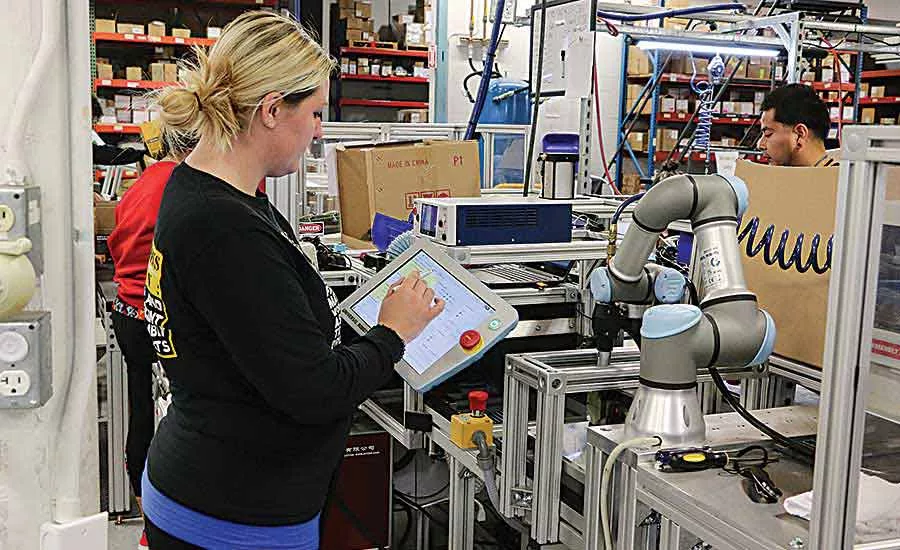
As you research automation options, it’s hard to ignore the cobot buzz. Since collaborative robots burst on the scene a decade ago, they’ve made automation accessible and affordable for many organizations for whom traditional robotics were out of reach. And that’s generated a lot of excitement.

But automating appropriately means evaluating your specific situation to make the best choice. The industry is changing rapidly and new robotic capabilities are blurring the lines between collaborative and industrial robots. At the same time, standards organizations are creating guidelines to keep workers safe as they interact with robots in a wide range of applications and environments.

This cheat sheet will help you go beyond the buzz to compare collaborative robots and traditional industrial robots, and dispel some commonly held misconceptions.

Collaborative and Traditional Industrial Robots Meet Different Needs

If you need…

…consider a traditional industrial robot

…consider a collaborative robot (“cobot”)

Ability to easily redeploy robot to different processes/tasks


X

Ability to program and set robot up in-house


X

Very high-volume in high-speed production (exceeding 1m/s)

X


Payload exceeding 16 kg (32 lbs)

X


Reach exceeding 1300mm (51.2 ins)

X


Minimal changes to existing production layout


X

Human workers to enter the robot cell to complete their tasks


X

Integration options with other machines and robots

X

X

Low initial cost and payback in under a year


X

Ability to run processes with few or no employees

X

X

Automation of processes or products that won’t change over time

X

X

Very quick unboxing and setup


X


The Truth Behind 6 Cobot Myths

1. Cobots are not industrial robots

Cobots were designed to be lightweight and easy to use, but today’s cobots are also powerful industrial tools that can be integrated with existing machinery and other robots through PLCs and sophisticated programming software.

Looking for quick answers on assembly and manufacturing topics? Try Ask ASM, our new smart AI search tool. Ask ASM →

2. Cobots are the only collaborative robots

Almost any robot can claim to be collaborative with the appropriate safety mechanisms in place (per the ISO/TS 15066 standard). But cobots are the only robots that were designed specifically to work alongside humans, and that also provide the versatility, user-friendliness, small footprint, and affordability that help define collaborative robotics.

3. Cobots are always safe to use next to human workers

Every automated application where humans are present requires a risk assessment—and that includes cobots. Based on the assessment, a collaborative application may still require safety mechanisms such as light curtains, safety mats, or reduced robot speed. But cobots are designed to be used within a collaborative workspace and have built-in safety mechanisms to support this use. A vast majority of Universal Robots cobots are used without safety cages.

4 Cobots result in people getting fired

With the U.S. unemployment rate remaining at 3.5 percent, the lowest in 50 years, 10,000 baby boomers retiring every day and few millennials interested in joining the manufacturing industry, cobots do not replace workers, they staff the repetitive tasks companies simply can’t fill. With cobots, manufacturers can reduce the number of human workers required for monotonous or injury-prone tasks and redeploy them into higher-value jobs. Often, the arrival of cobots significantly boosts manufacturers’ global competitiveness, enabling them to outbid competitors in low-wage countries, reshore work, and hire more people locally.

5. Cobots are slow

With extra safety devices installed, such as safety mats or light curtains, a cobot can work faster than a human and then either stop or reduce speed once a person enters the work envelope. Even in applications that handle tasks at the same speed as an employee would, cobots do so consistently without stopping or slowing down over time, which typically increases productivity and quality

6. Cobots are not ideal for precision handling

Cobots are suitable for very precise finishing, assembly and electronics tasks. Universal Robots’ e-Series cobots now feature a repeatability of 30 micron (0.03mm) in the UR3e and UR5e models and 50 micron (0.05mm) in the UR10e and UR16e. With built-in, tool-centric force/torque sensor the e-Series can handle applications where force-feedback is paramount in order to obtain uniform results and repeatability.

Ready to Get Started?

Once you’ve explored all your robotic options, see how easy it is to get started with cobots from Universal Robots, the company that pioneered the technology and continues to lead the market around the world. Download our ebook “Get Started with Cobots in 10 Easy Steps.” urrobots.com/ebooks


Universal Robots USA, Inc.
5430 Data Court, Suite 300
Ann Arbor, MI 48108
United States
(844) 462-6268
ur.na@universal-robots.com

Share This Story

Looking for a reprint of this article?
From high-res PDFs to custom plaques, order your copy today!

Recommended Content

JOIN TODAY
To unlock your recommendations.

Already have an account? Sign In

  • Made in the U.S.A.

    Consumer Products Manufacturing: Made in the USA

    Supply chain lessons learned during the coronavirus...
    Automated Assembly Systems
    By: Austin Weber
  • Best Practices for Press-Fit Assembly

    Best Practices for Press-Fit Assembly

    In manufacturing, ironclad formulas for success are hard...
    Assembly Presses
    By: Jim Camillo
  • aem0523leader-tesla1.jpg

    Tesla Rethinks the Assembly Line

    Engineers at Tesla Inc. have developed a new process that...
    Electrification
    By: Austin Weber
Manage My Account
  • eMagazine Subscription
  • Assembly Newsletters
  • Online Registration
  • Subscription Customer Service
  • Manage My Preferences

More Videos

Sponsored Content

Sponsored Content is a special paid section where industry companies provide high quality, objective, non-commercial content around topics of interest to the ASSEMBLY audience. All Sponsored Content is supplied by the advertising company and any opinions expressed in this article are those of the author and not necessarily reflect the views of ASSEMBLY or its parent company, BNP Media. Interested in participating in our Sponsored Content section? Contact your local rep!

close
  • ultrasonic welding
    Sponsored bySonobond Ultrasonics

    Engineering Efficiency in High-Performance Assembly: How Ultrasonic Welding Enhances Throughput, Reliability and Quality

  • UV curing system
    Sponsored byDymax

    Why UV Intensity Alone Doesn’t Define Curing Performance

  • wooden pallets
    Sponsored byLEAN Manufacturing Products

    Eliminating Waste on the Shop Floor: Applying Lean Principles to Improve Manufacturing Efficiency

Popular Stories

ASSEMBLY News Now, episode-30: Volvo Redesigns EV Manufacturing

Volvo Redesigns EV Manufacturing

Boeing CEO Kelly Ortberg announces 1 billion investment

Boeing Plans $1 Billion Wichita Investment, Workforce Training Center

automated consumer goods assembly system

Best Practices for Cycle Time Optimization

Watch the latest episode of ANN now!

Events

July 24, 2025

From Shop Floor to CFO: How Manufacturers Are Closing the Loop Between Operations and Finance

On Demand Learn how manufacturers are bridging the gap between the shop floor and ERP systems to gain real-time visibility, streamline operations, and kick-start digital transformation—without waiting years.

Sponsored by:

PicoStratusGreen
July 30, 2025

Buffer Analysis and Design Fundamentals for Manufacturing Excellence

On Demand In this presentation, Dr. Herman Tang shares practical insights from his industry experience and research on buffer management in manufacturing operations.

View All Submit An Event

Poll

Difficult Assembly Processes

Which assembly process gives you the most difficulty?
View Results Poll Archive

Products

Manufacturing Cost Policy Deployment (MCPD) Profitability Scenarios: Systematic and Systemic Improvement of Manufacturing Costs

Manufacturing Cost Policy Deployment (MCPD) Profitability Scenarios: Systematic and Systemic Improvement of Manufacturing Costs

See More Products
Register for webinar - Modernizing Automotive Assembly: Why Upgrading Legacy MES is a Business Imperative

Related Articles

  • schunk

    How to Choose Between Electric and Pneumatic Actuators and Grippers

    See More
  • zimmer

    How To How to choose the right type of EAOT for your collaborative robot?

    See More
  • Engineer Operating ABB PoWa Cobot on Assembly Line Collaborative Robot Manufacturing

    ABB Launches High-Speed Cobot Family to Bridge Gap Between Collaborative and Industrial Robots

    See More

Related Products

See More Products
  • pocket.jpg

    How To Implement Lean Manufacturing, Second Edition

  • leaner

    Leaner Manufacturing: How to Make the Lean Production Process Easier, Faster, and More Cost-Effective

  • Collaborative Product Assembly Design and Assembly Planning, 1st Edition

See More Products

Related Directories

  • HowToRobot

  • Universal Robots USA Inc.

    Universal Robots aims to empower change in the way work is done using its leading-edge robotics platform. Since introducing the world's first commercially viable collaborative robot (cobot) in 2008, UR has worked with partners to develop a product portfolio used across a wide range of industries and diverse tasks. The company, which is part of Teradyne Inc., is headquartered in Odense, Denmark with 22 offices and over 700 employees worldwide. Universal Robots has installed over 50,000 cobots.
×

Never miss the latest news and trends driving the manufacturing industry

Stay in the know on the latest assembly trends.

JOIN TODAY!
  • RESOURCES
    • Advertise
    • Contact Us
    • Directories
    • Manufacturing Division
    • Store
    • Want More?
  • SIGN UP TODAY
    • Create Account
    • eMagazine
    • Newsletters
    • Customer Service
    • Manage Preferences
  • SERVICES
    • Marketing Services
    • Reprints
    • Market Research
    • List Rental
    • Survey/Respondent Access
  • STAY CONNECTED
    • LinkedIn
    • Facebook
    • Instagram
    • YouTube
    • X (Twitter)
  • PRIVACY
    • PRIVACY POLICY
    • TERMS & CONDITIONS
    • DO NOT SELL MY PERSONAL INFORMATION
    • PRIVACY REQUEST
    • ACCESSIBILITY

Copyright ©2026. All Rights Reserved BNP Media, Inc. and BNP Media II, LLC.

Design, CMS, Hosting & Web Development :: ePublishing