Aerospace Assembler Forms Titanium Parts
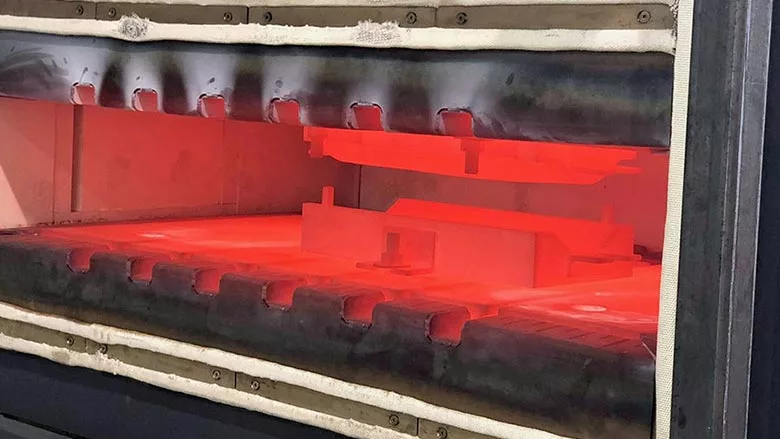
Hot forming is a process that heats titanium to extreme temperatures, enabling it to be formed in the press while in a soft, malleable state. Photo courtesy Pryer Aerospace
Pryer Aerospace has always taken an innovative approach to manufacturing.
Based in Tulsa, OK, the company was founded in 1965 by W.E. Pryer as a machine shop for aerospace components. In the company’s early days, Pryer designed and built his own multispindle hydraulic milling machines to meet the quality and high-rate delivery demands of the day.
The company’s tooling department designs and fabricates all the tooling used to produce components. Pryer’s tool makers can build production-grade tooling from any media in the marketplace. They routinely fabricate fiberglass, composite, plastic, wood, aluminum, Kirksite, and steel tooling from Mylar, Master, Splash, sample or digital data. “Old World” tool makers collaborate with expert CAD designers to build the most cost-effective tooling possible.
Today, Pryer Aerospace is still producing structural parts and assemblies for the aerospace industry. The company produces riveted, bonded and welded assemblies for commercial, corporate and military aircraft, and it is an FAA-approved repair station. The company’s manufacturing processes include hard-metal machining, high-speed machining, hydroforming, stretch forming, and hot forming.

These fairings for auxiliary power units were assembled from hot-formed titanium parts. Photo courtesy Pryer Aerospace

This aerospace component was produced with the hot-forming process. Photo courtesy Pryer Aerospace
The latter process was added to the company’s arsenal a few years ago, when a major customer made the ability to produce hot-formed titanium parts a condition for winning a large contract.
“We did every other type of metal forming for aerospace, but hot forming was the missing piece of our overall capability,” says Scott Pryer, director of engineering at Pryer Aerospace.
The properties that make titanium great for aerospace components also make it difficult to form. Standard cold-forming techniques can be used to form many titanium alloys. However, spring-back can be an issue, and cracking in curved sections is common.
Looking for quick answers on assembly and manufacturing topics? Try Ask ASM, our new smart AI search tool. Ask ASM
Adding heat to the process solves these problems. Hot forming is a process that heats titanium and other high-strength alloys to extreme temperatures, which enables them to be formed in the press while in a soft, malleable state. The hot-forming process uses heated platens to heat a cold or slightly warmed blank during the press cycle. The introduction of heat inside the press increases the ability to form complex shapes at lower tonnages without the worry of fracturing, spring-back or residual stress. Because the malleability of the material is increased, hot-forming presses are usually much lower tonnages than cold-forming presses performing the same function.
Cycle time ranges from 10 to 30 minutes. Parts go in cold, come out hot, and end with a similar microstructure as they began.
The Technology
Pryer contacted Beckwood Corp. to learn more about the hot-forming process and the machinery required to successfully form titanium parts.
Based in St. Louis, Beckwood has been making hydraulic and electric presses and forming machines since 1976. The company has developed a line of dedicated hot-forming presses for forming aluminum, titanium and other high-strength alloys. Press size, tonnage, cycle parameters, heat specifications, platen materials and controls can all be customized to meet the needs of specific applications.

Pryer Aerospace operates two Beckwood hot-forming presses for making titanium parts. Photo courtesy Pryer Aerospace
The machines are equipped with multizone electric cartridge heaters installed in gun-drilled passages. Thermocouples measure and record tool temperatures. Forming temperatures can be controlled to within ±10 F, enabling engineers to program temperature off-sets across the length and width of the platen.
Special components and materials are needed to handle the extreme temperatures inherent to the process. Platens are fabricated from ceramics, stainless steel or exotic metal alloys, depending on the application.
Platen boxes have ceramic insulation and are isolated from the press frame with a thermal break consisting of water-chilled platens and a closed-loop chiller. This helps prevent cracking and provides for long-term reliability.
Heat control is critical in hot forming, since it affects system efficiency and operating costs. Radiant heat is managed via heat shields. Air-conditioning units cool electrical panels, and thermocouples monitor operating conditions in critical areas. Heater life can be monitored via individual current monitors or by groups.
Allayed Concerns
Being unfamiliar with the hot forming, Pryer had some concerns about the safety of the process and whether his facility would be able to host a hot-forming press. So, Pryer and his team visited Beckwood’s facility and operated a similar machine.
“By getting to see a hot-forming press in person and test it myself, I learned that my earlier perceptions were incorrect,” adds Pryer. “Safety really wasn’t an issue—and that was a game-changer.”

Workers are protected by a robust safety system that includes automated insulated doors, light curtains, perimeter guarding, and lockout controls. Photo courtesy Pryer Aerospace
Pryer wore an overabundance of safety equipment on day one and quickly discovered that the press’ safety features and overall usability provided much of the protection his team required. By the end of day two, he chose to work with just gloves, safety glasses, a clear face shield, and a long-sleeved shirt, finding that additional safety gear was prohibitive and unnecessary.
During his visit, Pryer also learned that his facility was already equipped to run and maintain a hot-forming press, and he wasn’t required to obtain any special approvals to bid on hot-forming projects with OEMs or Tier 2 aerospace suppliers.
“I expected to find a surprise complication that would justify our fears, but it never happened. Instead, I found that our company already had a point of reference, so the hurdles were pretty low,” says Prior.
Today, Pryer Aerospace operates two Beckwood hot-forming presses. Workers are protected by a robust safety system that includes automated insulated doors, light curtains, perimeter guarding, and lockout controls. Flame-resistant hydraulic oil allows workers to operate the machinery with minimal protective gear at temperatures up to 1,300 F.
To minimize heat loss and increase energy efficiency, the presses are equipped with automated, insulated doors that create a tight seal during the forming cycle. The doors can cam outward simultaneously or independently, depending on the process requirements.
For more information on forming presses, visit https://beckwoodpress.com.
ASSEMBLY ONLINE
For more information on forming presses, read these articles:
Hot Forming Titanium
Hydraulic Press Bulge-Forms Metal Tankheads
Sheet Forming Machine Advances Capabilities of Aerospace Parts Maker
Looking for a reprint of this article?
From high-res PDFs to custom plaques, order your copy today!