Assembly Magazine logo
search
Ask ASSEMBLY AI
cart
facebook twitter linkedin youtube
  • Sign In
  • Create Account
  • Sign Out
  • My Account
Assembly Magazine logo
  • TRENDS
    • Ask ASSEMBLY AI
    • Trends
    • News
    • New Products
  • INDUSTRIES
    • Aerospace
    • Appliance
    • DFMA Assembly
    • Medical Devices
    • Green Manufacturing
    • Lean Manufacturing
    • Machinery Assembly
    • Electronics Assembly
    • Automotive
  • TECHNOLOGIES
    • Adhesives & Dispensing
    • Assembly Presses
    • Automated Assembly Systems
    • Manufacturing Management
    • Manufacturing Software
    • Motion Control
    • Screwdriving & Riveting
    • Robotics
    • Test & Inspection
    • Plastics & Metal Welding
    • Wire Processing
    • Workstations
  • AUTONOMOUS & ELECTRIC MOBILITY
    • AEM Magazine Archives
    • Autonomy
    • Electrification
    • Mobility Services
    • Assembly & Testing
    • AV/EM News
  • MEDIA
    • Ask ASSEMBLY AI
    • Podcasts
    • Assembly News Now
    • Assembly TV
    • Webinars
    • eBooks
  • EVENTS
    • Calendar
    • The ASSEMBLY Show
  • MORE
    • Exclusives >
      • Plant of the Year
      • Capital Spending
    • Buyers Guide >
      • Supplier Insights
    • Classifieds
    • Featured Products
    • Newsletters
    • Store
    • White Papers
    • Columns
    • Sponsor Insights
  • INFOCENTER
    • Assembly & Test Solutions
  • EMAGAZINE
    • eMagazine
    • Archive Issues
    • Advertise
    • Contact Us
    • Sign Up
TechnologiesAutomated Assembly SystemsRobotics Assembly

New System Enables Precise Pick-and-Place Applications
By Austin Weber
robotic pick and place

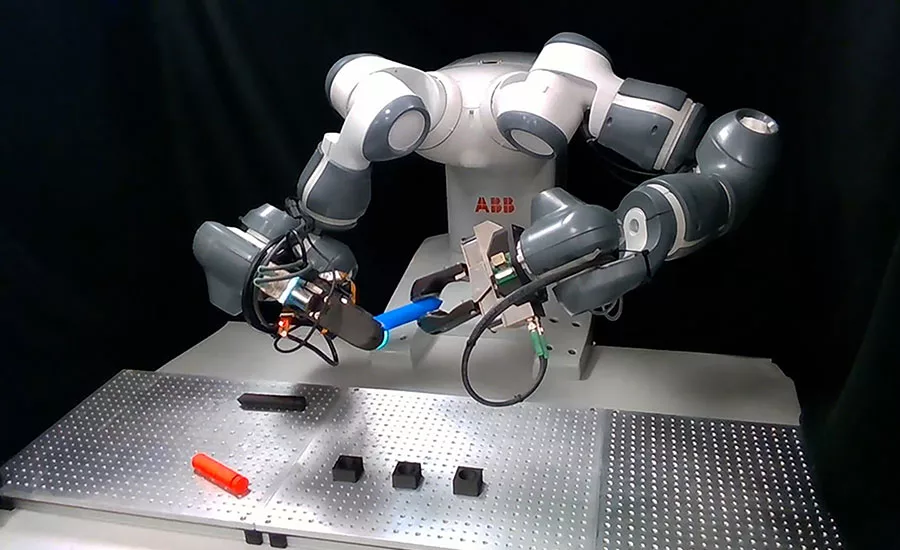
SimPLE is a learning-based tool to pick, regrasp and place objects precisely. It doesn’t require any prior real-world experience with the objects. Photo courtesy Massachusetts Institute of Technology
robotic pick and place

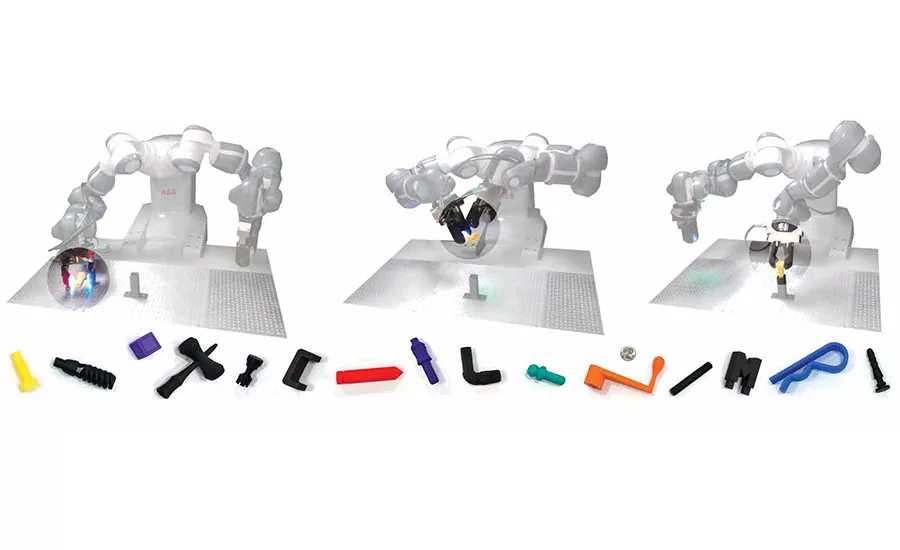
SimPLE relies on three main components, including visuotactile perception (middle) and motion planning (right). Illustration courtesy Massachusetts Institute of Technology

robotic pick and place
September 9, 2024

Picking and placing parts is one of the most common robotic applications. However, there is often a trade-off between high accuracy for a repetitive motion and reliability in an unstructured environment.

To teach robots how to move objects into an organized arrangement, engineers at the Massachusetts Institute of Technology (MIT) have developed a system called SimPLE (Simulation to Pick, Localize, and placE). Given only a model of the object, it generates training data by sampling grasps in simulation.

“SimPLE is a learning-based [tool] to pick, regrasp and place objects precisely that doesn’t require any prior real-world experience with the objects,” says Maria Bauza, Ph.D., a recent MIT grad who worked on the project at MIT’s Manipulation and Mechanisms Laboratory (MCube) along with lab director Alberto Rodriguez, Ph.D., and other students.

“SimPLE relies on three main components, which are developed in simulation,” explains Bauza. “First, a task-aware grasping module selects an object that is stable, observable and favorable to placing. Then, a visuotactile perception module fuses vision and touch to localize the object with high precision. Finally, a planning module computes the best path to the goal position.”

The combination of these three modules allows the robot to compute robust and efficient plans to manipulate a wide range of objects with high precision, while requiring no previous interaction with them in the real world.

According to Bauza, SimPLE is one of the first studies that utilizes tactile feedback for a complex manipulation task. “During our experiments, we found that both tactile [feedback] and vision are necessary to achieve the best performance, which suggest the importance of considering visuotactile perception in robotics applications,” she explains.

“Visuotactile perception is the ability to combine vision and touch sensing to perceive objects,” says Bauza. “In our case, this means combining vision and touch to precisely estimate the pose (position and orientation) of objects in order to manipulate them.”

Looking for quick answers on assembly and manufacturing topics? Try Ask ASM, our new smart AI search tool. Ask ASM →

Bauza and her colleagues used a dual-arm YuMi machine from ABB Robotics that was equipped with a pair of WSG-32 grippers from Weiss Robotics GmbH.

“Traditionally, robotics research has focused on single-arm setups with parallel-jaw grippers,” explains Bauza. “While this setting is usually sufficient to perform grasping on objects, it is often insufficient to efficiently perform precise pick-and-place.

“Dual-arm robots, while more challenging to control, offer a wider task space enabling the machine to easily regrasp objects and reorient them as required by the final placing configuration,” Bauza points out.

“On each gripper, we attached two fingers,” says Bauza. “For the arm that produces the first grasp, these fingers are [equipped] with tactile sensors called GelSlim V3, which are the final evolution of a family of tactile sensors developed at MCube. On the other arm, we use nonsensorized fingers made with the same shape and materials.”

Bauza and her colleagues also used machine vision technology to process information from a depth camera and the signal, in the form of images, produced by two tactile sensors in the arm that performs the first grasp on an object. “The algorithm we devised for perception works equally for both sensing modalities,” she explains.

“The main idea behind it is to leverage simulation to learn an embedding space where two images encoded in this embedding space are close, if the object poses that generated them are close,” says Bauza. “As a result, to obtain the distribution of possible objects positions given a new image from the depth camera or from a tactile sensor, we just need to encode that image and compare its embedding against a dense set of possible images previously generated in simulation.”

The MIT engineers tested 3D-printed objects with a range of sizes and shapes, including a mix of household objects and industrial parts. SimPLE picked and placed 15 diverse objects. It achieved successful placements into structured arrangements with 1-millimter clearance more than 90 percent of the time for six of the objects and more than 80 percent of the time for 11 objects.

Bauza believes SimPLE could eventually be applied in many real-world manufacturing settings. “By performing precise pick-and-place, it is able to take an unstructured set of objects into a structured arrangement, enabling any downstream task,” she claims. “As a result, SimPLE could fit well in [environments] where automation is already standard, such as the automotive industry.

“SimPLE could also enable automation in many semistructured environments, such as medium-sized factories, hospitals or medical laboratories, where automation is less commonplace,” says Bauza. “Semistructured environments are at the same time structured (job requirements don’t change drastically) but flexible, as the specific objects and tasks might change from time to time. SimPLE relies on machine learning and simulated experience with objects, which is a benefit for settings where flexibility is a requirement.

“We are currently working to increase the dexterity and robustness of systems like SimPLE,” notes Bauza. “Two directions of future work include enhancing the dexterity of the robot to solve even more complex tasks, and providing a closed-loop [system] that instead of computing a plan, computes a policy to adapt its actions continuously based on the sensors’ observations. We…plan to continue pushing dexterity and robustness for high-precision manipulation in our ongoing research.”


Learn about new products for robotic assembly

New Generation Collaborative CVGC Carbon Vacuum Gripper
ASG Automation Solutions Increase Throughput and Quality
Mobile Robotic Cell Provides Flexible Automation Solution

KEYWORDS: factory automation flexible assembly pick and place

Share This Story

Looking for a reprint of this article?
From high-res PDFs to custom plaques, order your copy today!

Austinweber headshot
Austin has been senior editor for ASSEMBLY Magazine since September 1999. He has more than 21 years of b-to-b publishing experience and has written about a wide variety of manufacturing and engineering topics. Austin is a graduate of the University of Michigan.

Recommended Content

JOIN TODAY
To unlock your recommendations.

Already have an account? Sign In

  • Made in the U.S.A.

    Consumer Products Manufacturing: Made in the USA

    Supply chain lessons learned during the coronavirus...
    Automated Assembly Systems
    By: Austin Weber
  • Best Practices for Press-Fit Assembly

    Best Practices for Press-Fit Assembly

    In manufacturing, ironclad formulas for success are hard...
    Assembly Presses
    By: Jim Camillo
  • aem0523leader-tesla1.jpg

    Tesla Rethinks the Assembly Line

    Engineers at Tesla Inc. have developed a new process that...
    Electrification
    By: Austin Weber
Manage My Account
  • eMagazine Subscription
  • Assembly Newsletters
  • Online Registration
  • Subscription Customer Service
  • Manage My Preferences

More Videos

Sponsored Content

Sponsored Content is a special paid section where industry companies provide high quality, objective, non-commercial content around topics of interest to the ASSEMBLY audience. All Sponsored Content is supplied by the advertising company and any opinions expressed in this article are those of the author and not necessarily reflect the views of ASSEMBLY or its parent company, BNP Media. Interested in participating in our Sponsored Content section? Contact your local rep!

close
  • ultrasonic welding
    Sponsored bySonobond Ultrasonics

    Engineering Efficiency in High-Performance Assembly: How Ultrasonic Welding Enhances Throughput, Reliability and Quality

  • UV curing system
    Sponsored byDymax

    Why UV Intensity Alone Doesn’t Define Curing Performance

  • wooden pallets
    Sponsored byLEAN Manufacturing Products

    Eliminating Waste on the Shop Floor: Applying Lean Principles to Improve Manufacturing Efficiency

Popular Stories

ASSEMBLY News Now, episode-30: Volvo Redesigns EV Manufacturing

Volvo Redesigns EV Manufacturing

Boeing CEO Kelly Ortberg announces 1 billion investment

Boeing Plans $1 Billion Wichita Investment, Workforce Training Center

automated consumer goods assembly system

Best Practices for Cycle Time Optimization

Watch the latest episode of ANN now!

Events

July 24, 2025

From Shop Floor to CFO: How Manufacturers Are Closing the Loop Between Operations and Finance

On Demand Learn how manufacturers are bridging the gap between the shop floor and ERP systems to gain real-time visibility, streamline operations, and kick-start digital transformation—without waiting years.

Sponsored by:

PicoStratusGreen
July 30, 2025

Buffer Analysis and Design Fundamentals for Manufacturing Excellence

On Demand In this presentation, Dr. Herman Tang shares practical insights from his industry experience and research on buffer management in manufacturing operations.

View All Submit An Event

Poll

Difficult Assembly Processes

Which assembly process gives you the most difficulty?
View Results Poll Archive

Products

Manufacturing Cost Policy Deployment (MCPD) Profitability Scenarios: Systematic and Systemic Improvement of Manufacturing Costs

Manufacturing Cost Policy Deployment (MCPD) Profitability Scenarios: Systematic and Systemic Improvement of Manufacturing Costs

See More Products
Register for webinar - Modernizing Automotive Assembly: Why Upgrading Legacy MES is a Business Imperative

Related Articles

  • robot determines how to manipulate blocks

    New System Enables Robots to Solve Complex Manipulation Problems

    See More
  • comau cobot

    AI System Enables Robots to Easily Manipulate Thousands of Objects

    See More
  • Automated Assembly System Enables Lock Manufacturer to Meet Production Goals

    See More

Related Products

See More Products
  • 4 apps.jpg

    Intelligent Analytics for Industry 4.0 Applications

  • Resistance Welding: Fundamentals and Applications, Second Edition

  • lean systems.jpg

    Lean Systems Applications and Case Studies in Manufacturing, Service, and Healthcare

See More Products

Related Directories

  • Infotech Automation Inc.

    Infotech Automation designs, produces and delivers high accuracy positioning systems for the automatic execution of precision processes - from laboratory to production cells to entire assembly lines. Our solutions are tailored to specific needs, using customizable machines built from standardized modules. The fully integrated vision system enables automatic calibration of pick-and-place nozzles, dispensing needles, as well as fiducial recognition and process inspection.
×

Never miss the latest news and trends driving the manufacturing industry

Stay in the know on the latest assembly trends.

JOIN TODAY!
  • RESOURCES
    • Advertise
    • Contact Us
    • Directories
    • Manufacturing Division
    • Store
    • Want More?
  • SIGN UP TODAY
    • Create Account
    • eMagazine
    • Newsletters
    • Customer Service
    • Manage Preferences
  • SERVICES
    • Marketing Services
    • Reprints
    • Market Research
    • List Rental
    • Survey/Respondent Access
  • STAY CONNECTED
    • LinkedIn
    • Facebook
    • Instagram
    • YouTube
    • X (Twitter)
  • PRIVACY
    • PRIVACY POLICY
    • TERMS & CONDITIONS
    • DO NOT SELL MY PERSONAL INFORMATION
    • PRIVACY REQUEST
    • ACCESSIBILITY

Copyright ©2026. All Rights Reserved BNP Media, Inc. and BNP Media II, LLC.

Design, CMS, Hosting & Web Development :: ePublishing