Build Your Own Lift-Assist Arm
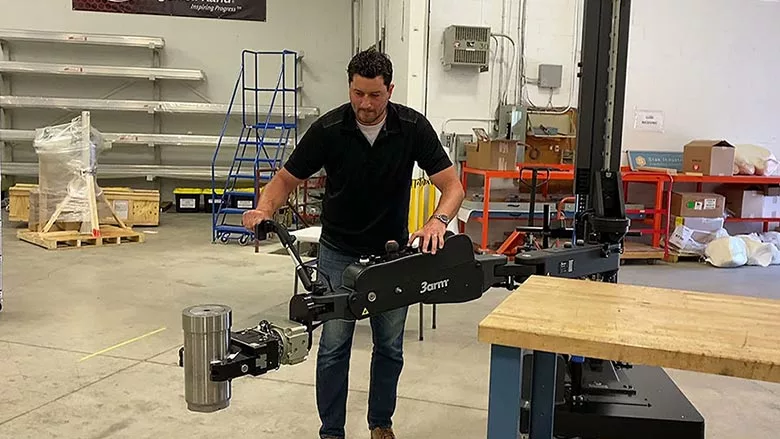
Grippers work best on round parts and allow the operator to rotate and position objects even in difficult spots. Photo courtesy 3arm America
Workplace injuries are costly. The U.S. Bureau of Labor Statistics has found that when an injury results in missed work, 25 percent of injured employees are out of commission for 31 days or more. And although 60 percent of injuries are preventable, companies spend an average of $2,000 annually per employee dealing with workplace injuries.
So when manufacturers seek out ergonomic lift-assist devices for their operations, it’s often a reactive measure. They’re responding to a safety concern or an actual workplace injury. Lift-assist devices help reduce hazards and operator fatigue, and they improve work quality in many industrial environments.
Other common reasons for implementing such equipment include:
- Lack of manpower for a two-person lift.
- Item to be manipulated is too small to warrant a two-person lift, but causes operator fatigue after several hours.
- Improving takt time.
- Building a new assembly line and being proactive about safety.
Not all lift-assist devices are created equal. Consider your intended use and environment to select the right lift-assist arms and accessories, including customizations, for your application.

This tool-support arm is designed for high-torque applications. Photo courtesy 3arm America
Manipulator vs. Tool-Holder
Determine how you will use the arm to identify whether you need a “pick-and-place style” manipulator or a more customized lift-assist device for your application.
A manipulator arm is ideal for material handling and can move objects from one place to another. It is designed to handle items of varying weights. A tool-holding arm is used to permanently hold a constant load, such as a fastening tool.
When choosing or customizing a manipulator arm, consider the following variables:
Looking for quick answers on assembly and manufacturing topics? Try Ask ASM, our new smart AI search tool. Ask ASM
- Dimensions of the part.
- Travel path and distance of the part from the operator.
- Current process.
- Weight of the part.
- Axes of manipulation.
- How the part will be gripped.
With these details, you can identify and design the perfect manipulator for your operations. Your equipment vendor will also help you determine the best end-effector, accessories and safety features for your needs.
The shape, dimensions and weight of your part determine the best end-effector or gripping system. Options include a gripper, vacuum, magnet or custom device.
Grippers work best on round parts and allow the operator to rotate and position objects even in difficult spots. Vacuum end-effectors are ideal for handling flat and nonporous parts. They can pick up a variety of shapes, sizes and types of material. Magnetic end-effectors work best for heavy steel parts and provide a level of safety, since the gripper remains on when the power goes out.
Your current processes and operations also factor into the decision. For instance, if you already have a vacuum system set up, a vacuum gripper might be the best option.
If you need the manipulator to travel beyond its regular vertical or horizontal reach, you’ll likely need some sort of accessory. Manipulators are heavy and robust, and their length is limited, because they are typically used to pick up substantial weight. Accessories that can extend their reach include mobile devices, such as trolleys or carts, and stationary devices, such as rails, columns, lifters and elevators. Each will be more or less of a fit depending on conditions like the weight of the part, how level the floor is, and whether you need the arm to reach very low or very high.
You may also need safety switches and locks for your arm. Drawings and videos of your process can help your lift-assist provider create the best system for your needs. For instance, if this will be a one-man operation, you may want to add locks to the arm to hold it in place as needed. A safety switch can prevent accidents when an arm’s actuation is automated, telling the arm when weight is present.

When choosing a manipulator arm, consider the size and weight of the part and how far you need to move it. Photo courtesy 3arm America
Choosing an Arm for a Constant Load
Selecting an tool-holding arm is more complex, as there are more options to consider. However, the factors are similar. These arms are best for permanently holding objects, such as tools. The primary considerations for a tool-holding arm include:
- The tool to be held.
- Vertical and horizontal reach.
- Current operations.
- Weight of tool.
- Need for brakes.
As with the manipulator, it’s useful to provide your equipment supplier with a drawing of the tool, plus a video or description of your current process. This will help narrow your options to the best arm for your application. It will also help identify which accessories you might need to achieve the optimum vertical or horizontal reach with the arm. Accessories include columns, lifts, elevators and floor rails.
Additionally, with this arm type, understanding torque is helpful in selecting the right arm and head member. Head members are attachments at the end of the arm that hold and position the tool. Tool-holding arms have different torque ratings, and different head members offer different levels of articulation. For example, a bolting tool, such as a nutrunner for underbody work at an automotive assembly plant, will need an arm with unique articulation and torque absorption. An arm for a grinding or finishing application will have a different set of requirements.
You’ll also need to determine whether brakes are required and what type will work best: manual or integrated braking. For example, a pneumatic nutrunners with an electronic controller might require a trigger-activated brake for safety. Trigger-activated brakes lock-up the arm when the assembler presses the tool trigger. Alternatively, engineers can specify which joints to lock-up. This ensures safety and saves time.

A nutrunner will need a different support arm than a grinding tool. Photo courtesy 3arm America
Benefits of Lift-Assist Devices
There are many benefits to using lift-assist devices, including:
- Preventing operator fatigue and strain from repetitive motion and overexertion.
- Absorption of torque reaction.
- Increased consistency, reliability and precision.
- Preventing operator injury.
- Preventing damage to assemblies or tools.
- Reduced takt time and increased productivity.
As you explore your options, consider whether the company you’re working with offers a variety of options in arm styles, head members, end-effectors, and devices for handling force, braking, mounting, and different weight ranges and torque, so you can design the arm to fit your tool and process. Some companies only design for specific tools or their own brands. If you need more custom equipment to achieve your objectives, be sure the company you choose will work with you to accommodate your specific needs to increase safety, reduce costs and increase productivity.

Support arms can position a tool in multiple degrees of freedom. Photo courtesy 3arm America
For more information on ergonomic products, read these articles:
Error-Proof Screwdriving
Tool Balancers and Support Arms
Giving Operators a Lift
Looking for a reprint of this article?
From high-res PDFs to custom plaques, order your copy today!


