Assembly Magazine logo
search
Ask ASSEMBLY AI
cart
facebook twitter linkedin youtube
  • Sign In
  • Create Account
  • Sign Out
  • My Account
Assembly Magazine logo
  • TRENDS
    • Ask ASSEMBLY AI
    • Trends
    • News
    • New Products
  • INDUSTRIES
    • Aerospace
    • Appliance
    • DFMA Assembly
    • Medical Devices
    • Green Manufacturing
    • Lean Manufacturing
    • Machinery Assembly
    • Electronics Assembly
    • Automotive
  • TECHNOLOGIES
    • Adhesives & Dispensing
    • Assembly Presses
    • Automated Assembly Systems
    • Manufacturing Management
    • Manufacturing Software
    • Motion Control
    • Screwdriving & Riveting
    • Robotics
    • Test & Inspection
    • Plastics & Metal Welding
    • Wire Processing
    • Workstations
  • AUTONOMOUS & ELECTRIC MOBILITY
    • AEM Magazine Archives
    • Autonomy
    • Electrification
    • Mobility Services
    • Assembly & Testing
    • AV/EM News
  • MEDIA
    • Ask ASSEMBLY AI
    • Podcasts
    • Assembly News Now
    • Assembly TV
    • Webinars
    • eBooks
  • EVENTS
    • Calendar
    • The ASSEMBLY Show
  • MORE
    • Exclusives >
      • Plant of the Year
      • Capital Spending
    • Buyers Guide >
      • Supplier Insights
    • Classifieds
    • Featured Products
    • Newsletters
    • Store
    • White Papers
    • Columns
    • Sponsor Insights
  • INFOCENTER
    • Assembly & Test Solutions
  • EMAGAZINE
    • eMagazine
    • Archive Issues
    • Advertise
    • Contact Us
    • Sign Up
TechnologiesColumnsAutomated Assembly SystemsRobotics AssemblyOn Campus

Research Focuses on Developing Versatile Robotic Hand
By Austin Weber
human-robot interaction

A new R&D initiative hopes to improve the dexterity of machines and enhance human-robot interaction. Illustration courtesy Texas A&M University

robotic soldering

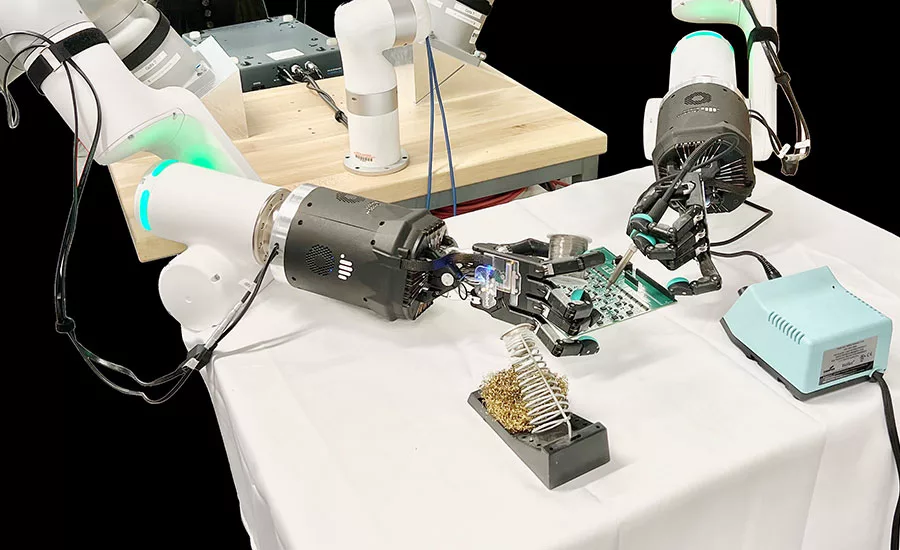
Many assembly tasks, such as soldering, will benefit from new types of robotic grasping devices. Photo courtesy Northwestern University

multifunctional materials provide both actuation and sensing capabilities

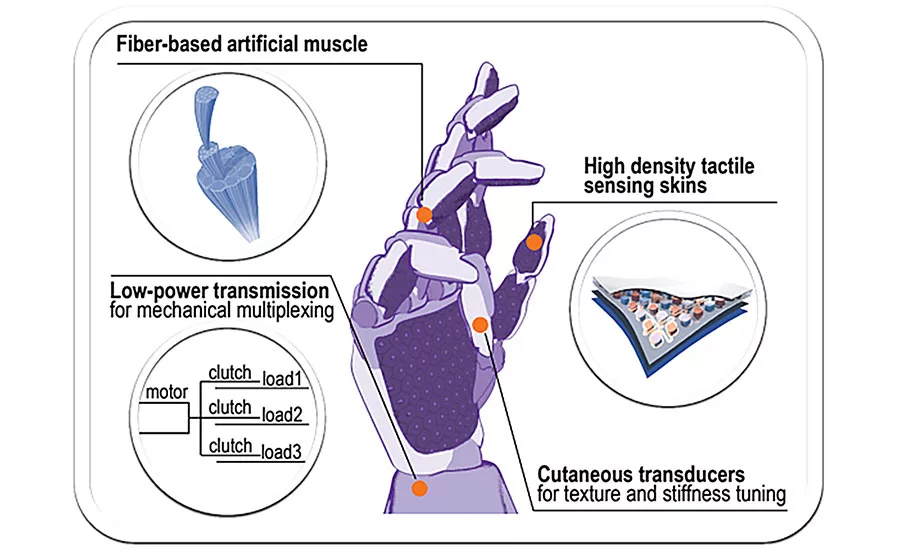
Engineers are developing multifunctional materials that provide both actuation and sensing capabilities. Illustration courtesy Carnegie Mellon University

robotic gripping

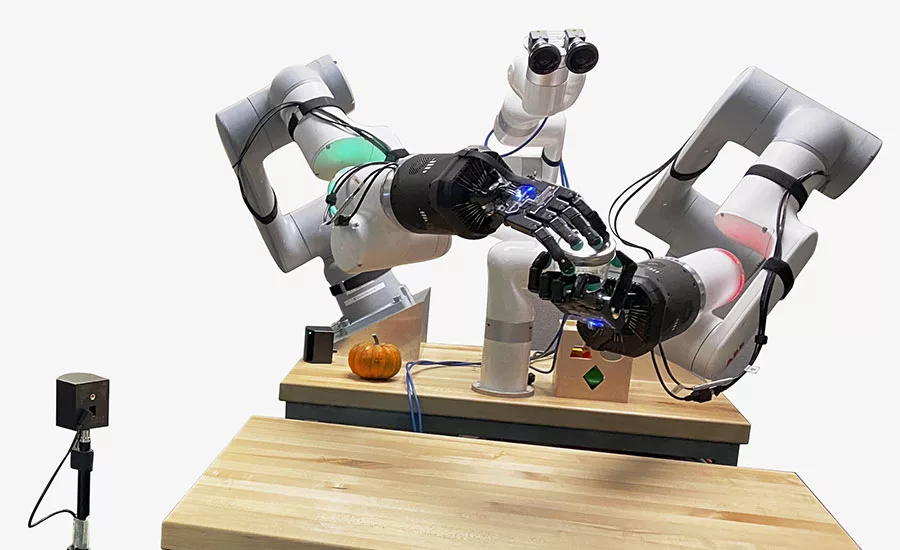
The HAND project is focusing on intelligent and versatile grasping, fine motor skills and hand-eye coordination. Photo courtesy Northwestern University
human-robot interaction
robotic soldering
multifunctional materials provide both actuation and sensing capabilities
robotic gripping
October 29, 2024

Hands and brains are two of the most complex and hard-to-duplicate attributes of humans. They are part of what distinguish people from robots. But, a new R&D initiative hopes to change that by improving the dexterity of machines and enhancing human-robot interaction.

The goal of the Human AugmentatioN via Dexterity (HAND) project is to develop robots capable of intelligent and versatile grasping, fine motor skills and hand-eye coordination. The multi-institutional collaboration, led by Northwestern University, recently received $26 million from the National Science Foundation to launch an Engineering Research Center (ERC) dedicated to studying robotic manipulation in applications ranging from manufacturing to caregiving.

In addition to Northwestern, several other schools are involved in the 10-year project, which comprises nearly 30 faculty members with a variety of expertise. Key academic partners include Carnegie Mellon, Florida A&M and Texas A&M, with additional faculty support from the Massachusetts Institute of Technology (MIT), Syracuse University and the University of Wisconsin-Madison.

The ERC, housed under the auspices of Northwestern’s McCormick School of Engineering, aims to build a variety of cutting-edge hardware and software tools that are versatile, robust and easy to integrate with existing technology. The interdisciplinary center involves experts in fields such as artificial intelligence, haptics, human-robot interaction, machine perception, manipulation, materials, modeling and soft robotics.

“This is a historic milestone that builds on [our] well-recognized expertise in robotics and human-machine systems,” says Eric Perreault, Ph.D., vice president for research at Northwestern. “The HAND [project] is bold and visionary. It will have a long-lasting, positive effect on manufacturing, food processing, healthcare and many other areas that rely on dexterous manipulation.”

“The focus of our engineering research center is on making robots easier to use,” adds Kevin Lynch, Ph.D., a professor of mechanical engineering and director of Northwestern’s Center for Robotics and Biosystems.

“Traditionally, most research activity has focused on robotic locomotion and navigation, and less on manipulation,” explains Lynch, who serves as HAND’s research director. “Our focus is on end effectors. We want to give robotic arms humanlike dexterity.”

Looking for quick answers on assembly and manufacturing topics? Try Ask ASM, our new smart AI search tool. Ask ASM →

While robots already play an important role in manufacturing, Lynch says their full potential has been limited. Developing hands that are as versatile and dexterous as their human counterparts will enable robots to adopt new grasping capabilities and allow smaller manufacturers to automate a variety of low-volume, high-mix production tasks.

“Our focus is on end effectors. We want to give robotic arms humanlike dexterity.”

– Kevin Lynch, Ph.D.

“Parallel and suction grippers have limitations,” claims Lynch. “Human hands are capable of so much more, because they have many degrees of motion and have numerous tactile sensors embedded in their fingertips. They can perform complex things such as using chopsticks, shuffling cards, screwing a cap onto a jar or writing with a pen.

“All those tasks require rolling at the fingertips, which we refer to as in-hand manipulation,” says Lynch. “Most things that humans do involve some kind of motion of the object relative to the hand. The sensing and control of our hands also makes up a huge portion of the human brain’s volume.

“However, when it comes to robotics, we are very far away from achieving that same sort of sensory motor integration,” Lynch points out. “That means all the intelligence we see in modern AI, such as ChatGPT, can’t be expressed through physical actions and manipulation. The sensing and control of hands is a major bottleneck toward unleashing the power of AI.”

Lynch and his colleagues plan to address robotic dexterity challenges through multiple thrusts. For instance, they’re developing new robotic hands with new actuation technologies and tactile sensors. They are also working on artificial intelligence and human interfaces related to robotic dexterity and manipulation.

“We currently use off-the-shelf components in our lab, including commercial robot arms, cameras and sensors,” says Lynch. “We’re using virtual reality headsets and haptic gloves to teleoperate robots through that interface. But, over the next few years, we will be replacing those components with new hands and interfaces that we are currently developing.”

HAND is focusing on three key areas: hands, intelligence and human interface. Engineers at Northwestern are tackling AI and intelligence dexterity, while their counterparts at Carnegie Mellon address hand hardware, including design, actuation and sensing. MIT engineers are in charge of human interface issues, such as how to make robots easier to use and perform useful tasks.

“Our long-term goal is to have a commercially available dexterity system that comes with hands and a human interface that can be easily connected to any standard industrial robot,” says Lynch. “You’ll be able to attach our hands to any robot arm.

“The devices will be able to perform dexterous skills straight out of the box instead of requiring months of integration time,” explains Lynch. “Assembly applications will include adhesive dispensing, screwdriving and soldering, with minimal initial programming effort required.”

The technology is being tested at several test beds. One is associated with the Shirley Ryan AbilityLab in Chicago, which is focused on helping people with motor disabilities so that they can be more independent at home. Test beds at Carnegie Mellon and MIT are focused on manufacturing applications. Another facility at Texas A&M is focused on handling rare or high consequence materials, such as biological agents.

“There are many areas that we still need to have significant advances in to achieve the vision of the center,” says Lynch. “One thing we have to address is improved actuation so that robotic hands are not so brittle and heavy. Reducing weight while increasing strength and dexterity are actuator problems that we need to address.

“Another challenge we face is making skin soft and durable,” adds Lynch. “We need to develop multifunctional materials that provide both actuation and sensing capabilities, while also providing a soft surface for interaction. We’ll be investigating technologies such as electrostatic clutches and liquid crystal elastomers. Then, once we address all those issues related to hands, we have to connect the intelligence.”

See more articles from our November 2024 issue!

KEYWORDS: collaborative robots factory automation humanoid robot robot grippers

Share This Story

Looking for a reprint of this article?
From high-res PDFs to custom plaques, order your copy today!

Austinweber headshot
Austin has been senior editor for ASSEMBLY Magazine since September 1999. He has more than 21 years of b-to-b publishing experience and has written about a wide variety of manufacturing and engineering topics. Austin is a graduate of the University of Michigan.

Recommended Content

JOIN TODAY
To unlock your recommendations.

Already have an account? Sign In

  • Made in the U.S.A.

    Consumer Products Manufacturing: Made in the USA

    Supply chain lessons learned during the coronavirus...
    Automated Assembly Systems
    By: Austin Weber
  • Best Practices for Press-Fit Assembly

    Best Practices for Press-Fit Assembly

    In manufacturing, ironclad formulas for success are hard...
    Assembly Presses
    By: Jim Camillo
  • aem0523leader-tesla1.jpg

    Tesla Rethinks the Assembly Line

    Engineers at Tesla Inc. have developed a new process that...
    Automotive Assembly
    By: Austin Weber
Manage My Account
  • eMagazine Subscription
  • Assembly Newsletters
  • Online Registration
  • Subscription Customer Service
  • Manage My Preferences

More Videos

Sponsored Content

Sponsored Content is a special paid section where industry companies provide high quality, objective, non-commercial content around topics of interest to the ASSEMBLY audience. All Sponsored Content is supplied by the advertising company and any opinions expressed in this article are those of the author and not necessarily reflect the views of ASSEMBLY or its parent company, BNP Media. Interested in participating in our Sponsored Content section? Contact your local rep!

close
  • ultrasonic welding
    Sponsored bySonobond Ultrasonics

    Engineering Efficiency in High-Performance Assembly: How Ultrasonic Welding Enhances Throughput, Reliability and Quality

  • UV curing system
    Sponsored byDymax

    Why UV Intensity Alone Doesn’t Define Curing Performance

  • wooden pallets
    Sponsored byLEAN Manufacturing Products

    Eliminating Waste on the Shop Floor: Applying Lean Principles to Improve Manufacturing Efficiency

Popular Stories

ASSEMBLY News Now, episode-30: Volvo Redesigns EV Manufacturing

Volvo Redesigns EV Manufacturing

Boeing CEO Kelly Ortberg announces 1 billion investment

Boeing Plans $1 Billion Wichita Investment, Workforce Training Center

automated consumer goods assembly system

Best Practices for Cycle Time Optimization

Watch the latest episode of ANN now!

Events

July 24, 2025

From Shop Floor to CFO: How Manufacturers Are Closing the Loop Between Operations and Finance

On Demand Learn how manufacturers are bridging the gap between the shop floor and ERP systems to gain real-time visibility, streamline operations, and kick-start digital transformation—without waiting years.

Sponsored by:

PicoStratusGreen
July 30, 2025

Buffer Analysis and Design Fundamentals for Manufacturing Excellence

On Demand In this presentation, Dr. Herman Tang shares practical insights from his industry experience and research on buffer management in manufacturing operations.

View All Submit An Event

Poll

Difficult Assembly Processes

Which assembly process gives you the most difficulty?
View Results Poll Archive

Products

Manufacturing Cost Policy Deployment (MCPD) Profitability Scenarios: Systematic and Systemic Improvement of Manufacturing Costs

Manufacturing Cost Policy Deployment (MCPD) Profitability Scenarios: Systematic and Systemic Improvement of Manufacturing Costs

See More Products
Register for webinar - Modernizing Automotive Assembly: Why Upgrading Legacy MES is a Business Imperative

Related Articles

  • Massachusetts Institute of Technology

    Wristband Enables Wearers to Control Robotic Hand

    See More
  • lightweight humanoid robotic hand in 2 sizes

    Tesollo Launches Robotic Hand as Samsung Expands Humanoid Robotics Development

    See More
  • Soft Robotic Hand Can Grasp, Identify Wide Array of Objects

    See More

Related Products

See More Products
  • Robotic Micro-Assembly

  • foreman.jpg

    The Foreman on the Assembly Line

  • Resistance Welding: Fundamentals and Applications, Second Edition

See More Products

Related Directories

  • One-Off Robotics

    One-Off Robotics is an advanced equipment manufacturer designing and building the world's most innovative robotic fabrication systems. We specialize in robotic metal additive manufacturing and robotic milling, offering both stationary and portable, field-deployable systems engineered for demanding production environments. Our technologies enable additive, subtractive, and hybrid fabrication processes, supporting applications across Defense, Aerospace, Research, and Specialized Production sectors.
×

Never miss the latest news and trends driving the manufacturing industry

Stay in the know on the latest assembly trends.

JOIN TODAY!
  • RESOURCES
    • Advertise
    • Contact Us
    • Directories
    • Manufacturing Division
    • Store
    • Want More?
  • SIGN UP TODAY
    • Create Account
    • eMagazine
    • Newsletters
    • Customer Service
    • Manage Preferences
  • SERVICES
    • Marketing Services
    • Reprints
    • Market Research
    • List Rental
    • Survey/Respondent Access
  • STAY CONNECTED
    • LinkedIn
    • Facebook
    • Instagram
    • YouTube
    • X (Twitter)
  • PRIVACY
    • PRIVACY POLICY
    • TERMS & CONDITIONS
    • DO NOT SELL MY PERSONAL INFORMATION
    • PRIVACY REQUEST
    • ACCESSIBILITY

Copyright ©2026. All Rights Reserved BNP Media, Inc. and BNP Media II, LLC.

Design, CMS, Hosting & Web Development :: ePublishing