Flexible Assembly With Manual Presses

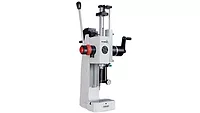
This manual workstation is equipped with an automatic pin feed system.
Photo courtesy Schmidt Technology Corp.
Pneumatic and electric presses provide tremendous force and a lot of bells and whistles for precision assembly. Benefits include closed-loop control of ram position, speed and force for accurate and repeatable pressing. However, for many applications, a simple, hand-operated press is all that’s needed.
Manual presses offer high precision, reliability and flexibility without the need for automation. They are ideal for small production runs, precise assembly tasks or high-mix production environments that don’t merit more expensive power presses.
A manual press consists of a metal C-frame, a ram, a lever and a small bed area. An operator mounts a part in the base fixture and sets the ram height. He or she then pulls on the lever to press the ram (with tooling) down onto the part.
There are three types of manual presses: rack-and-pinion, toggle and toggle with pneumatic assist. A rack-and-pinion press produces a constant linear force over the entire length of the stroke. It is popular for pressing and forming applications.
In a toggle press, the ram is connected via a toggle mechanism. The lever action of the toggle multiplies the force applied by the ram exponentially. The press produces little force at the start of the stroke, but delivers maximum force at the end. Toggle presses are typically used for crimping, flaring, punching, riveting and staking.
“Manual presses are designed for simplicity and precision, offering high-quality performance across a wide range of applications,” says David Zabrosky, North American sales manager at Schmidt Technology Corp. “Available in multiple configurations, these presses are perfect for [manufacturers] that require cost-effective, yet accurate production methods.
“They’re used to assemble a variety of products, including auto parts, electronics, household appliances and medical devices,” explains Zabrosky, who points out that manual presses are one of his company’s top sellers. “Hand presses are used everywhere. If it’s within the force range, just about any assembly application can be done with a manual press.
Looking for quick answers on assembly and manufacturing topics? Try Ask ASM, our new smart AI search tool. Ask ASM
“In addition to simplicity, manual presses offer versatility,” notes Zabrosky. “Sometimes, there’s just no other way to hold a part. And, when you get out of the manual press realm into powered presses, the process becomes much more complex.”

The press ram on this device is moved forward over a toggle mechanism by pulling the hand lever. Photo courtesy TOX Pressotechnik
High-Mix, Low-Volume Applications
Manual presses are ideal for high-mix, low-volume applications where an assembly task requires too much force to do by hand. “You typically see them being used by an operator who stands in front of the press loading and unloading a part,” says Zabrosky. “That’s the only cost associated with running a manual press.
“Unlike electric or pneumatic presses, there’s no need to hook up a service line, so the machine can be used anywhere in a facility,” explains Zabrosky. “If you need to produce a part every 5 seconds, a manual press is not ideal. However, if you only produce one part every 20 minutes, a hand press would be good.
“Ergonomic requirements and force are the two main factors that determine if a hand press should be used,” says Zabrosky. “Some manufacturers have maximum handle pull requirements on presses, such as 26 pounds or less. But, every company is different and has unique needs.”
Engineers should ensure that a manual press can be cycled quickly enough to meet required production levels without putting operators at risk of arm strain or other ergonomic injuries. If more workers and presses are needed to meet production levels, it might be more economical to use powered presses.
Although Schmidt produces a variety of powered presses, one of its newest products is a two-armed manual press. The DuplexPress 8 press is a rack-and-pinion style device that features a fast approach on the left side and a power stroke on the right.

Manual presses can be equipped with fully integrated force and distance monitoring capabilities. Photo courtesy Schmidt Technology Corp.
“This product came about because we noticed that customers were asking for hand presses that feature more force capability and longer strokes,” explains Zabrosky. “The duplex press combines two different technologies.
“It has 140 millimeters of ram stroke,” says Zabrosky. “The left handle offers low force and high speed, while the right handle is designed to generate high forces with as much stroke as you want. It offers the best of two worlds.
“Typical applications for manual presses include inserting a pin into a housing or attaching a small bearing onto a shaft,” notes Zabrosky. “Medical device manufacturers, on the other hand, use a standard toggle press to form markers that are installed onto stents to provide visibility for orientation and location.
“One of the newest applications we see is for leak testing,” explains Zabrosky. “Some engineers use manual presses to provide clamping force to hold parts closed while they run a leak test.”
“A variety of automotive and aerospace suppliers use manual presses,” adds Troy Waldherr, vice president of sales and operations at Tox Pressotechnik. “The aerospace industry, for instance, doesn’t have the high volumes that justify more expensive equipment. Many applications involve inserting small parts, such as electronic components.
“Manual presses enable the operator to have a feel or a control over the assembly process,” says Waldherr. “They’re good for inserting snap-in or press-type parts. And, they are safer than many powered alternatives, because the operator has full control and is less likely to get into trouble.”
According to Waldherr, manual presses are typically used for applications where operators make no more than a few parts every minute. “With any higher cycle times, a person is going to quickly wear out,” he warns. “Once you get beyond making one part every 12 seconds or so, operator fatigue plays a role.
“Hand presses are great for start-up companies,” Waldherr points out. “Many firms start with those types of products and then move to power presses as their volume ramps up.
“However, manual presses aren’t necessarily only used by small manufacturers or in small shops,” notes Waldherr. “Some large automakers use them to produce low-volume, niche vehicles.
“Manual presses are also widely used for making prototypes and test products,” claims Waldherr. “They’re really great for proving out new designs or new processes.

This duplex press features a left handle for low force and a right handle that generates high forces. Photo courtesy Schmidt Technology Corp.
“The biggest mistake that engineers make with manual presses is misapplying the technology and not fully understanding how to use the devices,” says Waldherr. “Some people believe that a manual press you can get from an industrial distributor, such as Grainger or McMaster-Carr, is the same as you can buy from a true press manufacturer, such as Schmidt or Tox Pressotechnik. But, that’s not true.
“The biggest difference is in precision,” warns Waldherr. “You might not get much wear on a cheap press after 1,000 cycles, but you eventually will a few years down the line.”
New ‘Handy’ Features
Traditionally, manual presses have been limited by force. However, recent advancements have increased their output-force capacity. For instance, Tox Pressotechnik’s PHFL series of products are equipped with pneumatic assist, which shortens cycle time and reduces strain on operators.
“With the right press selection, you can have as much control as pneumatic or servo presses, and almost to the level of programmable servo-based presses,” adds Zabrosky. “That’s why we offer manual presses with integrated control packages that prevent a cycle start if a specific condition is not met. Systems with fully integrated process monitoring and control elements ensure every part was produced with a specified tolerance.
“One of our most popular accessories is a return stroke lock, which is a quality control feature,” says Zabrosky. “It ensures that operators pull the handle all the way to the end of stroke. If they don’t, the handle doesn’t come back up. It prevents operators from making the mistake of short stroking. Our next most popular accessory is an ergonomic handle.”
Tox Pressotechnik also offers a variety of accessories, such as an ergonomic grip that turns an operator’s hand 90 degrees. It also has a rotating handle that changes the angle of the person’s shoulder. Other simple add-ons include counters and tool fixtures.
“In addition, we can add load cells, position sensors and monitoring screens to manual presses so that engineers can get signature curves,” says Waldherr. “Plus, the monitoring screen enables operators to use it as a target so that when they pull down the handle, they don’t let go until they hit the target window.
“We are currently testing a next-generation monitoring system for manual presses that will be Industry 4.0 compatible,” notes Waldherr. “It should be available by this summer.”
Looking for a reprint of this article?
From high-res PDFs to custom plaques, order your copy today!