Assembly Magazine logo
search
Ask ASSEMBLY AI
cart
facebook twitter linkedin youtube
  • Sign In
  • Create Account
  • Sign Out
  • My Account
Assembly Magazine logo
  • TRENDS
    • Ask ASSEMBLY AI
    • Trends
    • News
    • New Products
  • INDUSTRIES
    • Aerospace
    • Appliance
    • DFMA Assembly
    • Medical Devices
    • Green Manufacturing
    • Lean Manufacturing
    • Machinery Assembly
    • Electronics Assembly
    • Automotive
  • TECHNOLOGIES
    • Adhesives & Dispensing
    • Assembly Presses
    • Automated Assembly Systems
    • Manufacturing Management
    • Manufacturing Software
    • Motion Control
    • Screwdriving & Riveting
    • Robotics
    • Test & Inspection
    • Plastics & Metal Welding
    • Wire Processing
    • Workstations
  • AUTONOMOUS & ELECTRIC MOBILITY
    • AEM Magazine Archives
    • Autonomy
    • Electrification
    • Mobility Services
    • Assembly & Testing
    • AV/EM News
  • MEDIA
    • Ask ASSEMBLY AI
    • Podcasts
    • Assembly News Now
    • Assembly TV
    • Webinars
    • eBooks
  • EVENTS
    • Calendar
    • The ASSEMBLY Show
  • MORE
    • Exclusives >
      • Plant of the Year
      • Capital Spending
    • Buyers Guide >
      • Supplier Insights
    • Classifieds
    • Featured Products
    • Newsletters
    • Store
    • White Papers
    • Columns
    • Sponsor Insights
  • INFOCENTER
    • Assembly & Test Solutions
  • EMAGAZINE
    • eMagazine
    • Archive Issues
    • Advertise
    • Contact Us
    • Sign Up
TechnologiesColumnsManufacturing SoftwareOn Campus

University of Virginia Tackles AI in Manufacturing
By Austin Weber
automotive manufacturing

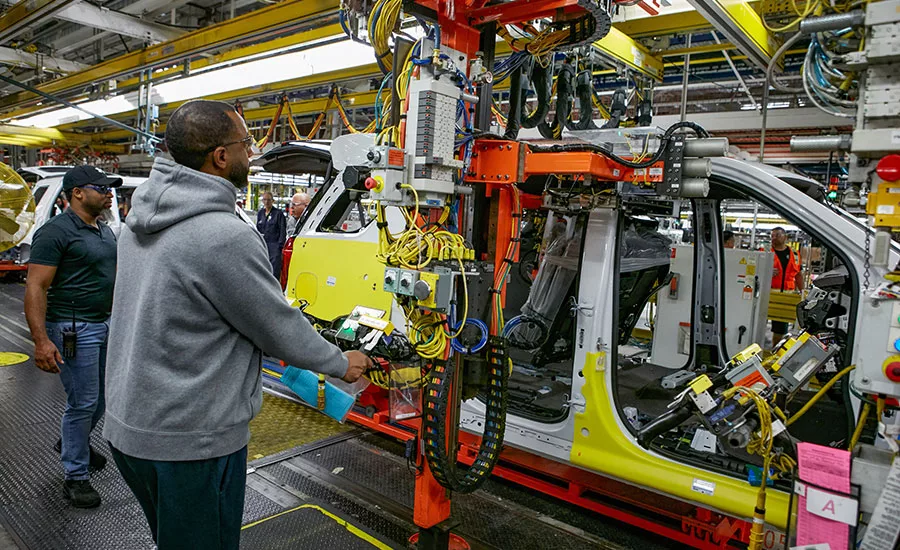
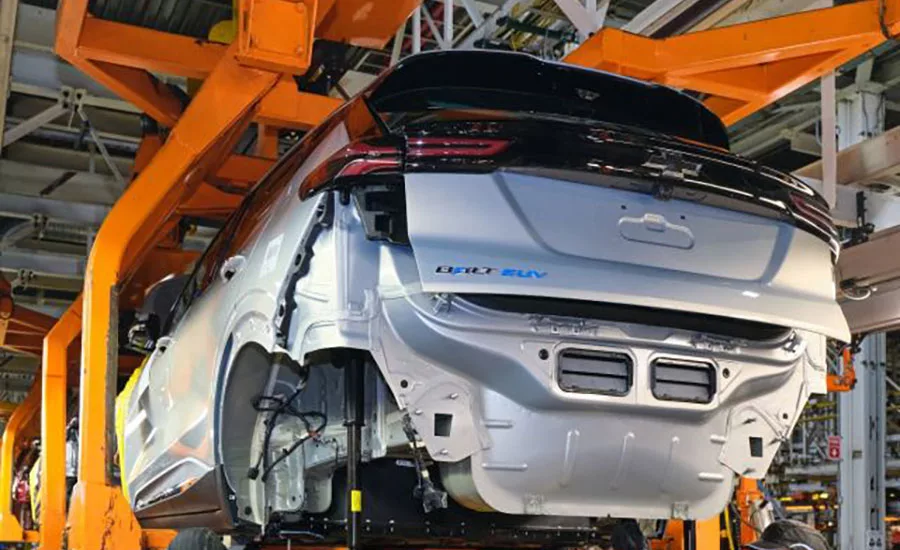
One of the key benefits of AI is enhanced efficiency and productivity. 

Photo courtesy General Motors

automotive manufacturing

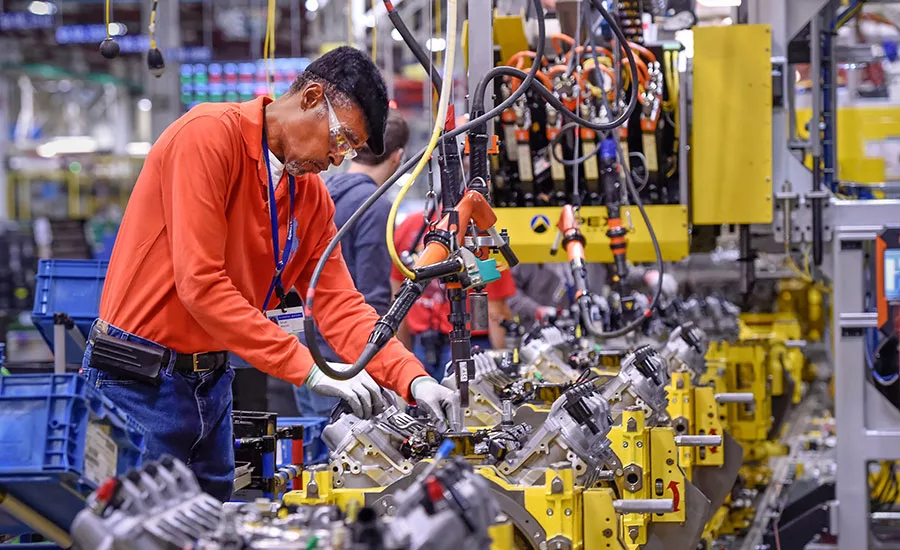
Artificial intelligence technology can identify inefficiencies in production processes and suggest improvements, leading to faster production cycles and reduced costs.

Photo courtesy General Motors

automotive manufacturing

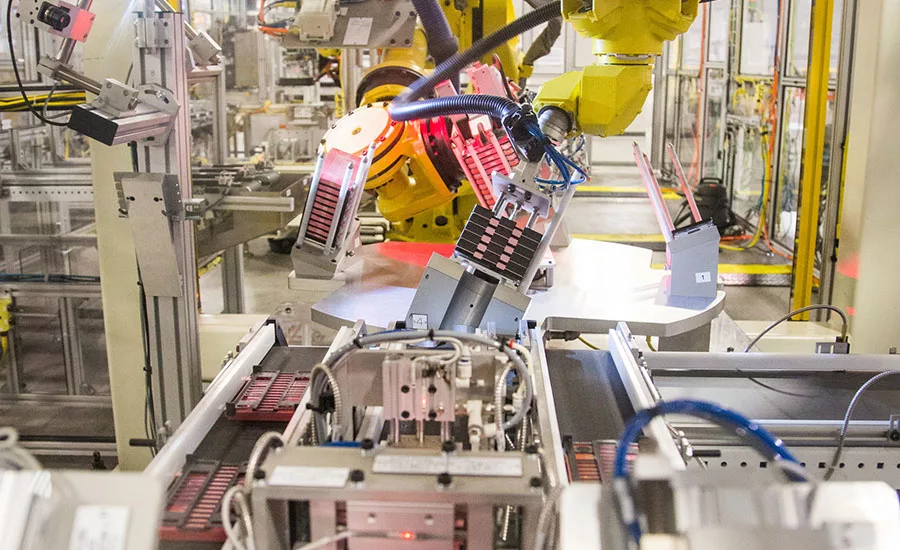
AI-enabled robots ensure consistent quality and reduce automation costs.

Photo courtesy General Motors

automotive manufacturing

Artificial intelligence enhanced tools can help optimize manual assembly lines.

Photo courtesy General Motors
automotive manufacturing
January 20, 2025

Artificial intelligence technology is transforming the way that manufacturers operate. Companies in a variety of industries are investing in AI tools to improve efficiency, product development, safety, predictive maintenance and supply chain logistics.

For instance, several Stellantis power train assembly plants are using AI-enabled robot guidance systems. The automaker leverages AI and vision systems to allow robots to adjust their trajectory in real-time to avoid potential conflicts or impacts. The system is delivering improved quality and reducing lead times.

Siemens AG has harnessed the power of AI at its state-of-the-art electronics factory in Erlangen, Germany, where machine learning optimizes test and inspection procedures, significantly increasing first-pass yield and boosting efficiency. AI-enabled robots that pick and place components on fully automated assembly lines have reduced automation costs by 90 percent.

Engineers at the University of Virginia (UVA) are also developing AI-driven systems to transform how factories operate. Using multi-agent reinforcement learning (MARL), they have created a more efficient way to optimize manufacturing systems, improving both speed and quality while reducing waste. By coordinating multiple agents to manage tasks in real time, the system adjusts automatically, learning and improving performance over time.

“AI is revolutionizing the manufacturing industry by offering a wide range of benefits that can significantly improve efficiency, productivity and overall performance,” says Qing “Cindy” Chang, Ph.D., a mechanical engineering professor who is heading up the R&D project.

“AI can analyze vast amounts of data collected from assembly lines, such as individual process times, downtime and over-cycle rates,” explains Chang. “By processing this information, [the technology] can identify bottlenecks, predict potential failures and optimize production schedules.”

However, Chang warns that a big misunderstanding about using AI technology in manufacturing is the belief that it can operate autonomously without human intervention or domain expertise.

Looking for quick answers on assembly and manufacturing topics? Try Ask ASM, our new smart AI search tool. Ask ASM →

“Many assume that implementing AI is a plug-and-play solution,” says Chang. “But, successful applications require high quality data and domain expertise. Customization is also often needed, since manufacturing environments vary significantly.”

According to Chang, one of the key benefits of AI is enhanced efficiency and productivity. Specifically, it enhances three types of factory operations:

  • Predictive maintenance. AI algorithms can analyze sensor data from machines to predict potential failures before they occur, allowing for proactive maintenance and minimizing downtime. 
  • Process optimization. AI can identify inefficiencies in production processes and suggest improvements, leading to faster production cycles and reduced costs. 
  • Automated quality control. AI-powered vision systems can inspect products for defects, ensuring consistent quality and reducing the need for manual inspection.

The technology can also improve plant floor decision making. “AI can analyze vast amounts of data from various sources to provide valuable insights into market trends, customer preferences and future demand forecasts,” explains Chang.

“By integrating diverse information using neural networks, algorithms can train control policies to optimize plant operations,” says Chang. “This includes fine-tuning cycle times, scheduling maintenance, prioritizing resource allocation and optimizing inventory levels to significantly enhance overall performance efficiency.”

Chang and her colleagues are focusing their research on modeling and controlling complex manufacturing systems. “These systems involve hundreds of interconnected machines, robots and human workers, often subject to random disruptions like machine failures and material shortages,” she points out.

“To address this complexity, we're developing neural network models to integrate vast amounts of data and disruption events,” explains Chang. “By employing a multi-agent reinforcement learning control scheme, we aim to optimize system yields, ensuring the production of high quality products.

“Our approach leverages physics-guided MARL to achieve exceptional robustness compared to other machine learning techniques,” claims Chang. “This innovative method enables our system to adapt to dynamic conditions and make real-time decisions, ultimately enhancing overall manufacturing efficiency and productivity."

The UVA research is being conducted in collaboration with General Motors, which provided valuable insights and real-world applications for the AI system. “GM’s involvement ensures the technology addresses the practical challenges of modern manufacturing,” notes Chang.”

“Instead of optimizing individual processes in isolation, our system looks at the big picture—coordinating everything at once,” says Chang. “The result is smarter, faster and more adaptable manufacturing.”

Algorithms were key in making this advancement. They enable the system to account for both the physical constraints of machinery and unpredictable production disruptions.

“By integrating system- and process-level parameters, this system can optimize yields and dynamically adapt to changes, such as machine breakdowns or production adjustments, without human intervention,” says Chang. “It’s a major leap forward in smart manufacturing.”

Chang believes this AI-driven control system could establish new benchmarks for manufacturing efficiency, particularly in complex, multi-stage production environments. She says it sets the stage for smarter, more adaptable production systems, with broad potential applications across various industries. 

“In addition to improving productivity, the system offers significant economic and environmental advantages,” adds Chang. “By reducing waste, minimizing downtime and lowering energy consumption, manufacturers can achieve substantial cost savings while shrinking their environmental footprint. The technology presents a powerful step forward for both industry and sustainability efforts.”

NOTE: This article was researched and written 100 percent by human – AI was not used in content creation.


See more articles from our July 2025 issue!

KEYWORDS: Artificial Intelligence (AI) equipment maintenance factory automation flexible assembly university innovation university research

Share This Story

Looking for a reprint of this article?
From high-res PDFs to custom plaques, order your copy today!

Austinweber headshot
Austin has been senior editor for ASSEMBLY Magazine since September 1999. He has more than 21 years of b-to-b publishing experience and has written about a wide variety of manufacturing and engineering topics. Austin is a graduate of the University of Michigan.

Recommended Content

JOIN TODAY
To unlock your recommendations.

Already have an account? Sign In

  • Made in the U.S.A.

    Consumer Products Manufacturing: Made in the USA

    Supply chain lessons learned during the coronavirus...
    Automated Assembly Systems
    By: Austin Weber
  • Best Practices for Press-Fit Assembly

    Best Practices for Press-Fit Assembly

    In manufacturing, ironclad formulas for success are hard...
    Assembly Presses
    By: Jim Camillo
  • aem0523leader-tesla1.jpg

    Tesla Rethinks the Assembly Line

    Engineers at Tesla Inc. have developed a new process that...
    Electrification
    By: Austin Weber
Manage My Account
  • eMagazine Subscription
  • Assembly Newsletters
  • Online Registration
  • Subscription Customer Service
  • Manage My Preferences

More Videos

Sponsored Content

Sponsored Content is a special paid section where industry companies provide high quality, objective, non-commercial content around topics of interest to the ASSEMBLY audience. All Sponsored Content is supplied by the advertising company and any opinions expressed in this article are those of the author and not necessarily reflect the views of ASSEMBLY or its parent company, BNP Media. Interested in participating in our Sponsored Content section? Contact your local rep!

close
  • ultrasonic welding
    Sponsored bySonobond Ultrasonics

    Engineering Efficiency in High-Performance Assembly: How Ultrasonic Welding Enhances Throughput, Reliability and Quality

  • UV curing system
    Sponsored byDymax

    Why UV Intensity Alone Doesn’t Define Curing Performance

  • wooden pallets
    Sponsored byLEAN Manufacturing Products

    Eliminating Waste on the Shop Floor: Applying Lean Principles to Improve Manufacturing Efficiency

Popular Stories

ASSEMBLY News Now, episode-30: Volvo Redesigns EV Manufacturing

Volvo Redesigns EV Manufacturing

Boeing CEO Kelly Ortberg announces 1 billion investment

Boeing Plans $1 Billion Wichita Investment, Workforce Training Center

automated consumer goods assembly system

Best Practices for Cycle Time Optimization

Watch the latest episode of ANN now!

Events

July 24, 2025

From Shop Floor to CFO: How Manufacturers Are Closing the Loop Between Operations and Finance

On Demand Learn how manufacturers are bridging the gap between the shop floor and ERP systems to gain real-time visibility, streamline operations, and kick-start digital transformation—without waiting years.

Sponsored by:

PicoStratusGreen
July 30, 2025

Buffer Analysis and Design Fundamentals for Manufacturing Excellence

On Demand In this presentation, Dr. Herman Tang shares practical insights from his industry experience and research on buffer management in manufacturing operations.

View All Submit An Event

Poll

Difficult Assembly Processes

Which assembly process gives you the most difficulty?
View Results Poll Archive

Products

Manufacturing Cost Policy Deployment (MCPD) Profitability Scenarios: Systematic and Systemic Improvement of Manufacturing Costs

Manufacturing Cost Policy Deployment (MCPD) Profitability Scenarios: Systematic and Systemic Improvement of Manufacturing Costs

See More Products
Register for webinar - Modernizing Automotive Assembly: Why Upgrading Legacy MES is a Business Imperative

Related Articles

  • GE Appliances

    NIST Launches Center for AI in Manufacturing

    See More
  • Female worker engineering staff work checking robot arm in assembly plant with tablet.

    AI in Manufacturing: Reshaping Quality Control and Efficiency

    See More
  • manufacturing facility

    AI Use in Manufacturing Is Growing

    See More

Related Products

See More Products
  • lean systems.jpg

    Lean Systems Applications and Case Studies in Manufacturing, Service, and Healthcare

  • investment.jpg

    Investment Decisions in Advanced Manufacturing Technology

  • 9780367532604.jpg

    Nature-Inspired Optimization in Advanced Manufacturing Processes and Systems

See More Products

Events

View AllSubmit An Event
  • September 16, 2025

    From Paper Chaos to Digital Clarity: Unlocking the Power of Audit-Proof Data in Manufacturing

    On Demand Learn how digitization enables compliance, analytics, dashboards, and even AI-driven insights.Sponsored by:
View AllSubmit An Event

Related Directories

  • Universal Instruments

    Universal Instruments is a technology leader in the design and manufacture of precision automation solutions for the semiconductor and electronics manufacturing industry. Universal is the longest-standing company in the electronics manufacturing space.
  • Deltia AI

  • Kitov AI

×

Never miss the latest news and trends driving the manufacturing industry

Stay in the know on the latest assembly trends.

JOIN TODAY!
  • RESOURCES
    • Advertise
    • Contact Us
    • Directories
    • Manufacturing Division
    • Store
    • Want More?
  • SIGN UP TODAY
    • Create Account
    • eMagazine
    • Newsletters
    • Customer Service
    • Manage Preferences
  • SERVICES
    • Marketing Services
    • Reprints
    • Market Research
    • List Rental
    • Survey/Respondent Access
  • STAY CONNECTED
    • LinkedIn
    • Facebook
    • Instagram
    • YouTube
    • X (Twitter)
  • PRIVACY
    • PRIVACY POLICY
    • TERMS & CONDITIONS
    • DO NOT SELL MY PERSONAL INFORMATION
    • PRIVACY REQUEST
    • ACCESSIBILITY

Copyright ©2026. All Rights Reserved BNP Media, Inc. and BNP Media II, LLC.

Design, CMS, Hosting & Web Development :: ePublishing