Renesas Powers Next-Gen EVs
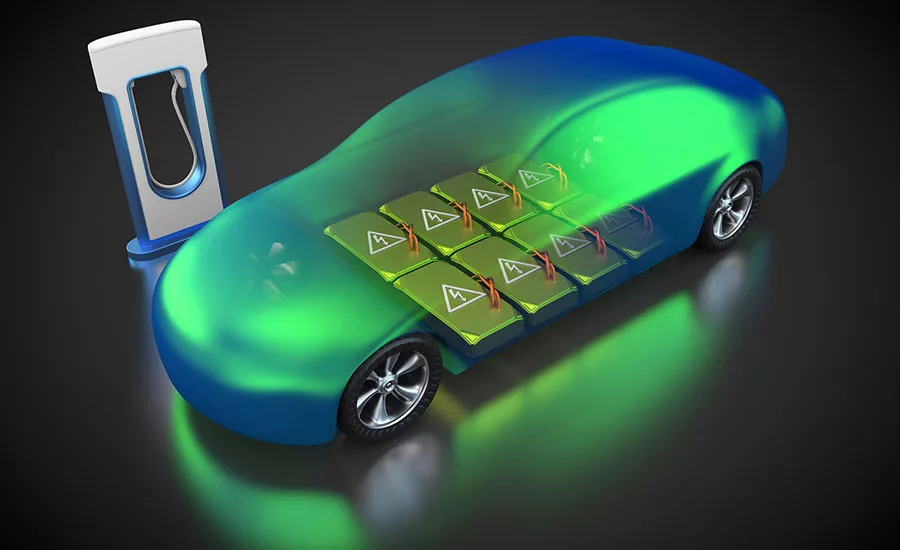
System-on-a-chip technology processes sensing data from a variety of critical devices used in autonomous and electric vehicles, including battery management systems.
Illustration courtesy Renesas Electronics Corp.
Automakers around the world depend on semiconductors and other advanced components made by Renesas Electronics Corp. The devices form the backbone of numerous electrification initiatives and advanced driver assistance systems (ADAS).
The company’s system-on-a-chip (SoC) technology processes sensing data from a variety of critical devices used in autonomous and electric vehicles, including battery management systems, cameras, radars and LiDARs, in addition to global navigation satellite systems. Renesas also produces products such as Si-IGBTs (silicon insulated gate bipolar transistors), which are used in next-generation EV inverters.
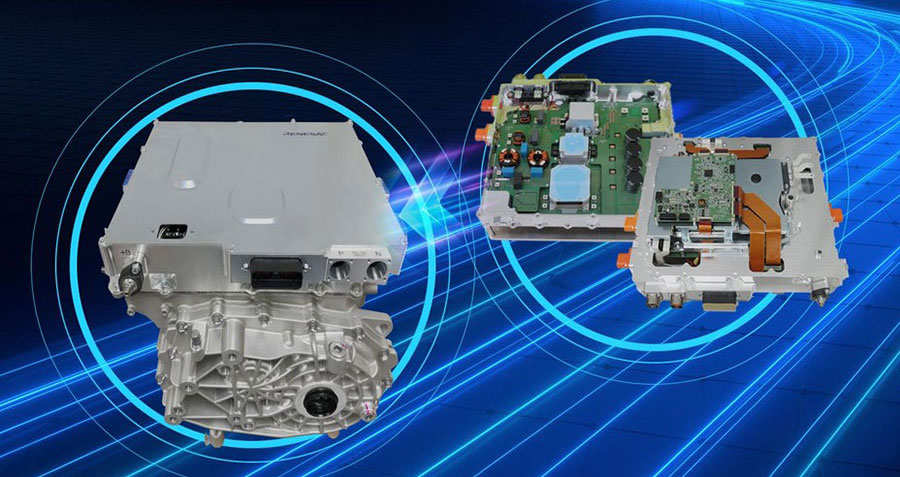
Renesas recently developed a new e-axle system that significantly reduces the number of components, cost and size. Illustration courtesy Renesas Electronics Corp.
The company’s R-Car V4M and R-Car V4H series of devices deliver robust AI processing capability and fast CPU performance, while carefully balancing performance and power consumption. They are designed for entry-level, cost-sensitive ADAS applications such as front smart camera systems, surround-view systems, automatic parking and driver monitoring systems.
“We are extending our offerings to meet the increasing demand for Level 1 and Level 2 ADAS solutions for mass-market vehicles,” says Aish Dubey, vice president and general manager for high performance computing at Renesas. “At the same time, we are developing our new fifth generation R-Car SoCs, which will further bolster our offerings in ADAS, cockpit, gateway and infotainment segments. We are committed to offer the broadest range of automotive embedded processor solutions for all vehicle classes—from entry-level to luxury-class models—all under a single development platform.”
Renesas is also focusing on helping OEMs create software-defined vehicles (SDVs). In fact, at last month’s Consumer Electronics Show in Las Vegas, it signed an agreement with Honda Motor Co. to develop high-performance SoC technology for SDVs. The new SoC is designed to deliver leading-edge AI performance combined with world-class power efficiency. It will be used in Honda’s next-generation O Series of EVs that are due to go into production next year.
The SDV technology will be optimized for each individual motorist. The EVs will feature a centralized electrical and electronic architecture that combines multiple electronic control units (ECUs) responsible for controlling vehicle functions into a single ECU.

Renesas supplies semiconductors that are used for a variety of advanced driver assistance system applications. Illustration courtesy Renesas Electronics Corp.
“The core ECU, which serves as the heart of the SDV, manages essential vehicle functions such as ADAS and automated driving, power train control and comfort features, all on a single ECU,” explains Dubey. “To achieve this, the ECU requires a SoC that provides higher processing performance than traditional systems, while minimizing any increase in power consumption.”
Looking for quick answers on assembly and manufacturing topics? Try Ask ASM, our new smart AI search tool. Ask ASM
Renesas also recently unveiled the world’s first “8-in-1” proof of concept for e-axle systems, which controls eight functions using a single microcontroller. Developed in collaboration with Nidec Corp., it integrates a motor, a gear (reduction gear), an inverter, a DC/DC converter and an on-board battery charger.
Having a single ECU manage an electric power train control unit will help lower the weight and cost of the system, reducing the number of components.
“[We are] committed to providing comprehensive systems, including reference designs and software to accelerate EV development,” Chris Allexandre, senior vice president and general manager of power at Renesas. “[Our] broad range of power management products work together with our digital products to provide complete, ready-to-use, system-level solutions. This approach enables [us] to help customers accelerate their development and time to market.”
Renesas is headquartered in Tokyo and operates seven state-of-the-art factories in Japan, in addition to other facilities in China and Malaysia. Its North American operations are based in Silicon Valley.
Autonomous & Electric Mobility recently asked Tetsuji Tsuda, senior manager for software engineering, power systems and automotive solution marketing, to explain how Renesas is developing new technology for electrification and ADAS applications.
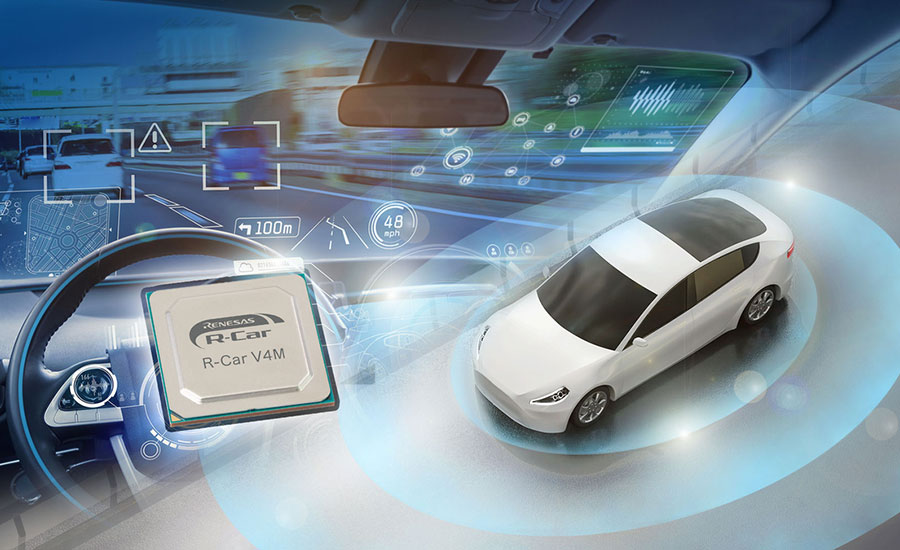
Renesas devices deliver robust AI processing capability while carefully balancing performance and power consumption. Illustration courtesy Renesas Electronics Corp.
AEM: Why are battery management systems (BMS) important for electric vehicles?
Tsuda: BMS is important to maximize battery performance. It monitors various battery states, most notably charge and health. Accurate estimation of remaining battery charge affects driving range performance and battery life.
Underestimating charge will reduce driving range. Overestimating charge will over-utilize the battery, which will cause it to deteriorate faster. Battery health estimates the current full charge capacity, including variations and degradation, for an accurate current value of the battery health and performance. Accurate charge and capacity estimations are made possible through battery cell voltage measurements by battery management IC (BMIC) and complex S/W processing by microprocessor unit (MCU).
Renesas provides high-precision BMICs with +/-2 millivolt cell voltage measurement accuracy in all voltage and temperature variations. New products that have more accuracy and functionality are also under development.
AEM: How is Renesas tackling advanced driver assistance systems technology?
Tsuda: ADAS is moving toward fully autonomous driving. To support this move, a large number of sensors, such as cameras, radar and LiDAR must be connected and controlled using high-compute devices, such as our R-Car SoC.
We recently introduced a fifth-generation SoC product (R-Car X5H). It is the first 3 nanometer automotive-grade SoC that can serve multiple automotive domains, including ADAS in-vehicle infotainment, and gateway applications on a single-chip. It offers the highest level of integration and performance in the industry, allowing OEMs and Tier 1s to shift to centralized electronic control units for streamlined development and future-proof systems.
R-Car X5H offers highly integrated, secure processing solutions on a single chip for multiple automotive domains, thanks to its unique hardware-based isolation technology. Additionally, the new SoC offers the option to expand AI and graphics processing performance using chiplet technology.
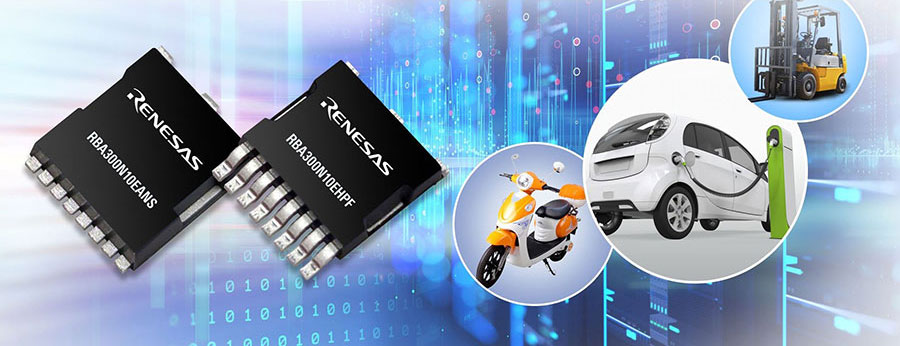
A variety of electric vehicles rely on advanced semiconductor technology. Illustration courtesy Renesas Electronics Corp.
AEM: What is the function of e-axles in electric vehicles?
Tsuda: An e-axle combines a drive motor, a gear and an inverter. By integrating multiple functions, it can reduce system size and weight, simplifying EV design. Packaging makes [our new] unit smaller and lighter, resulting in benefits such as space savings, improved power consumption and lower costs.
Renesas provided key components, including semiconductors and a reference design for the new 8-in-1 e-axle system.
While generally each function of an e-axle requires a dedicated microcontroller unit and a power management IC (PMIC) to control an X-in-1 system, [our] e-axle system can operate with only one MCU and a PMIC to control the entire 8-in-1 system. By systematically integrating these functions with a single MCU, [we] significantly reduced the number of components, cost and size.
AEM: What type of e-axles are OEMs looking for today?
Tsuda: Automakers are looking for e-axles [that include] on-board chargers and DC-DC converters. This structure is called X-in-1 (that is, the X functions are integrated into one box). Renesas plans to deliver turnkey semiconductor products for various X-in-1 systems based on the recent proof of concept design. Armed with this, [automotive engineers] can implement and evaluate X-in-1 systems instantly, accelerating EV development.
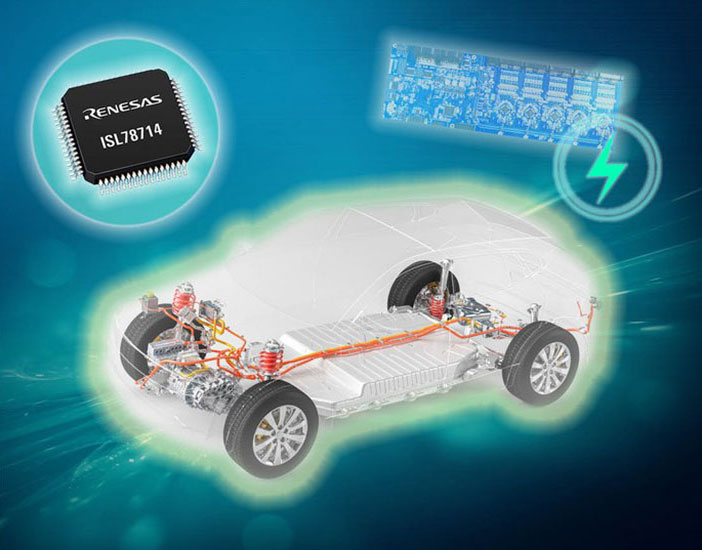
Renesas provides complex device driver software for EV battery management systems. Illustration courtesy Renesas Electronics Corp.
AEM: Why is there a growing need for smaller and lower cost e-axle systems?
Tsuda: Smaller e-axle systems are needed to expand the in-cabin space and the option of automotive shape for [consumers]. Our [system] consolidated each MCU into one unit. This enables our customers to reduce the number of parts, including PMICs, peripheral circuits and boards.
AEM: Where do you see EV microcontroller technology headed during the next five years?
Tsuda: Renesas’ key asset in the future will be 28-nanometer embedded flash, as more capacity is needed for the fusion of multiple functions into a single MCU. A future trend is to further shrink the nonvolatile memory technology node for an improved integration-level of cutting-edge features, such as AI. Another trend is enhanced energy efficiency based on low-power designs. As EVs aim for longer ranges, MCUs will focus on reducing power consumption through advanced power management techniques and low-power modes.
In the future, there will be an increased need for optimized algorithms. More efficient algorithms will maximize energy usage for motor control. Power conversion for new gallium nitride technology will be realized with new and improved hardware concepts.
Integrated resolver-to-digital converter technology will also enable high-precision control of motors at high speeds. There is a trend toward smaller motors, especially for X-in-1. And, they tend to rotate at higher speeds as motors become smaller.
Looking for a reprint of this article?
From high-res PDFs to custom plaques, order your copy today!