Automotive Industry
New Steel Alloy Helps Automakers Design Lightweight Chassis Parts
New alloy has better edge ductility to prevent cracking during stamping.

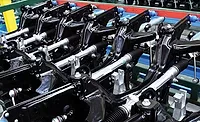
Tata Steel Nederland has developed a new hot-rolled steel alloy, CP800 HyperFlange, that will enable automotive engineers to design lighter, stronger chassis, ladder frames and suspension parts. Photo courtesy Tata Steel
IJMUIDEN, Netherlands—Tata Steel Nederland has developed a new hot-rolled steel alloy, CP800 HyperFlange, that will enable automotive engineers to design lighter, stronger chassis, ladder frames and suspension parts.
To reduce vehicle weight, engineers are increasingly using ultra high-strength steel alloys. These alloys have a yield strength of 800 megapascals (MPa) and are approximately 15 percent lighter than HR420LA, a high-strength, low-alloy hot-rolled steel that is often used in the auto industry.
However, making chassis parts with these higher strength alloys entails complex shapes with deeper holes and more intricate flanges, compensating for the use of thinner material in terms of stiffness and durability. These innovative designs place substantial demands on the material, posing increasing challenges for manufacturability. In particular, edge-cracking is a common pain point of press shops when forming chassis parts.
To prevent edge-cracking, engineers need materials with so-called “edge ductility.”
“Current high ductile steels rely upon their very high hole expansion capacity (HEC), but they can still encounter edge failures during forming, implying that there is a critical factor for the required edge ductility beyond HEC: fracture toughness,” explains Arjan Rijkenberg, Ph.D., principal scientist for high-strength strip steels at Tata Steel. “Understanding the pivotal role of fracture toughness in achieving true edge ductility, we conducted a research into the relationship of HEC and fracture toughness. Our findings played a pivotal role in the development of HyperFlange.”
Tata Steel developed two in-house tests to assess crack susceptibility and measure the fracture toughness of steels. These tests indicate the higher fracture toughness of CP800 HyperFlange compared to standard HSLA HR700LA. In combination with its HEC of 70 percent, this results in superior edge ductility for chassis parts. Deep drawing tests indicate that CP800 HyperFlange has significantly higher resistance to crack growth than HSLA HR700LA.
“We have optimized our steels to enhance edge ductility,” says Moe Ziaran, marketing manager for automotive chassis and components at Tata Steel. “This translates to fewer edge cracks, minimized material wastage, and reduced production line interruptions. As a result, chassis engineers can have confidence that their advanced lightweight designs will not only pass simulations but can also be reliably manufactured.”
The HyperFlange alloy is available in large width and thickness ranges. A galvanized variant is in development.
Looking for quick answers on assembly and manufacturing topics? Try Ask ASM, our new smart AI search tool. Ask ASM
Looking for a reprint of this article?
From high-res PDFs to custom plaques, order your copy today!