Human-Robot Collaboration Process Enables Remote Manufacturing
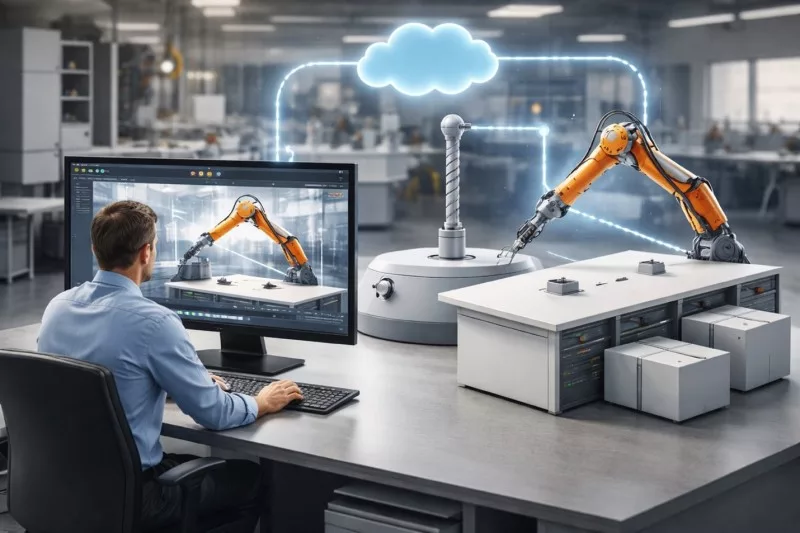
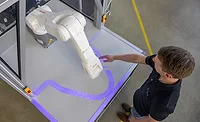
A new remote manufacturing system allows people to perform tasks and operate production equipment from anywhere. Illustration courtesy Florida Atlantic University
BOCA RATON, FL—Engineers at Florida Atlantic University (FAU) have developed a remote manufacturing system that allows people to perform tasks and operate production equipment from anywhere, addressing a critical gap in traditional automation. They recently received a U.S. patent for the breakthrough technology, entitled “Adaptive Cyber Manufacturing (ACM) Through Online Human-AI Partnerships.”
The system enables workers to operate facilities remotely through sensors, cameras and an online platform, similar to a video conference on Zoom or Google Meet, enabling seamless collaboration with robotic systems from any location.
“It dynamically adapts tasks and workloads based on individual user performance and experience level, including support for less-experienced workers,” says Mehrdad Nojoumian, Ph.D., an associate professor of electrical engineering and computer science at FAU who developed the system. “Predictive models reduce delays in human-machine interaction, helping ensure smoother, more responsive operation in remote manufacturing environments.
“ACM represents a new paradigm in which human workers and artificial intelligence-driven systems collaborate remotely through real-time, online partnerships to perform complex manufacturing tasks,” explains Nojoumian.
“This approach supports a more flexible and distributed manufacturing model, while maintaining performance and reliability over long working hours,” Nojoumian points out. “It also introduces a pathway for organizations to retain advanced manufacturing capabilities domestically, while expanding access to a broader, global workforce.
“ACM could pave the way for a new era of human-robot collaboration in manufacturing, where high-value jobs remain in industrial countries without sacrificing productivity or efficiency,” claims Nojoumian.
“Advancing human-AI collaboration in manufacturing is essential to building systems that are responsive to real-world conditions,” adds Stella Batalama, Ph.D., dean of the college of engineering and computer science at FAU. “The future of manufacturing will be driven by intelligent systems that adapt to people—enhancing performance while maintaining human oversight in complex decision-making.
“Nojoumian’s work presents a new model for real-time integration of human input with AI-driven systems, targeting industries where precision, adaptability and oversight are critical,” says Batalama.
Looking for quick answers on assembly and manufacturing topics? Try Ask ASM, our new smart AI search tool. Ask ASM
Looking for a reprint of this article?
From high-res PDFs to custom plaques, order your copy today!