CNH Enhances Ergonomics With AI Technology
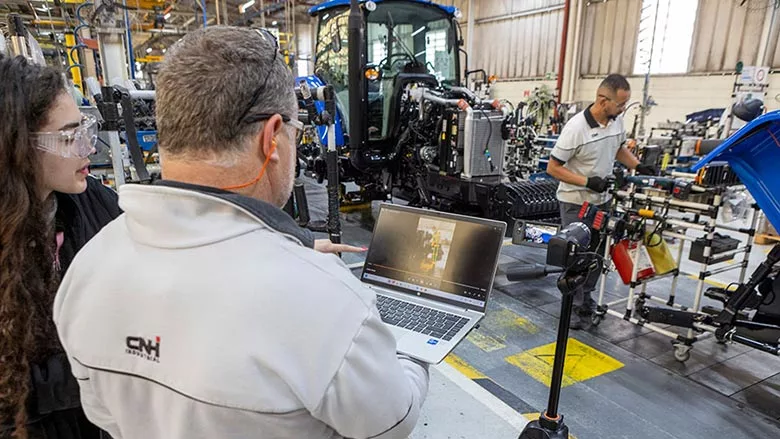
Moreli Roika, an ergonomist, and Vanessa Martins, an occupational physiotherapist, capture images of the workstations at the Curitiba plant.
Photo courtesy CNH Industrial
At CNH, our people are our most valuable asset, and we are always seeking new ways to improve their workplace experience.
One way we are making a meaningful impact with innovation is through ergonomic analysis at our production sites.
This is how our Curitiba ergonomics management project began. Leveraging the capabilities of artificial intelligence (AI) to streamline processes, we developed a cutting-edge model for analyzing ergonomics during a working shift at our Curitiba, Brazil, assembly plant, where we make combines and tractors for our Case IH and New Holland brands.
In partnership with Brazilian startup Kinebot, an ergonomic assessment technology company, we created a unique tool that captures, classifies and processes human movements, accurately identifying potential ergonomic problems. Our shop-floor employees took part in the project, helping to improve the accuracy of AI mapping. The data collected during the assessment was linked exclusively to the workstation to assess and improve the work environment, rather than evaluating individual employees. This results in the development of more suitable workstations for all operators.
Kinebot is a software tool for ergonomics assessment and management. To use the software, engineers record a worker’s activity at a workstation using the app or a camera. The video is then uploaded to the Kinebot platform. After uploading, an AI algorithm will recognize and evaluate all of the worker’s movements. The software extracts 30 angles per second per body part.
The software features tools for assessing specific work activities, such as lifting, material handling, and pushing and pulling. Engineers enter parameters, such as the weight of an object being lifted. The software then issues a report on the ergonomic risks for that activity. The software provides all the necessary information to generate an ergonomic work analysis (EWA) in compliance with ISO 20.646 standards.
The software also provides action plans. Engineers can organize corrections to be implemented, in order of priority. Action plans can be customized with information about each task, including deadlines, department, person in charge, activity and other information. This supports tracking and decision-making. All responsible parties are notified of progress via email alerts.
Looking for quick answers on assembly and manufacturing topics? Try Ask ASM, our new smart AI search tool. Ask ASM
With analysis done, engineers can use the software for ergonomic risk mapping using easy-to-read graphs. Ergonomics dashboards can be customized to fit specific data analysis needs.
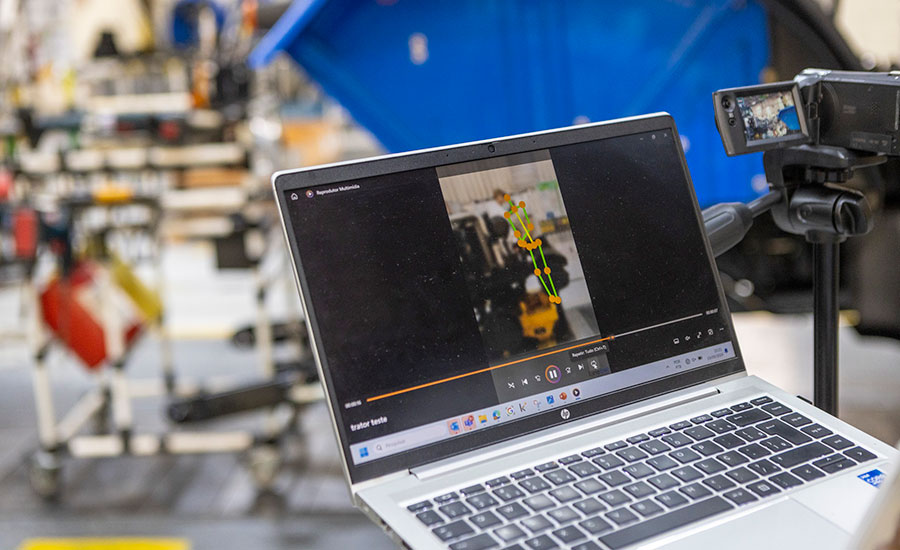
After downloading the images, the software uses artificial intelligence to capture workers’ movements through avatars. Photo courtesy CNH Industrial
The Results
Since implementing the Kinebot technology, the average time CNH engineers spent on analyzing and processing postures in the workplace has decreased from three hours to 30 minutes.
Before the implementation of AI, our specialists spent most of their time conducting ergonomic analysis. With the system’s implementation, the time required for analysis decreased by 75 percent, allowing our team to focus on implementing, adapting and managing ergonomic risks at workstations.
Since implementing the system, absences due to orthopedic issues have fallen by some 200 days per year.
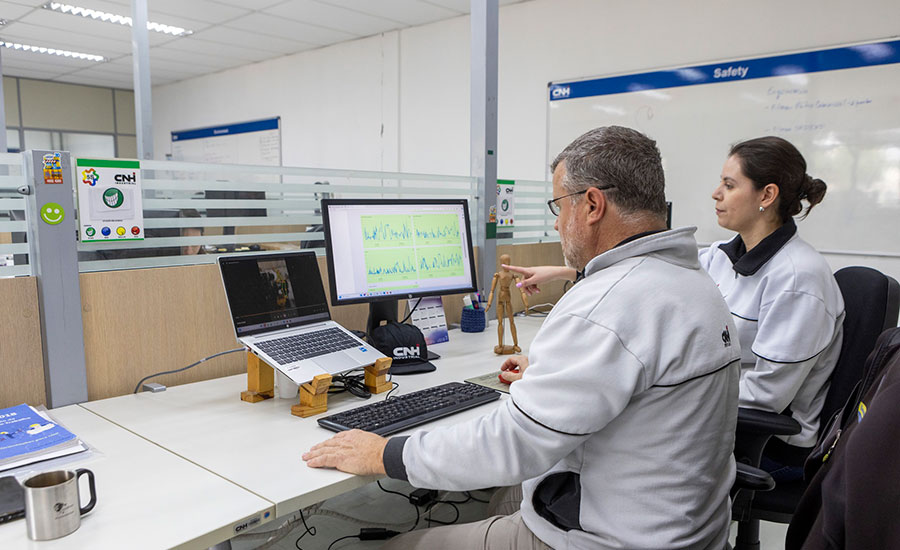
In the office, the ergonomics team receives the automatic analysis generated by the tool and works on the action plan and corrections for the workstations with greater speed and accuracy. Photo courtesy CNH Industrial
“This project offers various benefits for employees,” says Fabio Belasco, environment health and safety manager for Latin America at CNH. “The automation of ergonomic analysis allows for continuous and real-time evaluation of workers’ movements and postures, significantly reducing potential ergonomic issues at workstations. With the use of artificial intelligence, suboptimal posture patterns were identified, and improvement interventions can be made proactively, promoting a safer and healthier work environment.
“Furthermore, this technology provides a more accurate and unbiased approach, increasing the efficiency of assessments. The use of AI also speeds up the entire process, as evaluations are conducted automatically.”
Projects such as this reinforce our commitment to health and safety, while improving efficiency and productivity.
Canada Project
Similar initiatives have been running across other sites in North America, including Saskatoon, Canada, where we make sprayers, planters and seeders for our Case IH and New Holland brands. In Canada, legislation requires companies to lead ergonomics programs in collaboration with unions and works councils to reduce musculoskeletal injuries. We took that requirement one step further, partnering with Soter Analytics, a global safety technology company.
In Saskatoon, wearable devices from Soter are used to monitor and track an operator’s range of spine and shoulder movements. Intelligence gathered from these devices helps us to adjust our processes to make them more ergonomic. The data collected only looks at movements and does not require any personal information to be entered, ensuring it is fully anonymous.
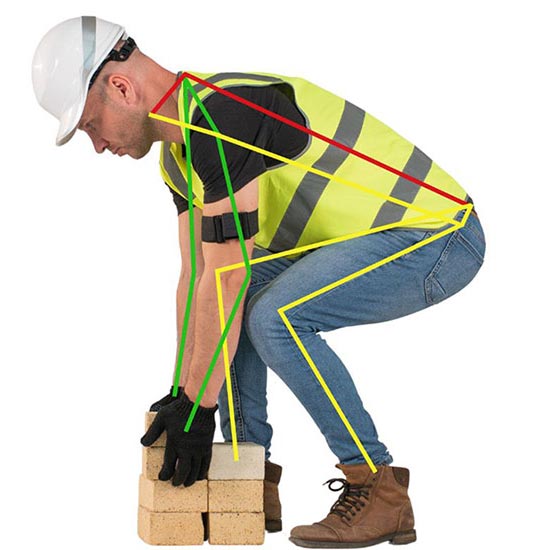
Through wearable sensors and a smartphone app, the Soter Coach system provides workers with feedback and guidance on safer, more ergonomic movement. Photo courtesy CNH Industrial
For example, to prevent shoulder injuries, a worker wears a small sensor on an armband for two weeks. The sensor looks for the five most common issues that lead to shoulder injuries: arm elevation, pushing and pulling, static arm elevation, repetitive arm movements, and overexertion. When workers perform a task incorrectly, smart algorithms analyze their back and shoulder positions in real time, providing audible and tactile feedback to alert them to the hazardous movement.
The sensor also sends performance data to a smartphone app. Once a day, during breaks or at the end of a shift, workers can log into the app to see how they’re doing. In three to five minutes, they can check their progress and engage in the micro-learning tutorials featuring personalized insights based on their individual data and exposure to risk. Biofeedback, in conjunction with ergonomics coaching, teaches workers the right manual handling behavior, helping them avoid the most common and costly injuries.
Following a successful trial in 2022, our North American assembly plants in Burlington, IA; Benson, MN; Fargo, ND; and New Holland, PA, have also implemented these devices.
For more information on AI-based ergonomic assessment tools, visit https://kinebot.com.br or https://soter.com.
For more information on manufacturing at CNH, read these articles:
Virtual Reality Systems Streamline Prototyping at CNH Global
Software Analyzes Fastening Data
Machinery Makers Invest in Automation
Looking for a reprint of this article?
From high-res PDFs to custom plaques, order your copy today!