Assembly Magazine logo
search
Ask ASSEMBLY AI
cart
facebook twitter linkedin youtube
  • Sign In
  • Create Account
  • Sign Out
  • My Account
Assembly Magazine logo
  • TRENDS
    • Ask ASSEMBLY AI
    • Trends
    • News
    • New Products
  • INDUSTRIES
    • Aerospace
    • Appliance
    • DFMA Assembly
    • Medical Devices
    • Green Manufacturing
    • Lean Manufacturing
    • Machinery Assembly
    • Electronics Assembly
    • Automotive
  • TECHNOLOGIES
    • Adhesives & Dispensing
    • Assembly Presses
    • Automated Assembly Systems
    • Manufacturing Management
    • Manufacturing Software
    • Motion Control
    • Screwdriving & Riveting
    • Robotics
    • Test & Inspection
    • Plastics & Metal Welding
    • Wire Processing
    • Workstations
  • AUTONOMOUS & ELECTRIC MOBILITY
    • AEM Magazine Archives
    • Autonomy
    • Electrification
    • Mobility Services
    • Assembly & Testing
    • AV/EM News
  • MEDIA
    • Ask ASSEMBLY AI
    • Podcasts
    • Assembly News Now
    • Assembly TV
    • Webinars
    • eBooks
  • EVENTS
    • Calendar
    • The ASSEMBLY Show
  • MORE
    • Exclusives >
      • Plant of the Year
      • Capital Spending
    • Buyers Guide >
      • Supplier Insights
    • Classifieds
    • Featured Products
    • Newsletters
    • Store
    • White Papers
    • Columns
    • Sponsor Insights
  • INFOCENTER
    • Assembly & Test Solutions
  • EMAGAZINE
    • eMagazine
    • Archive Issues
    • Advertise
    • Contact Us
    • Sign Up
TechnologiesAppliance AssemblyAutomotive AssemblyMedical Devices AssemblyElectronics AssemblyPlastics & Metal Welding Assembly

New Process Joins Plastic to Metal
By John Sprovieri
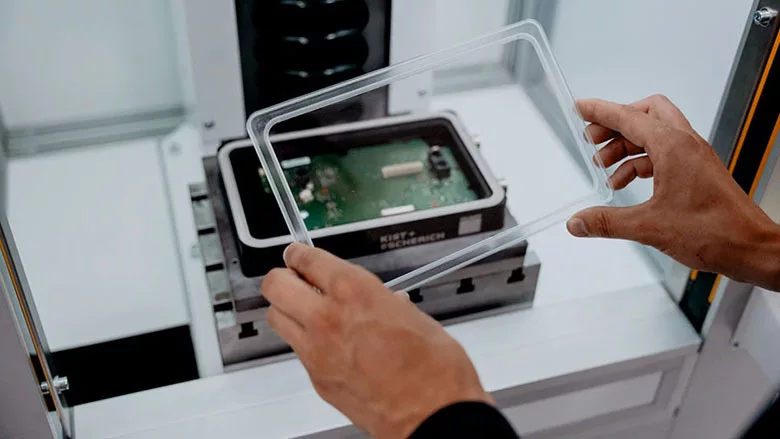
attaching a plastic cover to a metal housing
Photo courtesy Kist + Escherich

The HyJoin process is used to attach this plastic cover to a metal housing. Screws or gaskets are not needed.

August 16, 2025

Engineers have many options for joining plastic parts to plastic parts or metal parts to metal parts. However, when joining plastic parts to metal parts, engineers have fewer choices. 

Now, German company Kist + Escherich has developed an innovative new process, HyJoin, that can join plastic parts to metals without adhesives or fasteners.

The HyJoin process can be used to create both spot joints and media-tight seam joints. 

The process can be used on a variety of thermoplastics, including polyamide, polypropylene, polyethylene, polyphenylene sulfide, polyaryletherketone, polyoxymethylene, polycarbonate and thermoplastic polyurethane. The plastic can be unreinforced or reinforced with short or continuous glass or carbon fibers.

The metal component can be aluminum, steel, titanium, magnesium or copper. It can be extruded, cast, sintered or additively manufactured. It can be coated or uncoated. However, for the process to work, the area to be joined on the metal part must get an ablative pretreatment to roughen its surface.

To start the HyJoin process, the metal part is selectively heated in the joining area through electromagnetic induction. Embedded in the upper joining die, the inductive coil is energized by a high-frequency alternating current. Simulations and laboratory tests are used to optimize the design of the coil.

Subsequently or simultaneously during heating, the plastic part is pressed together with the metal part. The plastic reaches the glass transition temperature and melts at the contact area, flowing into microscopic nooks and crevices created in the metal part by the ablative pretreatment. After cooling, the plastic solidifies and becomes mechanically interlocked with the metal part.

Looking for quick answers on assembly and manufacturing topics? Try Ask ASM, our new smart AI search tool. Ask ASM →
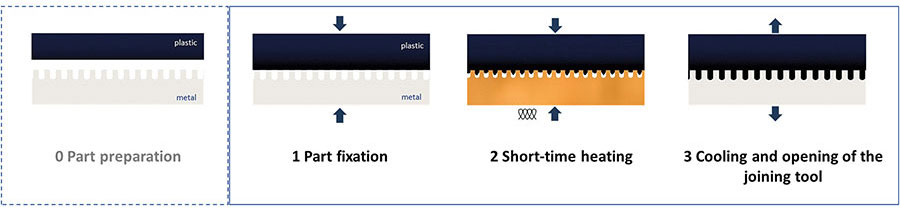
HyJoin process

Prior to assembly, the surface of the metal part must be roughened. To start, the metal part is selectively heated through electromagnetic induction. Next, the plastic part is pressed together with the metal part. The plastic melts at the contact area, flowing into microscopic crevices in the metal part. After cooling, the plastic solidifies and becomes mechanically interlocked with the metal part. Photo courtesy Kist + Escherich

The key parameters of the process are joining force, collapse distance, heating power and heating time.

HyJoin creates assemblies with lasting stability and high load-bearing capacity. Joints created through the process are comparable in strength to those created with structural adhesives. Unlike adhesive bonding, however, the HyJoin process is easily automated and only takes a few seconds. In addition, integrated force and stroke monitoring makes accurate process control possible, enabling the system to compensate for component tolerances and minimize joining times.

Another advantage of the HyJoin process is its reversibility. The connection can be undone with little damage to the parts, which makes for easy repairs or recycling of materials at the end of their service life. 

The flexible process can be used on small assemblies or large, complex structures. Applications abound in the automotive, electronics, appliance and medical device manufacturing industries.

Electrical equipment manufacturer Conductix-Wampfler is using the HyJoin system to connect copper-graphite sliding contacts with plastic insulation. The fully automated process assembles a sliding contact every 10 seconds. A six-axis robot loads parts from trays into fixtures around a rotary-indexing dial. After assembly, the parts are cooled and tested before a second robot unloads them. 

Another application is actively cooled plastic housings for energy storage, sensors or electronics. In this application, the HyJoin process is used to join a metallic heat sink with a plastic part. This obviates the need for screws or gaskets in the assembly. It also lets engineers reduce the width of the joining flange and therefore make the design more compact. At the end of the product’s life cycle, the connection can be thermally separated for recycling.
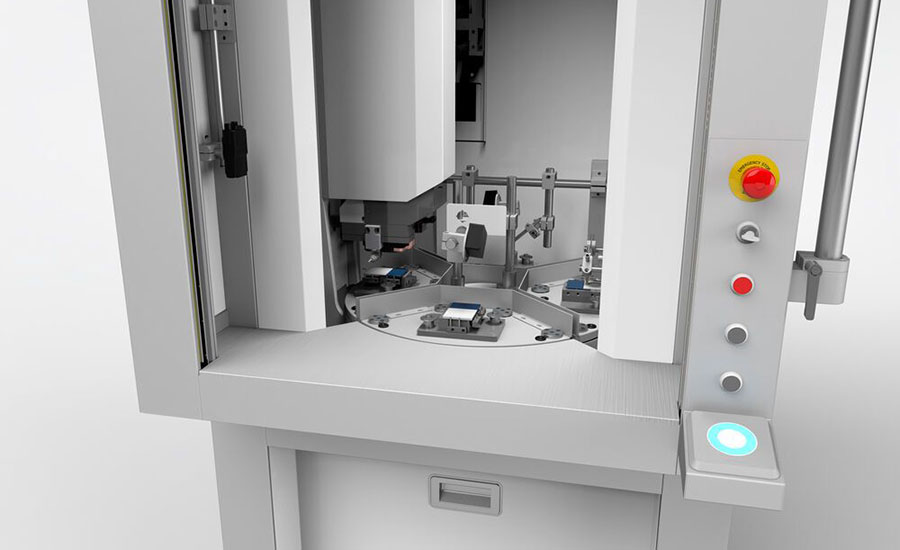
 

GiroJoin automated assembly cell

GiroJoin is a preconfigured automated assembly cell equipped with a rotary indexing table. Parts can be loaded manually or robotically. Photo courtesy Kist + Escherich

Equipment Options

Compact and modular, the HyJoin system can be operated as a standalone, semiautomatic process, or it can be integrated into an automated assembly line.

The main joining module is available in two versions: one with a maximum pressing force of 5 kilonewtons and the other with a maximum force of 10 kilonewtons. Maximum stroke length is 200 millimeters, and ram speed peaks at 100 millimeters per second. 

By itself, the module can join parts as large as 150 by 150 millimeters. Kist + Escherich also offers the module in a preconfigured, semiautomatic workstation, the VarioJoin, that can join assemblies as large as 300 by 200 by 300 millimeters. 

Another option is GiroJoin, a preconfigured automated assembly cell equipped with a rotary indexing table. Parts can be loaded manually or robotically. 

GiroJoin is available in two sizes. A cell with a table 600 millimeters in diameter can accommodate four stations and assemblies as large as 80 by 150 millimeters. A cell with a table 900 millimeters in diameter can accommodate six stations and assemblies as large as 150 by 200 millimeters. 

Optional equipment for VarioJoin and GiroJoin includes:

  • Sensors to detect when parts are present.
  • A controller that can store multiple process “recipes.”
  • A process monitoring system for quality assurance.
  • An interface to link the machine with MES software.

For more information on the HyJoin process, click www.kist-escherich.com.
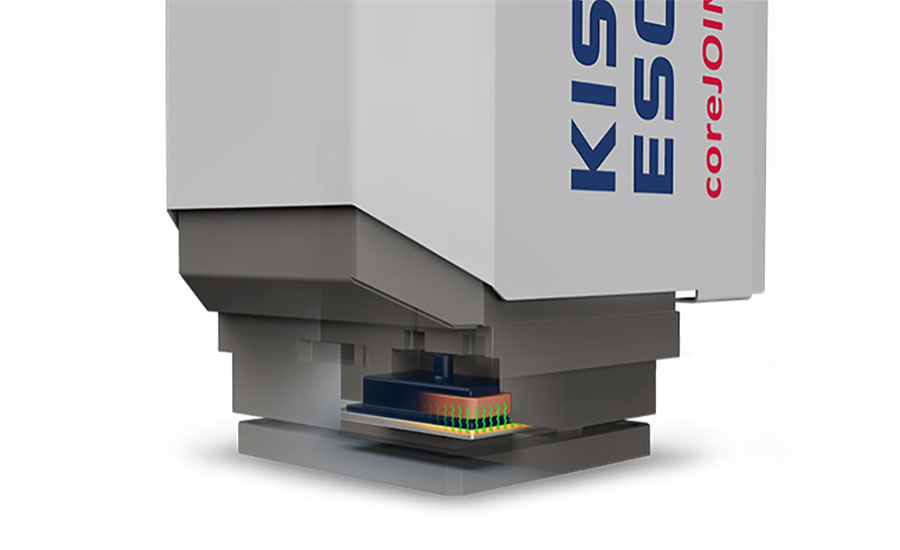
HyJoin process

The key parameters of the HyJoin process are joining force, collapse distance, heating power and heating time. Photo courtesy Kist + Escherich

See more articles from our September 2025 issue!

For more information on mixed-material assembly methods, read these articles:

New Process Enables Adhesive-Free Joining of Metal and Wood
New Techniques for Joining Plastic to Metal
New Techniques for Joining Steel and Aluminum

KEYWORDS: mixed material joining plastics assembly

Share This Story

Looking for a reprint of this article?
From high-res PDFs to custom plaques, order your copy today!

John has been with ASSEMBLY magazine since February 1997. John was formerly with a national medical news magazine, and has written for Pathology Today and the Green Bay Press-Gazette. John holds a B.A. in journalism from Northwestern University, Medill School of Journalism.

Recommended Content

JOIN TODAY
To unlock your recommendations.

Already have an account? Sign In

  • Made in the U.S.A.

    Consumer Products Manufacturing: Made in the USA

    Supply chain lessons learned during the coronavirus...
    Automated Assembly Systems
    By: Austin Weber
  • Best Practices for Press-Fit Assembly

    Best Practices for Press-Fit Assembly

    In manufacturing, ironclad formulas for success are hard...
    Assembly Presses
    By: Jim Camillo
  • aem0523leader-tesla1.jpg

    Tesla Rethinks the Assembly Line

    Engineers at Tesla Inc. have developed a new process that...
    Industries
    By: Austin Weber
Manage My Account
  • eMagazine Subscription
  • Assembly Newsletters
  • Online Registration
  • Subscription Customer Service
  • Manage My Preferences

More Videos

Sponsored Content

Sponsored Content is a special paid section where industry companies provide high quality, objective, non-commercial content around topics of interest to the ASSEMBLY audience. All Sponsored Content is supplied by the advertising company and any opinions expressed in this article are those of the author and not necessarily reflect the views of ASSEMBLY or its parent company, BNP Media. Interested in participating in our Sponsored Content section? Contact your local rep!

close
  • ultrasonic welding
    Sponsored bySonobond Ultrasonics

    Engineering Efficiency in High-Performance Assembly: How Ultrasonic Welding Enhances Throughput, Reliability and Quality

  • UV curing system
    Sponsored byDymax

    Why UV Intensity Alone Doesn’t Define Curing Performance

  • wooden pallets
    Sponsored byLEAN Manufacturing Products

    Eliminating Waste on the Shop Floor: Applying Lean Principles to Improve Manufacturing Efficiency

Popular Stories

ASSEMBLY News Now, episode-30: Volvo Redesigns EV Manufacturing

Volvo Redesigns EV Manufacturing

Boeing CEO Kelly Ortberg announces 1 billion investment

Boeing Plans $1 Billion Wichita Investment, Workforce Training Center

GE Appliances Worker on Line

GE Appliances Expands Factory AI With 800 Gemini Enterprise Agents

Watch the latest episode of ANN now!

Events

July 24, 2025

From Shop Floor to CFO: How Manufacturers Are Closing the Loop Between Operations and Finance

On Demand Learn how manufacturers are bridging the gap between the shop floor and ERP systems to gain real-time visibility, streamline operations, and kick-start digital transformation—without waiting years.

Sponsored by:

PicoStratusGreen
July 30, 2025

Buffer Analysis and Design Fundamentals for Manufacturing Excellence

On Demand In this presentation, Dr. Herman Tang shares practical insights from his industry experience and research on buffer management in manufacturing operations.

View All Submit An Event

Poll

Difficult Assembly Processes

Which assembly process gives you the most difficulty?
View Results Poll Archive

Products

Manufacturing Cost Policy Deployment (MCPD) Profitability Scenarios: Systematic and Systemic Improvement of Manufacturing Costs

Manufacturing Cost Policy Deployment (MCPD) Profitability Scenarios: Systematic and Systemic Improvement of Manufacturing Costs

See More Products
Register for webinar - Modernizing Automotive Assembly: Why Upgrading Legacy MES is a Business Imperative

Related Articles

  • New Process Joins Aluminum and Steel Parts

    New Process Joins Aluminum and Steel Parts

    See More
  • New Techniques for Joining Plastic to Metal

    See More
  • New GM Welding Process Joins Steel to Aluminum

    See More

Related Products

See More Products
  • leaner

    Leaner Manufacturing: How to Make the Lean Production Process Easier, Faster, and More Cost-Effective

  • 0001346.jpeg

    Designing Plastic Parts for Assembly 9E

  • robustplastic.jpg

    Robust Plastic Product Design: A Holistic Approach

See More Products

Related Directories

  • NoMuda VisualFactory

    NoMuda VisualFactory helps the world’s largest manufacturers implement the fastest, safest, lowest cost process to ensure right-first-time quality. Our customers gain control over their shop floor operations with 20% productivity increases whilst eliminating manufacturing errors and providing real-time visibility of production status to the Shop Floor and Management.
×

Never miss the latest news and trends driving the manufacturing industry

Stay in the know on the latest assembly trends.

JOIN TODAY!
  • RESOURCES
    • Advertise
    • Contact Us
    • Directories
    • Manufacturing Division
    • Store
    • Want More?
  • SIGN UP TODAY
    • Create Account
    • eMagazine
    • Newsletters
    • Customer Service
    • Manage Preferences
  • SERVICES
    • Marketing Services
    • Reprints
    • Market Research
    • List Rental
    • Survey/Respondent Access
  • STAY CONNECTED
    • LinkedIn
    • Facebook
    • Instagram
    • YouTube
    • X (Twitter)
  • PRIVACY
    • PRIVACY POLICY
    • TERMS & CONDITIONS
    • DO NOT SELL MY PERSONAL INFORMATION
    • PRIVACY REQUEST
    • ACCESSIBILITY

Copyright ©2026. All Rights Reserved BNP Media, Inc. and BNP Media II, LLC.

Design, CMS, Hosting & Web Development :: ePublishing