Assembly Lines
Self-Fixturing Technology Could Boost Friction Stir Welding
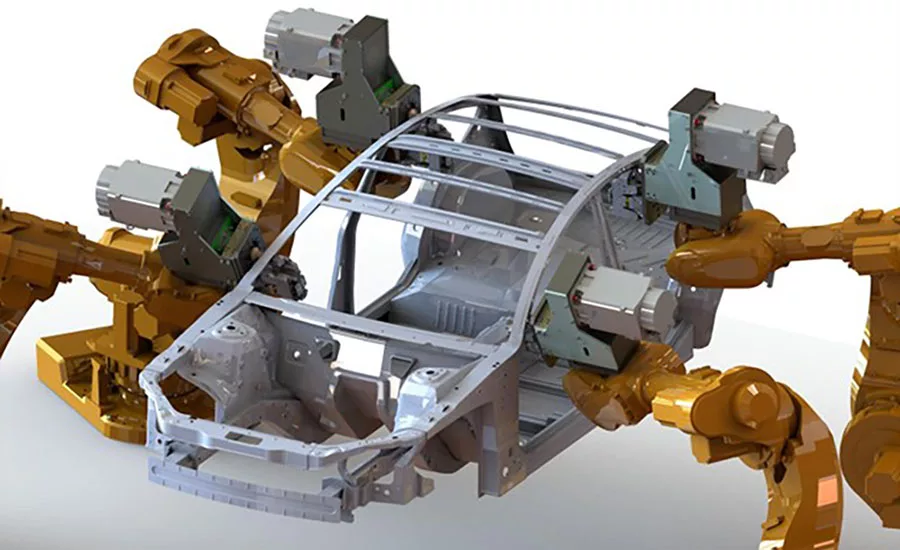
Self-fixturing friction stir welding could enable new applications on automotive assembly lines.
RICHLAND, WA—Engineers at the Pacific Northwest National Laboratory (PNNL) have developed a self-fixturing process for friction stir welding. It uses a robotic arm attachment that includes both the friction stir tool and a miniature backing plate.
The goal of the R&D project is to design a more maneuverable fixturing system that enables manufacturers to mass-produce metal components with lighter materials, stronger welds and lower energy costs.
The new attachment pinches the target material between the friction stir tool and the backing plate, exerting the necessary force and eliminating the need for a separate, custom-shaped anvil.
“If the old approach was an arm holding a pencil, the new approach is an arm holding both a pencil and a clipboard,” says Mitch Blocher, a mechanical engineer at PNNL working on the project.
According to Blocher, friction stir welding requires only a fraction of the energy required by conventional joining techniques, but isn’t used on many assembly lines today. That’s because it exerts tremendous force (up to 5,000 pounds) and something needs to capture that force.
“Currently, the process requires a rigid, perfectly shaped anvil underneath the material being welded,” explains Blocher. “For many assembly lines, that requirement is tough to meet.”
Blocher believes that PNNL’s breakthrough could free friction stir welding from those constraints and open the door for increased use of the joining process.
Looking for quick answers on assembly and manufacturing topics? Try Ask ASM, our new smart AI search tool. Ask ASM
“There is some friction stir welding that’s done in vehicle manufacturing,” notes Piyush Upadhyay, Ph.D., senior materials scientist at PNNL. “But, typically, it’s limited to two flat sheets welded on top of a rigid anvil.”
A decade ago, PNNL worked with several companies, including General Motors, to apply friction stir welding in the production of car doors. The process involved welding flat sheets before stamping them into the 3D shape of a car door. However, Upadhyay says that approach doesn’t work for larger, more complex car parts that can’t simply be stamped into shape, such as roof rails and the metal frames that surround doors.
“If you want to friction stir weld anything that isn’t flat, you’re going to need an anvil in the shape of that part,” Upadhyay points out. “If you’re welding a roof rail, you’ll need a roof rail-shaped anvil. For a real-world assembly line, that’s too cumbersome.
“Many components manufactured for vehicles still rely on spot welding and adhesives for joining applications,” says Upadhyay. “Friction stir tools have been attached to robotic arms in the past, but they always required a separate anvil.
“Self-fixturing friction stir welding, however, uses an attachment for a robotic arm that includes both the friction stir tool and a miniature backing plate,” explains Upadhyay. “[But], there’s still the issue of the thousands of pounds of force exerted by the friction stir tool.
“Because self-fixturing friction stir uses a built-in backing plate, rather than an anvil, the system must not only exert, but also withstand, that force,” notes Upadhyay. “There’s just one problem: most assembly lines don’t employ welding robots that are strong enough to handle that.
“Most of the welding in vehicle manufacturing requires very minimal force, since the material is melted in the process,” claims Upadhyay. “Friction stir welding doesn’t melt the material, so pushing into and across the material requires a significant amount of force.”
Upadhyay and his colleagues are in the process of adding another capability to their self-fixturing friction stir tooling: a hydraulic system that powers the attachment and creates a closed loop for the force it generates. Currently, the hydraulic system can capture the force from the tool pressing or tilting. The engineers are now designing new mechanisms to capture additional degrees of movement and developing a system that allows the attachment to pull material into the tool.
“Once this is perfected, there will be no fixturing, no anvil and no force transmitted into the assembly line,” says Blocher. “The only job of the robot will be to hold the friction stir attachment in place and to maintain the correct position.
“[We plan to] package self-fixturing friction stir into a more ergonomic, industry-hardened form so that the technology can be applied on real-world assembly lines,” adds Blocher.
Looking for a reprint of this article?
From high-res PDFs to custom plaques, order your copy today!