Assembly Magazine logo
search
Ask ASSEMBLY AI
cart
facebook twitter linkedin youtube
  • Sign In
  • Create Account
  • Sign Out
  • My Account
Assembly Magazine logo
  • TRENDS
    • Ask ASSEMBLY AI
    • Trends
    • News
    • New Products
  • INDUSTRIES
    • Aerospace
    • Appliance
    • DFMA Assembly
    • Medical Devices
    • Green Manufacturing
    • Lean Manufacturing
    • Machinery Assembly
    • Electronics Assembly
    • Automotive
  • TECHNOLOGIES
    • Adhesives & Dispensing
    • Assembly Presses
    • Automated Assembly Systems
    • Manufacturing Management
    • Manufacturing Software
    • Motion Control
    • Screwdriving & Riveting
    • Robotics
    • Test & Inspection
    • Plastics & Metal Welding
    • Wire Processing
    • Workstations
  • AUTONOMOUS & ELECTRIC MOBILITY
    • AEM Magazine Archives
    • Autonomy
    • Electrification
    • Mobility Services
    • Assembly & Testing
    • AV/EM News
  • MEDIA
    • Ask ASSEMBLY AI
    • Podcasts
    • Assembly News Now
    • Assembly TV
    • Webinars
    • eBooks
  • EVENTS
    • Calendar
    • The ASSEMBLY Show
  • MORE
    • Exclusives >
      • Plant of the Year
      • Capital Spending
    • Buyers Guide >
      • Supplier Insights
    • Classifieds
    • Featured Products
    • Newsletters
    • Store
    • White Papers
    • Columns
    • Sponsor Insights
  • INFOCENTER
    • Assembly & Test Solutions
  • EMAGAZINE
    • eMagazine
    • Archive Issues
    • Advertise
    • Contact Us
    • Sign Up
TechnologiesLean Manufacturing AssemblyWorkstations Assembly

See it at the Show

Custom Workstations Improve Ergonomics
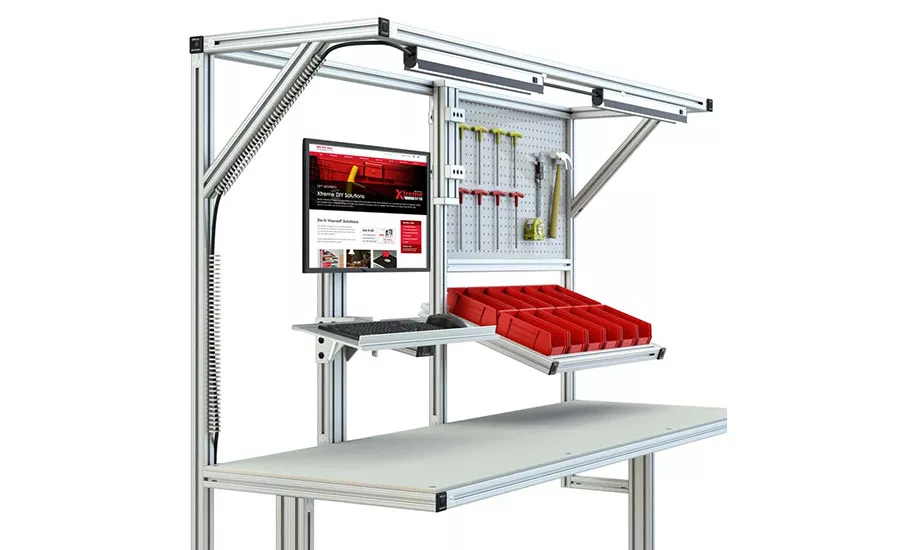
By John Sprovieri
ergonomic workstation
Photo courtesy 80/20

Studies demonstrate that ergonomic work environments increase productivity by 25 percent and lower absenteeism by 75 percent.
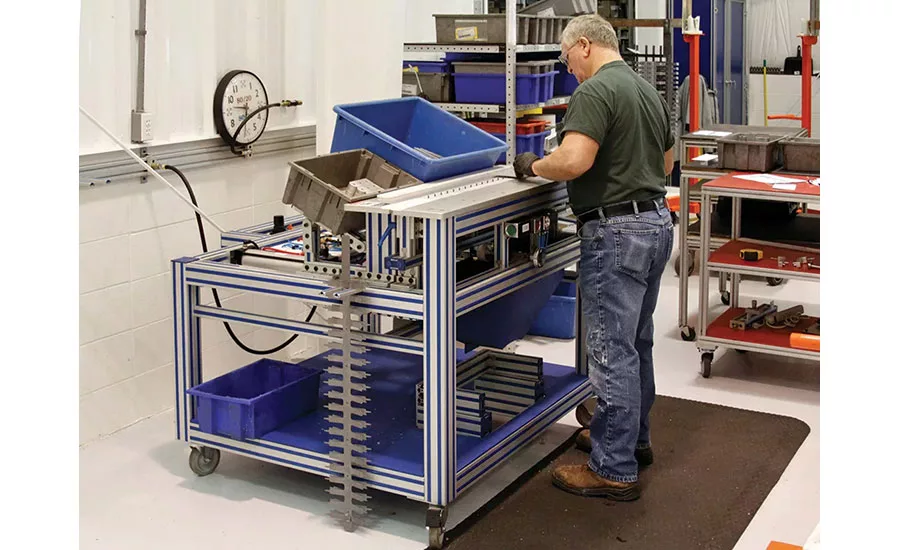
ergonomic workstation
Photo courtesy 80/20

Engineers should consider who will be using the workstation and how. Will the work be done sitting or standing? Will different people use the workstation over the course of a workday?

ergonomic workstation
December 30, 2025

According to the Centers for Disease Control and Prevention, U.S. employers lose an estimated $225.8 billion annually due to absenteeism. While there are several contributing factors, none are more costly than musculoskeletal disorders (MSDs), which account for $54 billion in annual losses.

The good news is that the problem is relatively easy and inexpensive to fix by creating a more ergonomic workplace. As a bonus, a safer assembly line also helps to increase productivity, boost employee morale and reduce workforce attrition. Studies demonstrate that ergonomic work environments increase productivity by 25 percent, lower absenteeism by 75 percent, and reduce workers’ compensation costs by up to 60 percent.

The key to better ergonomics is adjustability. Workbenches built from welded steel might seem like a good idea from a durability perspective, but they’re not very flexible. A better alternative is modular, adjustable, mobile workstations that adapt to employees’ natural movements, supporting continuous improvement while maintaining safety and efficiency.

Such workstations can be built using T-slot aluminum framing and modular accessories from 80/20, based in Columbia City, IN. With 80/20 components, engineers can design and assemble their own modular, adjustable workstations. They can change or tweak these workstations without sending them to a third-party for time-consuming and costly modifications. Instead, they can make the adjustments in-house. Most changes can be accomplished in less than an hour.

The main component of the 80/20 hardware line-up is the T-slot aluminum profile, a durable, high-strength, and visually appealing anodized aluminum beam that resists impacts and corrosion. These lightweight profiles have a high load-bearing capacity, are easy to cut, and simple to assemble. 

The profiles can be reused as needed. Engineers can easily disassemble and reassemble workstations and other structures as requirements change. Hand tools are all that is needed. 

A wide range of accessories and interchangeable components are available to create workstations, supply racks, material handling carts, and other structures. These include fasteners, connectors, joints, hinges, steel pipes, shelves, work surfaces, lighting, peg boards, storage bins, roller tracks, tool holders, tool rails, cup holders, and display holders. All components are designed to mount to the T-slot of the profile, so they can be positioned for optimal efficiency and ergonomics.

Looking for quick answers on assembly and manufacturing topics? Try Ask ASM, our new smart AI search tool. Ask ASM →


Building a Workstation

There are five steps to designing and assembling a mobile, ergonomic workstation. They are defining the work zone, defining the workflow and work surfaces, organizing tools and consumables, ergonomic adjustments, and choosing the right casters.

The first—and most important—step is to define the work zones. This means identifying the most often used areas, the occasionally used areas, and the areas that are rarely used. What task will the assembler be performing at this workstation? What are the physical dimensions of the product the assembler will be working on? What essential tools and consumables are needed to perform the task? How should these be positioned to ensure the least amount of strain?

The goal is to configure the work zone in a way that minimizes reaching, limits repetitive movements, and ensures a natural, comfortable posture for the employee. 

Next, engineers should define the workflow to ensure there is ample space for semi-finished parts to move freely within the workstation. Engineers should define entry and exit points for the product before and after the work task is completed.

If the assembler is working with electronic components, the workstation should be static-dissipative and properly grounded. 

The next step is to organize tools and parts. From shadow boards and hooks to wire mesh, bins, plastic panels, and mounting plates, 80/20 offers an extensive selection of components for organizing the workstation.

From there, engineers should consider who will be using the workstation and how. Will the work be done sitting or standing? Will different people use the workstation over the course of a shift or workday? Again, accessories are available to enable assemblers to adjust the height of the worksurface to meet their needs.

Finally, engineers should consider their mobility requirements. If the workstation will need to be moved, a variety of casters are available to make the task easy. Some casters come with polyurethane wheels, while others have either rubber or nylon wheels. Some come with or without foot brakes. Some swivel; some don’t. 

For more information on workstations and modular structural components, click https://8020.net or visit the company’s booth at The Manufacturing & Automation eXchange (MAX), which will be held March 25-26, 2026, at the Music City Center in Nashville, TN. 

MAX was created in direct response to the shifts shaping manufacturing today: smart factories, integrated systems, workforce challenges, and the need for collaboration across disciplines. MAX merges the strengths of five manufacturing brands—ASSEMBLY, Quality, Adhesives & Sealants Industry, ISHN, and Packaging Strategies—to create one collaborative, unified event that reflects how modern manufacturers think, work, and solve.

Besides workstations and modular components, you’ll find more than 200 suppliers of automation, fastening tools, robotics, software, presses, adhesives, test and inspection technology, packaging equipment and safety products.
KEYWORDS: ergonomics flexible assembly modular structural components

Share This Story

Looking for a reprint of this article?
From high-res PDFs to custom plaques, order your copy today!

John has been with ASSEMBLY magazine since February 1997. John was formerly with a national medical news magazine, and has written for Pathology Today and the Green Bay Press-Gazette. John holds a B.A. in journalism from Northwestern University, Medill School of Journalism.

Recommended Content

JOIN TODAY
To unlock your recommendations.

Already have an account? Sign In

  • Made in the U.S.A.

    Consumer Products Manufacturing: Made in the USA

    Supply chain lessons learned during the coronavirus...
    Automated Assembly Systems
    By: Austin Weber
  • Best Practices for Press-Fit Assembly

    Best Practices for Press-Fit Assembly

    In manufacturing, ironclad formulas for success are hard...
    Assembly Presses
    By: Jim Camillo
  • aem0523leader-tesla1.jpg

    Tesla Rethinks the Assembly Line

    Engineers at Tesla Inc. have developed a new process that...
    Electrification
    By: Austin Weber
Manage My Account
  • eMagazine Subscription
  • Assembly Newsletters
  • Online Registration
  • Subscription Customer Service
  • Manage My Preferences

More Videos

Sponsored Content

Sponsored Content is a special paid section where industry companies provide high quality, objective, non-commercial content around topics of interest to the ASSEMBLY audience. All Sponsored Content is supplied by the advertising company and any opinions expressed in this article are those of the author and not necessarily reflect the views of ASSEMBLY or its parent company, BNP Media. Interested in participating in our Sponsored Content section? Contact your local rep!

close
  • ultrasonic welding
    Sponsored bySonobond Ultrasonics

    Engineering Efficiency in High-Performance Assembly: How Ultrasonic Welding Enhances Throughput, Reliability and Quality

  • UV curing system
    Sponsored byDymax

    Why UV Intensity Alone Doesn’t Define Curing Performance

  • wooden pallets
    Sponsored byLEAN Manufacturing Products

    Eliminating Waste on the Shop Floor: Applying Lean Principles to Improve Manufacturing Efficiency

Popular Stories

ASSEMBLY News Now, episode-30: Volvo Redesigns EV Manufacturing

Volvo Redesigns EV Manufacturing

Boeing CEO Kelly Ortberg announces 1 billion investment

Boeing Plans $1 Billion Wichita Investment, Workforce Training Center

automated consumer goods assembly system

Best Practices for Cycle Time Optimization

Watch the latest episode of ANN now!

Events

July 24, 2025

From Shop Floor to CFO: How Manufacturers Are Closing the Loop Between Operations and Finance

On Demand Learn how manufacturers are bridging the gap between the shop floor and ERP systems to gain real-time visibility, streamline operations, and kick-start digital transformation—without waiting years.

Sponsored by:

PicoStratusGreen
July 30, 2025

Buffer Analysis and Design Fundamentals for Manufacturing Excellence

On Demand In this presentation, Dr. Herman Tang shares practical insights from his industry experience and research on buffer management in manufacturing operations.

View All Submit An Event

Poll

Difficult Assembly Processes

Which assembly process gives you the most difficulty?
View Results Poll Archive

Products

Manufacturing Cost Policy Deployment (MCPD) Profitability Scenarios: Systematic and Systemic Improvement of Manufacturing Costs

Manufacturing Cost Policy Deployment (MCPD) Profitability Scenarios: Systematic and Systemic Improvement of Manufacturing Costs

See More Products
Register for webinar - Modernizing Automotive Assembly: Why Upgrading Legacy MES is a Business Imperative

Related Articles

  • workstations

    New Workstations Improve Ergonomics, Efficiency

    See More
  • intelligent lift-assist devices

    Lift-Assist Devices Improve Ergonomics at Pump Manufacturer

    See More
  • new assembly tools

    New Fastening Tools Improve Ergonomics, Throughput

    See More

Related Products

See More Products
  • value stream.jpg

    Using Hoshin Kanri to Improve the Value Stream

  • manu.jpg

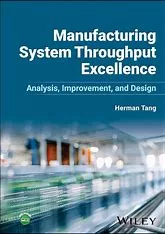
    Manufacturing System Throughput Excellence: Analysis, Improvement, and Design

  • leaner

    Leaner Manufacturing: How to Make the Lean Production Process Easier, Faster, and More Cost-Effective

See More Products

Events

View AllSubmit An Event
  • April 10, 2014

    Managing an Ergonomics Process

     Attendees will develop the ability to recognize, plan, and integrate the strategic elements of ergonomics into their current business processes. This workshop is not an introductory course and is intended for those who have previously attended the Applied Industrial Ergonomics seminar.  
View AllSubmit An Event

Related Directories

  • Proline

    Pro-Line offers Modular Ergonomic Industrial Workbenches. Including four leg benches, height adjustable benches, assembly workstations, wire harness benches, clean room, Ball Transfers, packaging benches, modular cabinets and Lab furniture and more. Many units "IN STOCK".
×

Never miss the latest news and trends driving the manufacturing industry

Stay in the know on the latest assembly trends.

JOIN TODAY!
  • RESOURCES
    • Advertise
    • Contact Us
    • Directories
    • Manufacturing Division
    • Store
    • Want More?
  • SIGN UP TODAY
    • Create Account
    • eMagazine
    • Newsletters
    • Customer Service
    • Manage Preferences
  • SERVICES
    • Marketing Services
    • Reprints
    • Market Research
    • List Rental
    • Survey/Respondent Access
  • STAY CONNECTED
    • LinkedIn
    • Facebook
    • Instagram
    • YouTube
    • X (Twitter)
  • PRIVACY
    • PRIVACY POLICY
    • TERMS & CONDITIONS
    • DO NOT SELL MY PERSONAL INFORMATION
    • PRIVACY REQUEST
    • ACCESSIBILITY

Copyright ©2026. All Rights Reserved BNP Media, Inc. and BNP Media II, LLC.

Design, CMS, Hosting & Web Development :: ePublishing