Assembly Lines
Self-Healing Composite Automatically Repairs Damage
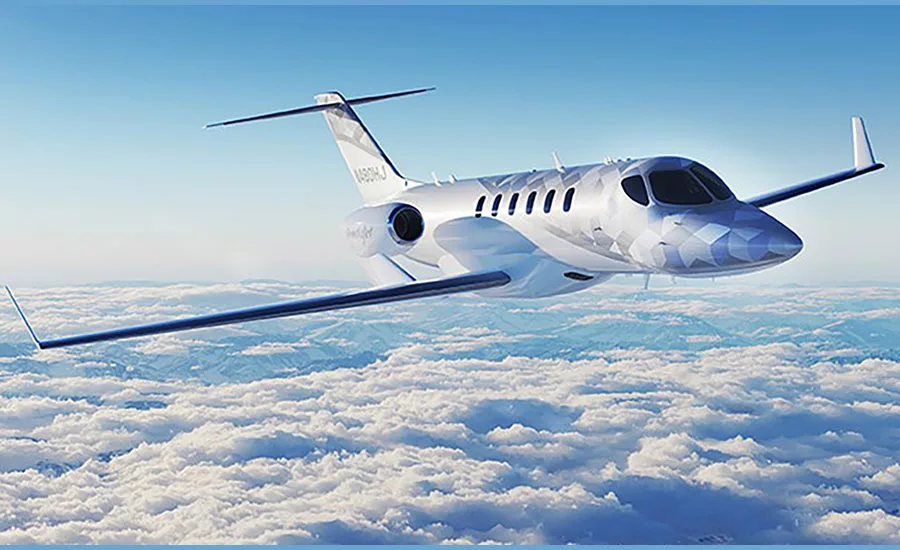
A new self-healing composite material could be used to assemble aircraft fuselages and wings.
RALEIGH, NC—Engineers at North Carolina State University have developed a self-healing composite that is tougher than materials currently used to assemble aircraft, automobiles, wind turbine blades and other products. In real-world scenarios, healing would only be triggered after the material is damaged by hail or other events, or during scheduled maintenance.
The self-healing material resembles conventional fiber-reinforced polymer (FRP) composites, but with two additional features that target interlaminar delamination, which occurs when cracks within the composite form and cause the fiber layers to separate from the matrix.
First, a thermoplastic healing agent is 3D-printed onto the fiber reinforcement, creating a polymer-patterned interlayer that makes the laminate two to four times more resistant to delamination.
Next, thin, carbon-based heater layers embedded into the material warm up when an electrical current is applied. The heat melts the healing agent, which then flows into cracks and microfractures and rebonds delaminated interfaces. restoring structural performance.
“The self-healing technology that we’ve developed could be a long-term solution for delamination, allowing components to last for centuries,” says Jason Patrick, Ph.D., an associate professor of civil, construction and environmental engineering at North Carolina State University. “That’s far beyond the typical lifespan of conventional FRP composites, which ranges from 15 to 40 years.”
“This would significantly drive down costs and labor associated with replacing damaged composite components,” claims Patrick. “[It would also] reduce the amount of energy consumed and waste produced by many industrial sectors, because they’ll have fewer broken parts to manually inspect, repair or throw away.”
“This provides obvious value for large-scale and expensive technologies such as aircraft and wind turbines,” explains Patrick. “But, it could be exceptionally important for technologies such as spacecraft, which operate in largely inaccessible environments that would be difficult or impossible to repair via conventional methods on-site.”
Looking for quick answers on assembly and manufacturing topics? Try Ask ASM, our new smart AI search tool. Ask ASM
To evaluate long-term healing performance, Patrick and his colleagues built an automated testing system that repeatedly applied tensile force to an FRP composite producing a 50-millimeter-long delamination, then triggered thermal remending. The experimental setup ran 1,000 fracture-and-heal cycles continuously over 40 days, measuring resistance to delamination after each repair.
Patrick has patented and licensed the technology through his start-up company, Structeryx Inc.
“We’re excited to work with industry and government partners to explore how this self-healing approach could be incorporated into their technologies, which has been strategically designed to integrate with existing composite manufacturing processes,” he points out.Looking for a reprint of this article?
From high-res PDFs to custom plaques, order your copy today!