Ford Outlines Next-Generation EV Strategy
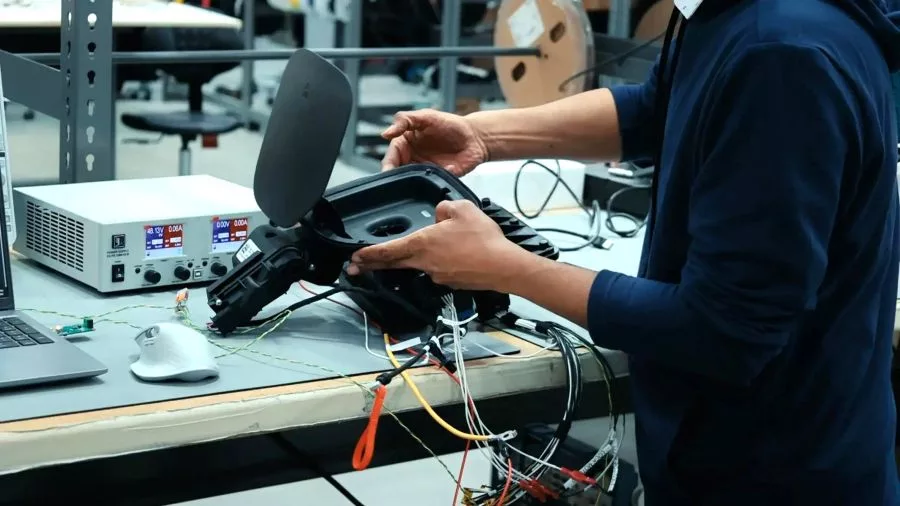
Ford engineers are developing next-generation electric vehicles. Photo courtesy Ford Motor Co.
DEARBORN, MI—Ford Motor Co. is developing an affordable battery-powered truck that features extended range capabilities.
According to Alan Clarke, executive director of advanced EV development, the engineering answer for range anxiety has traditionally been to increase the size of the battery in a vehicle. “But, the battery is the most crucial component to tackle affordability, because it accounts for somewhere around 40 percent of the vehicle’s total cost and upwards of 25 percent of its total weight,” he points out. “Just like when automakers simply made bigger engines, adding more battery makes the vehicle heavier, more expensive and creates a massive physics challenge.”
Instead, Clarke says he and his colleagues are “obsessing over the vehicle as a system to get more miles out of a smaller battery and radically simplifying the system to reduce the number of parts so we can deliver a new family of affordable electric vehicles to driveways around the world.
“Affordability is not a marketing tagline for us,” claims Clarke. “To truly make vehicles built on this platform affordable, starting with a mid-size electric truck, we needed to hunt down the cost opportunities.
“We started by creating a team within the skunkworks operation, tasked with developing range, efficiency and performance metrics for priorities such as weight, drag and rolling resistance, and ultimately battery size,” explains Clarke. “That team armed every engineer with a new way of evaluating tradeoffs. We call them bounties.”
Historically, engineers at legacy automakers are siloed in departments that match the component or system they specialize in. They’re expected to advocate for the part they are working on while decreasing its cost. Usually, these groups negotiate until they find a middle ground, one that inevitably ends in a tradeoff.
“Bounties change the negotiation, making the true cost of a tradeoff much clearer by connecting it to a specific value tied to the range and battery cost,” says Clarke. “[For example], the aerodynamics team and interior team share the same goal, and both understand that adding even 1 millimeter to the roof height would mean $1.30 in additional battery cost or 0.055 miles of range. With bounties, each team has a common objective to maximize range while decreasing battery cost.”
Looking for quick answers on assembly and manufacturing topics? Try Ask ASM, our new smart AI search tool. Ask ASM
The Ford engineers have also been developing new types of energy management systems and power electronics architectures.
“For the first time, customers will experience a fully electric vehicle charging ecosystem designed in-house using our own software,” says Clarke. “That means the hardware in the vehicle, including the bidirectional charging capabilities, comes from a team directly integrated into the one working on the platform and vehicle products. Customers will benefit from improvements that decrease the amount of time waiting around for the battery to charge, maximize the lifespan of the battery and decreases in total cost of ownership.
“The team’s work has had profound improvements beyond just developing Ford’s first 48-volt low-voltage system,” explains Clarke. “In fact, this new hardware and software have played a key role in making the mid-size electric truck's wire harness 4,000 feet shorter and 22 pounds lighter than one of our first-gen electric vehicles.
“We are moving to a zonal architecture where multiple vehicle functions are integrated into a small number of modules,” notes Clarke. “This is a significant shift from conventional vehicles, which typically use over 30 scattered electronic control units from various suppliers, leading to complex wiring, weight and higher manufacturing costs.
“Our platform combines functions into five main modules, substantially reducing cost and complexity,” says Clarke. “We also transitioned from a 12-volt system to a 48-volt system, which allows for thinner copper wires.
“We're creating a truly integrated electric vehicle platform, not a single part that can be easily copied,” claims Clarke. “If we succeed, we will have a family of vehicles that we expect to compete on price with the best in the world, including gas vehicles.”
Looking for a reprint of this article?
From high-res PDFs to custom plaques, order your copy today!