Industry Insight
Zonal Wiring Architecture Will Make EVs Easier to Assemble

Zonal architecture organizes electrical components and their connections by physical zones within a vehicle, rather than by functions or domains.
Zone defense is a popular strategy in sports such as basketball and football. When executed correctly, it can give teams a strategic advantage.
Today, automotive engineers are intrigued by a similar concept for cable and wire systems, which have become bulky, complex and expensive to produce. They’re exploring next-generation alternatives to traditional wire harnesses, such as zonal architectures.
The term refers to electrical and electronic systems that have a small number of central computers connected by high-performance data highways. Surrounding computers, the wiring system is divided into several zones where controllers independently perform sub tasks such as power distribution or data management to and from the sensors and actuators.
Molex Inc. is at the forefront of zonal architecture technology. It has already developed modular connectors, high-speed data communication components and cable assemblies that support automotive Ethernet and power distribution, while enabling efficient diagnostics and testing at the zone level. The company is also working closely with automakers and suppliers to ensure compatibility with evolving industry needs.
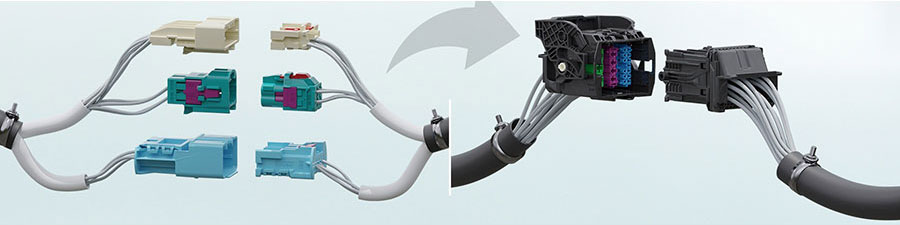
Modular wire-to-wire connectors will streamline complexity, cut costs and power the transition to zonal architectures. Illustration courtesy Molex Inc.
For example, the MX-DaSH (Molex data-signal hybrid) connector system features inline and wire-to-board connectors designed with zonal in mind. It combines traditional power and signal with high-speed data in a single compact system.
“The adoption of zonal architecture into vehicle design marks a pivotal shift in the transportation industry,” says Kevin Vander Putten, global product manager at Molex. “It addresses the major challenges of complexity, weight, durability, maintenance and assembly that have long plagued vehicle manufacturers.
“As the transportation sector continues to innovate with advanced driver assistance systems (ADAS), electrification and shared mobility models, zonal architecture emerges as the new foundation upon which [future vehicles] will be built,” adds Vander Putten.
Looking for quick answers on assembly and manufacturing topics? Try Ask ASM, our new smart AI search tool. Ask ASM
Autonomous and Electric Mobility recently asked Vander Putten to explain why zonal architecture is important to the automotive industry.

By distributing control to localized controllers, zonal configurations significantly cut wiring lengths compared to traditional centralized platforms. Illustration courtesy Molex Inc.
AEM: What does “zonal” mean?
Vander Putten: Zonal architecture organizes electrical components and their connections by physical zones within the vehicle, rather than by functions or domains. Essentially, the vehicle is divided into sections such as front-left and rear-right. Each zone has a local control unit that manages communications and power distribution within that area of the vehicle, as opposed to controllers within the vehicle that support specific functions. This decentralizes wiring and reduces complexity compared to traditional domain architectures.
AEM: Why hasn’t this type of system been used in the auto industry in the past?
Vander Putten: Historically, zonal architectures haven't been widely adopted due to technology and cost constraints. Traditional vehicles rely on simpler, function-based controllers that communicate over lower speed networks. Zonal architectures require a central compute module that has been very costly in the past, along with high-speed communications between the zonal controllers and the central compute. On top of this, the software required to handle all of this is complex and something automotive OEMs historically have not been equipped to handle.
AEM: What is the key difference between a zonal architecture and a domain architecture?
Vander Putten: The key difference lies in how the vehicle’s electrical systems are organized. Domain architecture groups systems by function, such as ADAS, infotainment and power train, centralizing control within each domain. Zonal architecture organizes systems geographically by vehicle location, with each zone independently managing its local components. It brings control closer to the physical location of components, reducing wiring length and complexity, while domain architectures centralize control by function.

The decentralized approach of zonal architecture improves vehicle design flexibility. Illustration courtesy Molex Inc.
AEM: How do zonal architectures benefit automakers?
Vander Putten: Zonal architectures offer several benefits, including:
- Reduced wiring complexity and weight. Shorter wiring runs within zones help reduce material costs and vehicle weight.
- Simplified vehicle assembly. Modular zones mean easier installation and troubleshooting.
- Scalability and flexibility. Standardized modules can be easily deployed to add additional zones, depending on the platform.
- Resource utilization. Better balanced computing, along with a reduction in cross-domain traffic, minimizes bottlenecks on the communication bus.
- Latency and signal integrity. The signal path is shorter, thus reducing latency and improving signal integrity for critical data such as ADAS.
AEM: Why are zonal architectures ideal for electric vehicles?
Vander Putten: Zonal architectures are well-suited to EVs for several reasons:
- Optimized wiring harnesses reduce weight and cost, which is critical to maximizing range and efficiency.
- Modular zones simplify integration of high- and low-voltage systems, improving safety and performance.
- Scalability supports rapid technology upgrades, which are important as battery and charging technologies evolve.
- Improved data handling supports advanced battery management and driver assistance features.
- Simplified vehicle assembly leads to lower manufacturing costs.
Together, these factors help make EVs more affordable to produce and easier to maintain, supporting broader adoption.
AEM: Does a zonal architecture take up less space than a traditional wiring harness?
Vander Putten: Yes. Zonal architectures typically take up less space because wiring is consolidated within defined zones, reducing the length and bundle size of cables running through the vehicle. This makes packaging easier and improves vehicle design flexibility. Additionally, the modular nature of the zones simplifies installation and can streamline vehicle manufacturing compared to complex, traditional wiring harnesses.

Consolidating connectors simplifies assembly operations and supports zonal architectures. Photo courtesy Molex Inc.
AEM: How easy is it to assemble zonal architectures? Are any special tools or equipment required?
Vander Putten: Assembling zonal architectures is generally easier than traditional harnesses because the wiring within a zone is more localized and standardized. Modular connectors and pre-assembled zone harnesses can be installed quickly with fewer steps. However, since zonal architectures rely on high-speed Ethernet communications between the zones and central computer, wiring harnesses must be manufactured with tight tolerances to ensure signal integrity is not compromised.
AEM: Can conventional connectors be used with zonal architectures?
Vander Putten: Some conventional connectors can be used, especially within zones for signal and power, but zonal architectures also require connectors designed for high-speed data. Molex has developed specific connectors tailored for zonal architectures that support high-speed data transmission, power delivery and simplified installation. The MX-DaSH line of products, for instance, features a modular connector design that allows OEMs to customize their specific needs with minimal tooling costs for both signal and power, along with high-speed data.
AEM: Traditionally, the automotive wiring harness assembly process has been difficult to automate. Will this scenario change with zonal architectures?
Vander Putten: Yes. Zonal architectures can open new possibilities for automation. Because zones are modular and standardized, they can be pre-assembled and tested off-line, which lends itself well to automated assembly lines. This approach reduces the complexity and variability that have long challenged harness automation. While full automation is still evolving, the modular nature of zonal harnesses makes it much more feasible to implement automated assembly processes compared to traditional harnesses.
AEM: How easy (or difficult) will it be to convert traditional wire harness shops to produce zonal products?
Vander Putten: It's a bit of a "double-edged sword” for wire harness suppliers to make this transition. On one hand, you now reduce complexity of the overall harness, making them easier to physically handle. Less floor space per station is also now required and the harness assembly board size is reduced significantly. On top of this, there is more standardization in components, so inventory management is easier. Electrical testing is also less complex, because it can be done on small zonal subharnesses as opposed to giant vehicle-wide harnesses. However, with this move, there is a push for more automation during assembly. This will drive significant capital expenditures for automated equipment, along with the need to hire and train employees to operate it. Finally, the move to zonal brings the need for high-speed data throughout the vehicle, which requires precise manufacturing of data cables to ensure signal integrity is not compromised.

With a zonal architecture, each zone has its own cables and wires, which are shorter, thinner and lighter. Illustration courtesy BMW AG
AEM: Where do U.S. automakers and suppliers stand when it comes to adopting zonal architectures?
Vander Putten: The global landscape is evolving rapidly. China is emerging as a clear leader in Asia, while Japan is progressing more cautiously. In the U.S., innovative companies like Rivian and Tesla are pushing zonal architecture forward aggressively, while traditional automakers, like Ford, GM and Stellantis, have planned production launches in the coming years. Legacy European and U.S. OEMs have similar roadmaps for when they will be bringing zonal architectures to market at scale.
AEM: What issues or challenges still need to be addressed before more automakers adopt zonal architectures?
Vander Putten: A few challenges remain, such as standardization (industry-wide standards for zonal networks, connectors and communication protocols are still maturing); cost (upfront investments in development for hardware and software, and tooling for zonal controllers and central compute modules, will be significant); and software complexity (managing zonal control units will require sophisticated software and cybersecurity measures to ensure vehicles are safe).
AEM: Do any zonal architecture standards currently exist or are any in the process of development?
Vander Putten: No zonal-specific industry standards exist, but there are related standards, such as AUTOSAR, IEEE Ethernet protocols and ISO 26262, that provide foundational frameworks for zonal architectures. Industry groups and OEMs are actively working on zonal-specific protocols and interfaces, which signals that more formalized standards will emerge in the near future.
AEM: How long will it be until we see zonal architectures widely used in the auto industry?
Vander Putten: Widespread adoption of zonal architectures is expected within five to 10 years. Early implementations are already underway in premium EVs, with larger vehicle rollouts set to follow as costs and maturity evolve. Based on industry data, around 2030 is when we can expect to see a significant uptick in zonal architectures brought to market.Looking for a reprint of this article?
From high-res PDFs to custom plaques, order your copy today!