BMW to Deploy Humanoids at German Assembly Plant
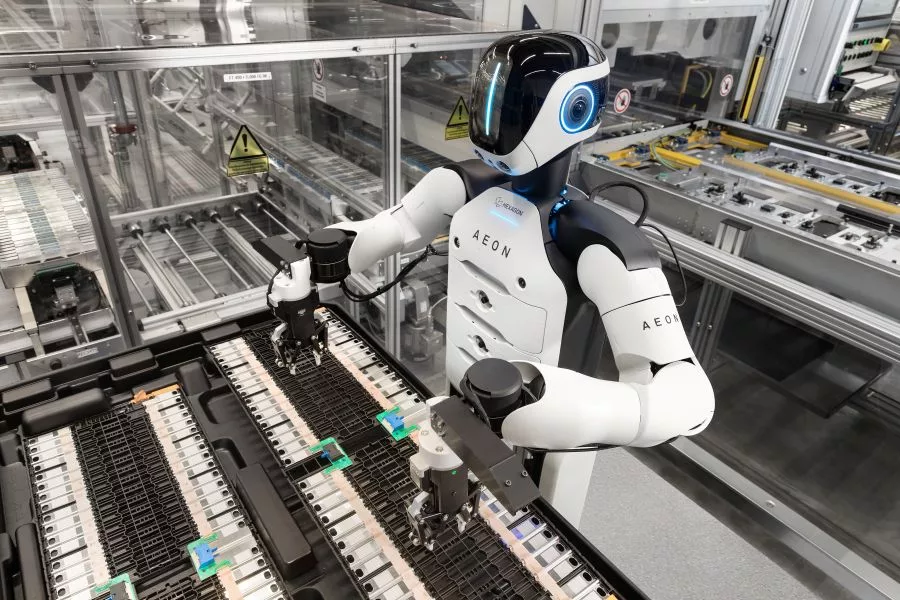
BMW is deploying humanoid robots at its assembly plant in Leipzig, Germany. Photo courtesy BMW Group
MUNICH—The BMW Group is the latest automaker that plans to use humanoid robots in an assembly plant. After experimenting with the technology at its facility in Spartanburg, SC, the company is now deploying general-purpose machines at its flexible factory in Leipzig, Germany. The plant produces vehicles such as 1 Series and 2 Series sedans.
Although BMW tested a Figure 02 robot in the U.S., the European application involves Hexagon AB’s AEON machine. The 65-inch-tall robot features 34 degrees of freedom and can carry payloads of up to 15 kilograms. AEON’s human like body allows a wide range of hand and gripper elements or scanning tools to be attached.
“Our aim is to be a technology leader and to integrate new technologies into production at an early stage,” says Michael Nikolaides, senior vice president of production network and supply chain management at BMW Group. “Pilot projects help us to test and further develop the use of Physical AI—that is, AI enabled robots capable of learning—under real-world industrial conditions
“Digitalization and artificial intelligence are core elements of BMW iFACTORY and are the foundation for future proof, flexible and competitive production,” explains Nikolaides. “The pilot project aims to integrate humanoid robotics into existing series production of cars, and to explore further applications in the production of batteries and components.”
According to Nikolaides, BMW views humanoid robots as a “value adding complement to existing automation. Particularly, they demonstrate potential in monotonous, ergonomically demanding or safety critical tasks. The goal is to relieve employees and further improve working conditions.”
BMW Spartanburg used a humanoid robot in its body shop. During tests conducted last year, a Figure 02 machine removed and positioned sheet metal parts as part of the welding process. It moved more than 90,000 components and covered approximately 1.2 million steps in around 1,250 operating hours.
“The pilot confirmed that humanoid robots can safely perform precise, repetitive work steps and provided important insights for the further deployment of Physical AI in production,” says Nikolaides. “The body shop was deliberately selected for the test phase in Spartanburg, as it already has a high degree of automation. The deployment of humanoid robots was met with great interest among employees and quickly became a natural part of everyday work during the course of the project.”
Looking for quick answers on assembly and manufacturing topics? Try Ask ASM, our new smart AI search tool. Ask ASM
Looking for a reprint of this article?
From high-res PDFs to custom plaques, order your copy today!