FANUC, NVIDIA Partner to Advance Physical AI in Industrial Robotics
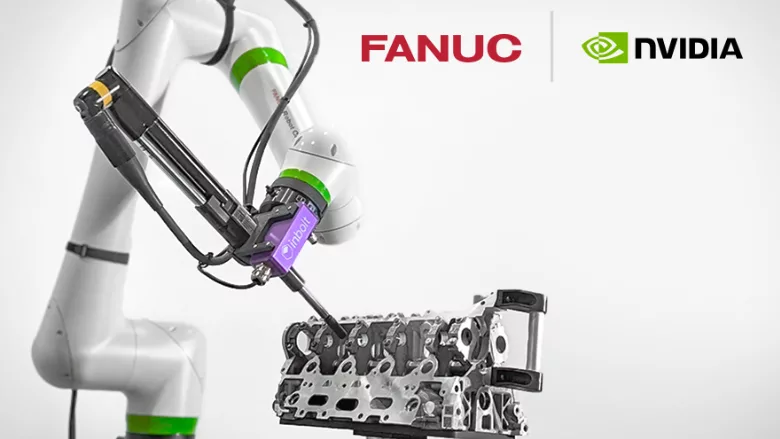
ROCHESTER HILLS, MI — FANUC America is collaborating with NVIDIA to advance the use of physical AI in industrial robotics, combining automation systems with AI computing and simulation technologies to support more adaptive manufacturing environments.
The partnership focuses on integrating NVIDIA’s AI infrastructure, including Jetson edge modules, simulation platforms and Omniverse libraries, into FANUC’s robotics portfolio and ROBOGUIDE simulation software. The goal is to enable manufacturers to train and deploy robots more efficiently using virtual environments and real-time data.
Physical AI represents a shift in how automation systems operate. Instead of relying on pre-programmed instructions, systems are designed to perceive their surroundings, make decisions and adjust to changing conditions on the factory floor.
“Physical AI is the next frontier in industrial automation,” said Mike Cicco, president and CEO of FANUC America. “By collaborating with NVIDIA, we’re giving manufacturers the tools to deploy intelligent robotics faster and align virtual design with real-world production.”
A key component of the collaboration is the use of digital twin technology. By integrating FANUC’s ROBOGUIDE simulation software with NVIDIA Isaac Sim and Omniverse platforms, manufacturers can create virtual models of production lines, test workflows and optimize operations before deploying physical equipment.
This approach allows companies to reduce commissioning time and cost while improving system performance. It also supports faster iteration, enabling manufacturers to refine processes in simulation before making changes on the plant floor.
The collaboration also expands how robots are controlled and programmed. FANUC is applying NVIDIA AI technologies to enable robots to interpret voice commands and automatically generate Python code, allowing operators to adjust processes without advanced programming skills.
Looking for quick answers on assembly and manufacturing topics? Try Ask ASM, our new smart AI search tool. Ask ASM
In addition, FANUC is supporting open development frameworks by releasing a ROS 2 driver and standardizing Python support across its robot portfolio, which ranges from small payload systems to large-scale industrial robots.
“Manufacturers are increasingly seeking physical AI solutions that bridge the gap between virtual simulation and real-world production to overcome labor shortages and increase operational efficiency,” said Murali Gopalakrishna, general manager of robotics at NVIDIA.
The integration of AI computing with robotics is intended to support more flexible and responsive production systems. By combining simulation, real-time data processing and adaptive control, manufacturers can deploy automation that adjusts to variability in materials, processes and demand.
FANUC demonstrated elements of the integration at the International Robot Exhibition in Tokyo, where NVIDIA Isaac Sim was used to simulate robot behavior in complex environments. The platform enables high-fidelity modeling and testing, allowing manufacturers to evaluate performance under a range of conditions before implementation.
A range of FANUC robots are available as simulation-ready assets within the platform, supporting faster development of digital environments and reducing the time required to bring new automation systems online.
Looking for a reprint of this article?
From high-res PDFs to custom plaques, order your copy today!