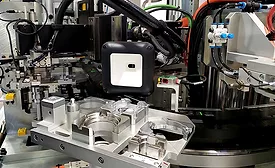
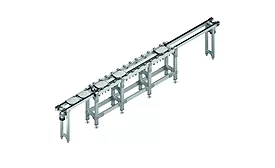
Middlesex provides conveyor technology solutions in instrument assembly, medical device assembly, injection nozzle assembly in automotive, and in numerous critical robotic assembly stations.
Conveyors do more than simply move parts from point A to point B. They serve as the backbone of an assembly line, and, as such, help manufacturers move forward on their road to success.
Despite its advanced capabilities, automation equipment used on assembly lines remains susceptible to failure. This presents manufacturers with the ongoing challenge of preventing unplanned equipment downtime, which is always disruptive and costly.
Saving a penny per part or a millisecond of cycle time might not matter to some manufacturers. But machine builder Eclipse Automation knows that even small gains can offer huge competitive advantages for its customers. Greater flexibility and uptime through predictive maintenance are also crucial.
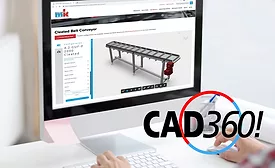
BLOOMFIELD, CT—Conveyor manufacturer mk North America has released a new version of its online conveyor modeling tool. The latest release of CAD360! features enhanced design tools and better access to equipment models to make it faster and easier to design and share custom conveyor systems from the manufacturer.
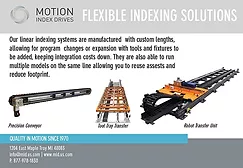
With our newly developed LATC series of precision indexing conveyors, we can achieve and guarantee a +/- 0.04 mm accuracy across the entire system. Similar to the LFA, the LATC is manufactured with an inner structure manufactured from aluminum extrusion and very high-grade aluminum links.
The COVID-19 pandemic has led to a massive surge in demand for a variety of medical devices, not the least of which are N95 respirators and other personal protective equipment. To meet that need, manufacturers worldwide are building new factories and installing new automated assembly lines. Two of those companies are Breathe Medical Manufacturing in Kelowna, BC, Canada, and Husco International Inc. in Waukesha, WI.
Short-cycle applications have a wide range of requirements. Manufacturing engineers must consider numerous aspects of transfer systems: Can the system move forwards and back again? How flexible is it? What sizes and weights can be transported? Can it be expanded if necessary?