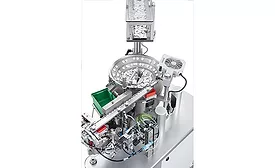
Medical devices pose a special challenge to designers of parts feeding equipment. Parts for such devices can be tiny, sharp, clingy, floppy, tangly; or some combination of those properties.
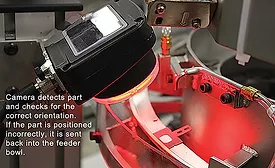
The manufacturer needed to present thin steel blades down an assembly line in a specific orientation. However, the parts were essentially symmetrical, with the exception of a small notch that had to be presented on the right side. With no real differences in the part other than this notch, feeding them to an assembly mechanism with 100 percent accuracy was a challenge.
Multistation automated assembly systems are a wonder to behold. A well-designed system can mass-produce hundreds of assemblies per minute with minimal human intervention.
Today’s automobiles contain dozens of electric motors. They adjust the mirrors, position the seats, aim the headlights, provide heating and cooling, and raise and lower the windows. In fact, a luxury car might have as many as 120 electric motors of various sizes.
There’s an old joke that the factory of the future will be so automated that it will have just two employees: a guard dog and someone to feed it. Fortunately or not, such a scenario remains the purview of science fiction. Indeed, despite advances in robotics and automation, people remain the most flexible assembly technology.
It's human nature to want to solve what appears to be the immediate issue. However, it makes little sense to frantically mop up a flooded house while the faucet remains wide open.