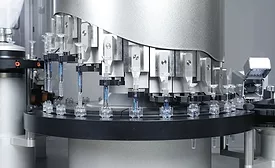
From trigger sprayers to disposable shavers, high-speed automation systems assemble consumer products by the millions. Both synchronous and asynchronous automation systems can be used to assemble consumer products, depending on the number and shape of the parts, the processes for assembling them, and the production volume and variety.
Besides the air bag module, an air bag system consists of crash sensors, passenger sensors, a control unit, seat belt pretensioners, a warning light and a wire harness to link them all together. It’s the small components, like the inflator and sensors, that are assembled with high-speed automation.
ASSEMBLY magazine is celebrating its 50th anniversary this year. To mark the occasion, we are publishing a series of articles examining the past, present and future of various assembly technologies.
Laser Design Inc. (Minneapolis) manufactures ultra-precise, 3-D laser scanning systems that are used to capture the shape of objects with complex geometries and free-form surfaces.
Founded in 1978, ATS Automation Tooling Systems (Cambridge, Ontario) builds automated assembly and packaging machines for a wide variety of companies in the automotive, medical device, computer, electronics and consumer products industries.
Retina Systems Inc. (Seymour, CT) manufactures high speed, noncontact laser vision inspection systems for use in everything from the electronics to the aerospace industries.
It should come as no surprise that assembling the engine for the Bugatti Veyron 16.4-the fastest production sports car in the world-poses some unique challenges. Nonetheless, even fans of the legendary Bugatti name, now the property of Volkswagen AG (Wolfsburg, Germany), might be daunted by the scope of the problem.
Prettl Group (Pfullingen, Germany) manufactures a wide range of products, including wire harnesses for the automotive industry and control displays for home appliances.
Many people believe that the golden age of American manufacturing is long past. They claim the good old days vanished some time in the late 20th century. However, I believe we are entering a new golden era.
Like the proverbial chain, an assembly line or process is only as strong as its weakest link. Central to this process is the correct valve. At first glance, many of the various valves used in industrial dispensing may appear to be pretty much the same. However, the reality couldn’t be more different.
 RSS
RSS