As the Industry 5.0 era transforms manufacturing, academic curriculums and research initiatives must evolve to meet new challenges, demands and opportunities.
Manufacturers are rapidly adopting AI, but most deployments remain limited to small-scale pilots. In this episode, Mike Sabin, CEO of Revalize, explains why scaling AI across the enterprise is proving far more difficult than expected.
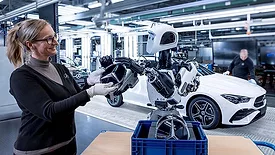
Compared with Industry 4.0, where humans mainly act as supervisors, Industry 5.0 elevates human expertise and contextual understanding. The objective is to allow people to focus on high-value cognitive tasks while being supported by intelligent machines that handle routine, hazardous or precision-intensive work.
Although Industry 5.0 is still a relatively new term, engineers are already talking about another buzz word called Physical AI. The term refers to augmenting physical systems with intelligence that scales.
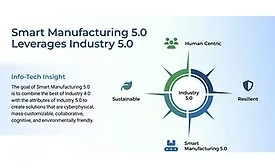
According to Info-Tech, companies should adopt Smart Manufacturing 5.0, which combines the innovations of Industry 4.0 with a focus on human-centric, resilient and sustainable practices.
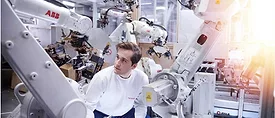
Many people are afraid of snakes and spiders. But, robots and other machines also create anxiety and trepidation in some humans. While Industry 4.0 technology, such as artificial intelligence, augmented reality, collaborative robots, data analytics and digital twins, now make it easier than ever for humans and machines to work in close proximity, fears persist.