Assembly Magazine logo
search
Ask ASSEMBLY AI
cart
facebook twitter linkedin youtube
  • Sign In
  • Create Account
  • Sign Out
  • My Account
Assembly Magazine logo
  • TRENDS
    • Ask ASSEMBLY AI
    • Trends
    • News
    • New Products
  • INDUSTRIES
    • Aerospace
    • Appliance
    • DFMA Assembly
    • Medical Devices
    • Green Manufacturing
    • Lean Manufacturing
    • Machinery Assembly
    • Electronics Assembly
    • Automotive
  • TECHNOLOGIES
    • Adhesives & Dispensing
    • Assembly Presses
    • Automated Assembly Systems
    • Manufacturing Management
    • Manufacturing Software
    • Motion Control
    • Screwdriving & Riveting
    • Robotics
    • Test & Inspection
    • Plastics & Metal Welding
    • Wire Processing
    • Workstations
  • AUTONOMOUS & ELECTRIC MOBILITY
    • AEM Magazine Archives
    • Autonomy
    • Electrification
    • Mobility Services
    • Assembly & Testing
    • AV/EM News
  • MEDIA
    • Ask ASSEMBLY AI
    • Podcasts
    • Assembly News Now
    • Assembly TV
    • Webinars
    • eBooks
  • EVENTS
    • Calendar
    • The ASSEMBLY Show
  • MORE
    • Exclusives >
      • Plant of the Year
      • Capital Spending
    • Buyers Guide >
      • Supplier Insights
    • Classifieds
    • Featured Products
    • Newsletters
    • Store
    • White Papers
    • Columns
    • Sponsor Insights
  • INFOCENTER
    • Assembly & Test Solutions
  • EMAGAZINE
    • eMagazine
    • Archive Issues
    • Advertise
    • Contact Us
    • Sign Up
TechnologiesManufacturing SoftwareRobotics Assembly

Rockwell Automation Tackles Industry 5.0
By Austin Weber
Rockwell Automation Inc.

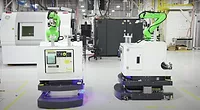
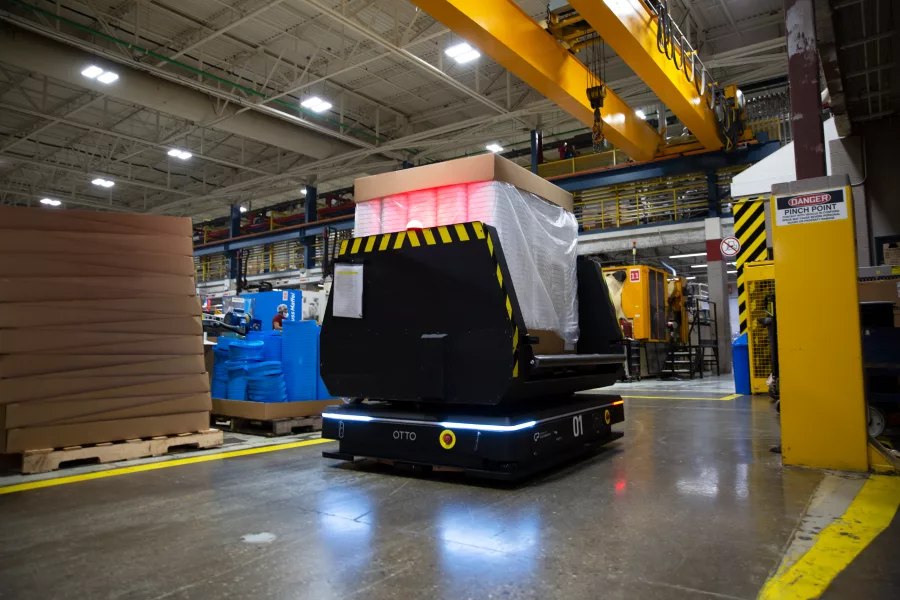
Autonomous mobile robots play an important role in human-centric manufacturing. Photo courtesy Rockwell Automation Inc.

February 16, 2026

Rockwell Automation Inc. has been at the forefront of manufacturing for decades, ever since it pioneered the programmable logic controller more than 50 years ago. Today, it’s focusing on artificial intelligence, autonomous mobile robots (AMRs), data analytics, digital twins, next-generation software and other smart technology that is transforming manufacturers in a variety of industries.

ASSEMBLY recently asked Ryan Gariepy, vice president of robotics at Rockwell Automation to explain how the company is navigating the new world of Industry 5.0.

ASSEMBLY: What is Industry 5.0?

Gariepy: Industry 5.0 is about building industrial systems that learn and adapt—not just systems which have been interconnected, but still execute the same tasks over and over. That’s a fundamental shift from how most factories operate today.

For decades, we’ve designed factories around predetermined instructions: program the machine, repeat the process and optimize for consistency. The shift to Industry 5.0 is about creating production environments where technology empowers people rather than simply replacing manual tasks with automated ones. 

For instance, when we deploy AMRs into a facility, the goal isn’t just to move material from point A to point B. It’s to create a system that coexists with workers, adapts to changing conditions and gets smarter over time. Technology in service of people, with systems that continuously improve.


ASSEMBLY: How is Industry 5.0 different than Industry 4.0?

Looking for quick answers on assembly and manufacturing topics? Try Ask ASM, our new smart AI search tool. Ask ASM →

Gariepy: Industry 4.0 gave us connectivity. Its about digitalization: connecting machines, devices and systems so you can monitor operations in real time and make data-driven decisions. Technologies like IoT, cloud computing and digital twins all fall under that umbrella.

Industry 5.0 builds on that connected infrastructure, but shifts the focus from connectivity to adaptability. The question moves from “Can we collect this data?” to “Can the system act on it intelligently, without human intervention, and keep getting better?” We envision factories that go beyond following instructions; they make independent decisions, learn from outcomes and optimize themselves throughout their entire lifecycle.

Three technologies make this possible: software-defined automation, artificial intelligence (AI) and robotics. Software-defined automation architectures give you the flexibility to update and evolve systems without ripping out hardware. AI gives those systems the ability to perceive, predict and decide. Robotics gives AI a physical presence—machines that can act in the real world. When you bring all three together, you’re able to move from automation to autonomy. 


ASSEMBLY: What role do humans play in Industry 5.0?

Gariepy: Industry 5.0 is about designing technology around how people actually work and amplifying what they’re capable of. For years, we’ve asked workers to adapt to systems: learn the interface, navigate the menus, interpret the data and figure out what to do. In Industry 5.0, the system adapts to the worker.

We’ve accumulated tens of thousands of hours of robot operational data. Using AI, we’ve shown that we can now let someone on the floor ask a plain-language question, such as “Why does the robot keep stopping in aisle one?” and get an immediate answer with context, visuals and actionable insight. It puts powerful information directly in the hands of the people who need it most. Tha’'s what human-centric really means: technology that amplifies what people can do.


ASSEMBLY: What is the role of robots in the new era of human-centric manufacturing?

Gariepy: Robots go beyond being tools and become collaborators. The old model kept robots isolated and caged off, doing repetitive tasks in spaces where people weren’t allowed. That’s changing fast.

AMRs move through the same aisles as workers. Robot arms operate alongside people on assembly lines. The physical separation between worker and machine is disappearing, and that forces us to think differently about safety, about factory layout, about how we coordinate dozens or hundreds of machines operating in shared spaces.

At Rockwell, w’'ve built production logistics middleware that ties together everything from traditional robot arms to AMRs to mobile manipulators in a single coordinated system. That integration layer is what makes human-robot collaboration actually work at scale.


ASSEMBLY: What is the role of artificial intelligence in Industry 5.0?

Gariepy: AI is what makes adaptability possible. Without it, you have connected systems that still require humans to interpret data and make every decision. With it, you have systems that perceive, learn and act.

At Rockwell, we’re embedding AI into design tools that help engineers build systems faster. We’re embedding it into control systems that optimize processes in real time. And we’re building agentic systems—AI takes action, moving from “here’s what you should know” to “here’s what I’ve done about it.”

In robotics, AI is what allows machines to handle the variability of the real world. An AMR navigating a factory uses a variety of AI techniques to perceive obstacles, predict movement and adapt its path on the fly.


ASSEMBLY: Has Rockwell Automation developed any new products for today’s new manufacturing paradigm?

Gariepy: Yes. We are actively engaged in AMRs and software-defined automation (SDA). We manufacture our AMRs in-house, first in Canada and as of October 2025 also in the United States. We have fleet management software, production logistics middleware, and the ability to seamlessly integrate autonomous robots with the rest of a factory’s more traditional automation architecture. That end-to-end capability matters, because deploying robots successfully depends on how it fits into existing operations.

Our Logix SDA platform brings control, safety and motion into a software-defined architecture that can evolve without replacing hardware. Using Logix SDA alongside other Rockwell software, such as Unified Robot Control, enables machine builders to combine high-speed motion control with open-source frameworks like the Robot Operating System (ROS), accelerating development without sacrificing reliability. And, we’re embedding AI across the stack—in design tools, real-time process optimization and agentic systems.


KEYWORDS: advanced manufacturing Artificial Intelligence (AI) autonomous mobile robot factory automation human-machine interface (HMI) human-robot collaboration Industry 4.0 Industry 5.0 Rockwell Automation smart factory smart manufacturing

Share This Story

Looking for a reprint of this article?
From high-res PDFs to custom plaques, order your copy today!

Austinweber headshot
Austin has been senior editor for ASSEMBLY Magazine since September 1999. He has more than 21 years of b-to-b publishing experience and has written about a wide variety of manufacturing and engineering topics. Austin is a graduate of the University of Michigan.

Recommended Content

JOIN TODAY
To unlock your recommendations.

Already have an account? Sign In

  • Made in the U.S.A.

    Consumer Products Manufacturing: Made in the USA

    Supply chain lessons learned during the coronavirus...
    Automated Assembly Systems
    By: Austin Weber
  • Best Practices for Press-Fit Assembly

    Best Practices for Press-Fit Assembly

    In manufacturing, ironclad formulas for success are hard...
    Assembly Presses
    By: Jim Camillo
  • aem0523leader-tesla1.jpg

    Tesla Rethinks the Assembly Line

    Engineers at Tesla Inc. have developed a new process that...
    Assembly and Testing
    By: Austin Weber
Manage My Account
  • eMagazine Subscription
  • Assembly Newsletters
  • Online Registration
  • Subscription Customer Service
  • Manage My Preferences

More Videos

Sponsored Content

Sponsored Content is a special paid section where industry companies provide high quality, objective, non-commercial content around topics of interest to the ASSEMBLY audience. All Sponsored Content is supplied by the advertising company and any opinions expressed in this article are those of the author and not necessarily reflect the views of ASSEMBLY or its parent company, BNP Media. Interested in participating in our Sponsored Content section? Contact your local rep!

close
  • ultrasonic welding
    Sponsored bySonobond Ultrasonics

    Engineering Efficiency in High-Performance Assembly: How Ultrasonic Welding Enhances Throughput, Reliability and Quality

  • UV curing system
    Sponsored byDymax

    Why UV Intensity Alone Doesn’t Define Curing Performance

  • wooden pallets
    Sponsored byLEAN Manufacturing Products

    Eliminating Waste on the Shop Floor: Applying Lean Principles to Improve Manufacturing Efficiency

Popular Stories

ASSEMBLY News Now, episode-30: Volvo Redesigns EV Manufacturing

Volvo Redesigns EV Manufacturing

Boeing CEO Kelly Ortberg announces 1 billion investment

Boeing Plans $1 Billion Wichita Investment, Workforce Training Center

GE Appliances Worker on Line

GE Appliances Expands Factory AI With 800 Gemini Enterprise Agents

Watch the latest episode of ANN now!

Events

July 24, 2025

From Shop Floor to CFO: How Manufacturers Are Closing the Loop Between Operations and Finance

On Demand Learn how manufacturers are bridging the gap between the shop floor and ERP systems to gain real-time visibility, streamline operations, and kick-start digital transformation—without waiting years.

Sponsored by:

PicoStratusGreen
July 30, 2025

Buffer Analysis and Design Fundamentals for Manufacturing Excellence

On Demand In this presentation, Dr. Herman Tang shares practical insights from his industry experience and research on buffer management in manufacturing operations.

View All Submit An Event

Poll

Difficult Assembly Processes

Which assembly process gives you the most difficulty?
View Results Poll Archive

Products

Manufacturing Cost Policy Deployment (MCPD) Profitability Scenarios: Systematic and Systemic Improvement of Manufacturing Costs

Manufacturing Cost Policy Deployment (MCPD) Profitability Scenarios: Systematic and Systemic Improvement of Manufacturing Costs

See More Products
Register for webinar - Modernizing Automotive Assembly: Why Upgrading Legacy MES is a Business Imperative

Related Articles

  • Human-centered manufacturing

    Robots Play a Key Role in Industry 5.0

    See More
  • OTTO 100 at GE Aviation.png

    Rockwell Automation and Nvidia Team Up to Advance Mobile Robotics

    See More
  • Lucid Group Inc.

    Lucid Partners With Rockwell Automation

    See More

Related Products

See More Products
  • 4 perspective.jpg

    Handbook of Manufacturing Systems and Design: An Industry 4.0 Perspective

  • 4 apps.jpg

    Intelligent Analytics for Industry 4.0 Applications

  • digital.jpg

    Digital Manufacturing and Assembly Systems in Industry 4.0

See More Products

Related Directories

  • Rockwell Automation Inc.

×

Never miss the latest news and trends driving the manufacturing industry

Stay in the know on the latest assembly trends.

JOIN TODAY!
  • RESOURCES
    • Advertise
    • Contact Us
    • Directories
    • Manufacturing Division
    • Store
    • Want More?
  • SIGN UP TODAY
    • Create Account
    • eMagazine
    • Newsletters
    • Customer Service
    • Manage Preferences
  • SERVICES
    • Marketing Services
    • Reprints
    • Market Research
    • List Rental
    • Survey/Respondent Access
  • STAY CONNECTED
    • LinkedIn
    • Facebook
    • Instagram
    • YouTube
    • X (Twitter)
  • PRIVACY
    • PRIVACY POLICY
    • TERMS & CONDITIONS
    • DO NOT SELL MY PERSONAL INFORMATION
    • PRIVACY REQUEST
    • ACCESSIBILITY

Copyright ©2026. All Rights Reserved BNP Media, Inc. and BNP Media II, LLC.

Design, CMS, Hosting & Web Development :: ePublishing