Physical AI Creates New Roles for Humans and Robots
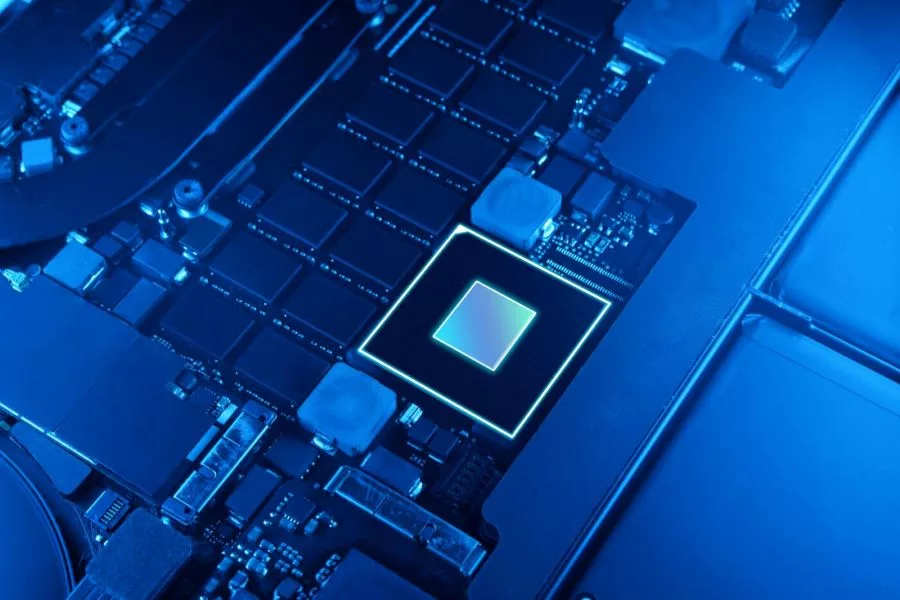
Advanced processors power humanoid robots and other types of next-generation automation. Photo courtesy Arm Holding plc
Although Industry 5.0 is still a relatively new term, engineers are already talking about another buzz word called Physical AI. The term refers to augmenting physical systems with intelligence that scales.
More capable AI models, cheaper sensing and edge compute that runs within real-world power and latency constraints are finally enabling robots to adapt to variability—people, environments and changing tasks—rather than operating as fixed-function machines in structured settings. Arm Holdings plc is a semiconductor and software design company based in Cambridge, England, that designs processor technology that enables next-generation machines like Boston Dynamics’ Atlas humanoid robot.
ASSEMBLY recently asked Drew Henry, executive vice president of the physical AI business unit at Arm to explain why engineers will be hearing more and more about the role of Physical AI in manufacturing.
ASSEMBLY: What is Physical AI and how is it different than Industry 5.0 or Industry 4.0?
Henry: Physical AI is intelligence embodied in machines and systems that can sense, decide and act in real time in the physical world. Think robots, autonomous vehicles and other machines that operate with increasing autonomy. Industry 4.0 and Industry 5.0 are frameworks describing manufacturing evolution.
Industry 4.0 brought digital transformation through interconnectivity, automation and machine learning. Industry 5.0 builds on that digitalization by adding greater focus on human-machine collaboration, sustainability and resiliency. Physical AI is the technology capability that enables Industry 5.0 by making machines adaptive, responsive and safe to work alongside people.
A clear example of this is how automotive and industrial robotics is converging around shared AI capabilities, including real-time perception, low-latency decision-making and safe actuation. As robots become more autonomous and mobile, they increasingly face the same compute, safety and power constraints as autonomous vehicles. This convergence is driving demand for common, scalable computing platforms that are performant, efficient and safety-ready.
Looking for quick answers on assembly and manufacturing topics? Try Ask ASM, our new smart AI search tool. Ask ASM
ASSEMBLY: Does the term “automation” take on a different meaning or purpose in the new era of Physical AI?
Henry: Absolutely. Traditional automation meant fixed-function machines doing repetitive tasks in structured environments. Physical AI enables adaptive automation where systems can handle variability, learn from their environment and work alongside people safely without rigid pre-programmed paths.
In many ways, robotics has been waiting for AI to catch up, and now it has. Several long-standing barriers are falling simultaneously: sensors and actuators are more affordable; AI models can adapt to real-world variability; and compute can run locally within power, cost and safety constraints.
The purpose shifts from replacing repetitive human labor to augmenting human capability in environments where safety, complexity or scale previously created limits. Because of this, AI is becoming the most significant accelerator of productivity in human history.
ASSEMBLY: How does Physical AI change human-robot interaction and collaboration in manufacturing environments?
Henry: Physical AI changes human-robot interaction by allowing robots to adapt to people, changing environments and variable tasks, rather than requiring everything around them to be rigidly structured and predictable. Robots can now perceive what’s happening, decide and respond instantly and work naturally alongside human coworkers.
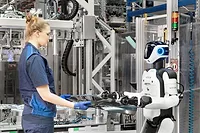
This enables true collaboration in manufacturing environments. Instead of robots working in isolated cells or behind safety cages, they can work side-by-side with human coworkers, handling the physically demanding or precision work, while humans focus on judgment, creativity and problem-solving, helping manufacturers maintain productivity amid ongoing skilled labor constraints.
ASSEMBLY: What is the role of humans in Physical AI?
Henry: Physical AI is about augmenting human capability in physical systems at industrial scale, not replacing people. The human brain remains the ultimate processor. Physical AI extends human productivity into environments and tasks that were previously limited by safety constraints, cost or operational complexity.
Humans provide the creativity, oversight and strategic decision-making. Physical AI handles the execution, such as the repetitive precision work, the physically demanding tasks and the 24/7 monitoring. Together, humans and intelligent machines enable safer, more flexible operations and unlock productivity gains comparable to earlier industrial transitions.
ASSEMBLY: What is the role of robots in human-centric manufacturing?
Henry: Robots have the capability to handle the physically demanding, repetitive or high-precision work that’s either unsafe for humans or doesn’t make the best use of human capability. They extend what’s possible in manufacturing and are capable of working longer hours, in harsh conditions or with micron-level precision. This allows humans to focus on what we do best: judgment, quality oversight, problem-solving and continuous improvement. Human-centric manufacturing isn’t about choosing between people and robots; it’s about designing systems where both perform at their best.
ASSEMBLY: As more robots are deployed in factories and do more complex work alongside people, what challenges or issues need to be addressed by manufacturers?
Henry: Three big ones: safety, interoperability and scalability. Safety is paramount when robots operate closer to people with increasing autonomy. These systems need deterministic, real-time behavior where response times are predictable, failures are managed safely and human trust is maintained.
Interoperability matters, because fragmented hardware and software stacks have historically stalled deployment. Manufacturers need computing platforms that work seamlessly across different systems and use cases.
Scalability is the ultimate challenge, not just within a single cell, but across lines, factories and fleets. We know the industry can build a single capable robot or autonomous system, but the real challenge is deploying them reliably at scale. That requires a compute foundation that’s performant, efficient and can run continuously within strict power and thermal limits, paired with a mature software ecosystem that enables developers to build once and deploy broadly. This is where Arm-based computing has become increasingly relevant, enabling manufacturers to scale Physical AI systems more quickly and economically.
ASSEMBLY: Do any standards exist for Physical AI applications in manufacturing or are any standards in the process of development?
Henry: The standards landscape is evolving rapidly, but not starting from zero. Existing robotics and functional safety standards are already in place, and we’re seeing them extended to support more autonomous, AI-driven systems. At the same time, automotive safety standards developed for real-time, safety-critical autonomy are increasingly influencing how Physical AI systems are designed for manufacturing environments. What’s becoming clear is that Physical AI requires computing platforms that are not just performant but predictable, deterministic and trusted, especially when machines operate with greater autonomy near people. We see the industry converging around those core principles, even as formal standards continue to develop.
Looking for a reprint of this article?
From high-res PDFs to custom plaques, order your copy today!