Focus On Robotics
Robots Play a Key Role in Industry 5.0
With human-centric manufacturing, automation takes on a new purpose.
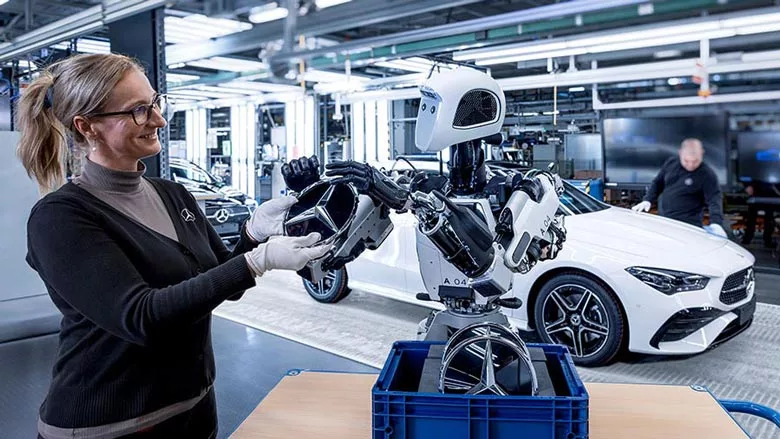
Human-centered manufacturing is the focus of Industry 5.0.
As advanced sensors, artificial intelligence and other technology transforms industrial robotics, some observers predict that humans will play less of a hands-on role in manufacturing. Others argue that people will become more important than ever.
Human-centered manufacturing is the focus of Industry 5.0, which is the next step beyond Industry 4.0 initiatives. The goal is to enhance the role of humans in factories and improve how they interact with robots on assembly lines.
The term originated in Europe several years ago to describe an environment where people maintain full control while fostering a harmonious collaboration with machines. Robots handle labor-intensive or high-risk tasks, but humans focus on complex or value-added production tasks.
Humans remain in the loop for decision-making and judgment. Automation supports flexibility, learning and system resilience rather than rigid optimization.
“Manufacturing is often described in terms of machines, automation and technology,” says Todd Deaville, vice president of advanced manufacturing innovation at Magna International Inc. “But, the most important change happening on today’s factory floor isn’t mechanical—it’s human.
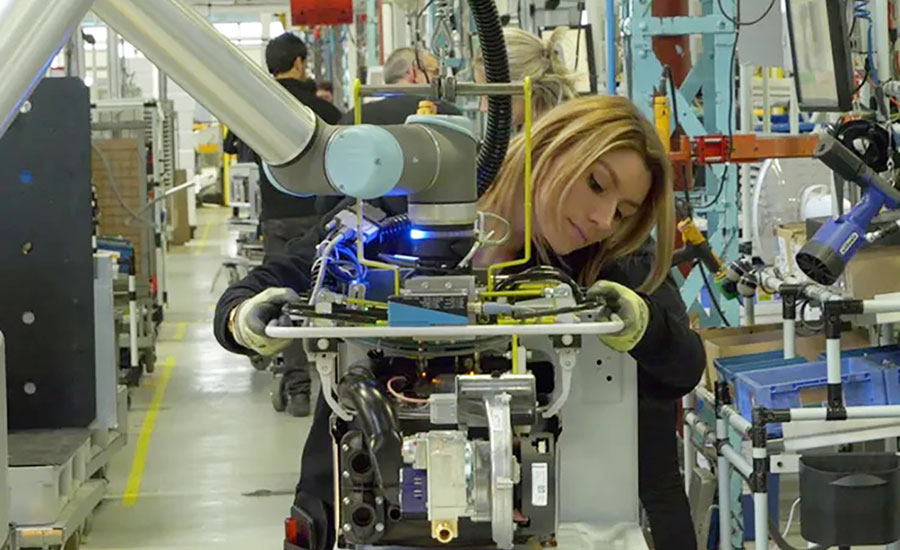
Industry 5.0 emphasizes human-centricity, sustainability and system resilience. Photo courtesy Universal Robots
“Automation doesn’t replace people—it changes how people add value,” claims Deaville. “As machines take on more repetitive, dangerous or physically demanding tasks, human work shifts toward interpretation, troubleshooting, problem solving and continuous improvement. The work becomes less about motion and more about judgment.”
“Industry 5.0 represents a value-driven evolution beyond Industry 4.0 rather than a replacement,” adds Shihao Fu, a technology analyst at IDTechEx. “While Industry 4.0 focuses on efficiency, automation and digital connectivity, Industry 5.0 emphasizes human-centricity, sustainability and system resilience.
Looking for quick answers on assembly and manufacturing topics? Try Ask ASM, our new smart AI search tool. Ask ASM
“In this context, technology is no longer designed solely to maximize throughput or reduce costs,” explains Fu. “Instead, Industry 5.0 asks how machines, robots and artificial intelligence can augment human capabilities, support collaboration, and enable manufacturing systems to remain robust and adaptable under uncertainty. Humans are no longer treated as system variables, but as the central element around which technology is designed.”
According to Fu, the key difference between Industry 5.0 and Industry 4.0 lies in the real-world challenges they are designed to address.
“Industry 4.0 emerged in a period of relative global stability, with supply chains optimized for efficiency and predictability,” explains Fu. “Its focus was on making manufacturing faster, cheaper and more stable through system-level automation and digitalization.
“Industry 5.0 arises because these assumptions no longer hold,” says Fu. “Market volatility, geopolitical uncertainty, supply chain disruptions and labor shortages have exposed a key limitation of Industry 4.0 systems: they are highly efficient, but often fragile.”

Industry 5.0 shifts automation from isolated, cage-based systems to environments where humans and robots work safely together. Illustration courtesy Siemens
“Industry 5.0 shifts automation from isolated, cage-based systems to environments where humans and robots work safely and naturally together, with automation designed to assist and amplify human workers, not replace them,” adds Vincent Duchaine, chief technology officer at Robotiq, a Canadian company that specializes in collaborative robot technology.
“While Industry 4.0 focused on connecting machines and data, Industry 5.0 is about intelligent interaction,” Duchaine points out. “It’s about using AI to simplify integration, coordination and real-world decision-making across robots, machines and peripherals.
“Industry 5.0, or what could be referred to more accurately as ‘smart automation,’ means systems are intuitive, quick to deploy and operable by teams working on the shop floor, not by robot experts,” says Duchaine. “This lowers integration cost and complexity, which is especially important for small- and mid-sized manufacturers.
“Industry 5.0 is about making automation truly work,” notes Duchaine. “It’s more than just connecting machines. [The goal is to simplify] how humans and robots interact, using AI to make automation easier to deploy, simpler to use and more accessible to manufacturers that don’t have deep automation expertise.”
“Industry 5.0 represents a recalibration in how technology is applied across manufacturing operations,” adds Loic Barancourt, CEO, of Digital Matter, a company that specializes in Internet of Things hardware. “Success is defined less by the volume of automation or data collected, and more by the outcomes technology enables—
supporting people, strengthening resilience and helping operations perform reliably under real-world conditions.
“Engineers and operators remain responsible for the decisions that matter most, from when to intervene to how risk and resources are managed,” explains Barancourt. “Industry 5.0 positions technology as a practical enabler of those judgments, providing consistent and trustworthy insight that helps people act with confidence as conditions evolve.
“Industry 4.0 emphasized automation, connectivity and the large-scale data collection inside the factory, with a strong focus on efficiency and optimization,” says Barancourt. “While many organizations are still in the process of implementing these systems, experience has shown that efficiency alone doesn’t guarantee resilience or better outcomes.
“Industry 5.0 builds on that foundation, but reframes the objective,” claims Barancourt. “Instead of simply asking ‘how much can be automated or measured?’ manufacturers are asking whether technology genuinely supports people, holds up over time and contributes to long-term operational stability. In practice, this means applying existing technologies more deliberately across the full operating system.”
Human Collaboration
During the last 15 years, manufacturers in a variety of industries have adopted key principles of Industry 4.0 by investing in augmented reality, cloud computing, collaborative robots, data analytics, digital twins, 5G communication networks and other technology.
“This period has witnessed multiple global events which have challenged industries in various ways, including economic volatility and supply chain disruptions,” says Umang Garg, managing director and global practice leader for automation and manufacturing Nagarro, a digital engineering and consulting firm that works with a variety of Fortune 500 companies. “Industry 5.0 has brought back the need for human effort and put workers at the center of manufacturing operations.”
With Industry 5.0, automation becomes human-centric, adaptive and collaborative. “In Industry 4.0, automation primarily aims to reduce human variability by standardizing processes for efficiency and stability,” explains Fu. “Industry 5.0 shifts the emphasis from automating tasks to automating collaboration and coordination between humans, machines and software.
“Automation systems are increasingly designed to interact with humans, understand intent and context, and continuously adapt,” says Fu. “In Industry 5.0, humans are the core of the manufacturing system. Their value lies not in repetitive manual work, but in decision-making, judgment, creativity and handling complex or unexpected situations.”

The goal of Industry 5.0 is to simplify how humans and robots interact, using AI to make automation easier to deploy, simpler to use and more accessible to manufacturers. Photo courtesy Robotiq
Compared with Industry 4.0, where humans mainly act as supervisors, Industry 5.0 elevates human expertise and contextual understanding. The objective is to allow people to focus on high-value cognitive tasks while being supported by intelligent machines that handle routine, hazardous or precision-intensive work.
Indeed, a human-centric approach is one of the key differentiators of Industry 5.0. Within this context, people play several key roles, including:
- Supervision. “Humans act as supervisors of the automation, overseeing the process and outcome,” says Garg.
- Collaboration. “Humans work with cobots to ensure task completion,” Garg points out. “These tasks may be across different parts of the industrial value chain. For example, a cobot may be used to lift a heavy object while the human is responsible for performing the necessary steps on that object.”
- Personalization. “Industry 5.0 is likely to enable large-scale personalization of products,” predicts Garg. “This might encompass robots performing production steps in small batches, while humans focus on product customization and managing the final outcome.”
- Innovation. “While robotic automation drives efficiency in performing repetitive tasks with high accuracy, the role of humans is to create process innovation and product innovation,” says Garg.
“Successful human-robot collaboration requires early involvement of operators, clear qualification pathways and continuous feedback loops,” says LJ Holmes, executive director of the Center of Advanced Manufacturing and Materials at Harrisburg University of Science and Technology. “Industry 5.0 rewards organizations that design technology around people. Not the other way around. Human needs—resilience and readiness—are the true measures of success.”
Role of Robots
Experts believe that autonomous mobile robots (AMRs), six-axis collaborative robots and humanoid robots will all play interconnected roles in the new world of Industry 5.0.
“Robots will evolve from isolated task executors into collaborative partners and capability amplifiers,” says Fu. “Collaborative robots and more advanced, human-like robotic systems are designed to work safely alongside humans in shared environments.
“They take on repetitive, physically demanding or high-risk tasks, while adapting to human pace and intent,” notes Fu. “This collaboration enhances flexibility and resilience, allowing production systems to respond more effectively to variability and disruption.”
“The distinction lies in a fundamental shift of industrial philosophy moving from a technology-driven mindset to a purpose-driven one,” notes Arungalai Anbarasu, a member of the group executive board at Körber AG. “Industry 4.0 was centered on achieving competitive advantages through increasing connectivity, data transparency and maximized throughput.
“Industry 5.0 takes those digital tools, but applies a completely different intent, pivoting toward the three critical pillars of human-centricity, resilience and sustainability,” says Anbarasu. “This marks a transition from simply building smart factories and process solutions to designing future-ready ecosystems.

Automation systems are increasingly designed to interact with humans, understand intent and continuously adapt. Photo courtesy National Institute of Standards and Technology
“While the 4.0 era succeeded in connecting machines to each other, Industry 5.0 focuses on the collaboration between those machines and human operators,” explains Anbarasu. “I view this as shifting the focus from the sheer acceleration of output toward creating systems that are disruption-ready, environmentally conscious, and fundamentally designed to harmonize with human capabilities, such as creativity, rather than replace them.”
Anbarasu believes that it’s no longer just about what technology can do, but how technology can serve the long-term resilience of a manufacturing operation and the co-existence of the people within it.
Automation is undergoing a fundamental shift from being a tool of replacement to a tool of augmentation. In the Industry 5.0 era, automation will be designed to serve as a strategic partner to the workforce.
“Automation is no longer just about doing things faster without human interaction,” claims Anbarasu. “It is about building more adaptable and flexible systems that enhance worker safety and support complex decision making. It becomes a lever for personalization and a way to build resilience into the very fabric of the assembly process.”
According to Anbarasu, the most competitive manufacturing systems in the near future will be those that seamlessly combine machine reliability with the unique adaptability of the human mind. “Robots are evolving from isolated machines behind safety fences into collaborative partners,” she points out. “In this new era, robotic systems address critical pain points like skilled-labor shortages, while improving yield and safety.
“This transformation is visible in our deployment of collaborative robots that work alongside operators and AMRs that handle complex logistics,” says Anbarasu. “By integrating perception and sensing technologies, we enable robots to understand their environment and assist humans more intuitively. Their role is to handle dull and dangerous tasks. This allows the human workforce to focus on the creative side of manufacturing.”
As more robots are deployed in factories and do more complex work alongside people, they need a common way to communicate not just where they are, but what they’re trying to do and how they’ll respond to their surroundings.
“As robots move beyond isolated, preprogrammed tasks and work more closely with humans, they must be able to communicate information beyond basic state and status,” says Andrew Singletary, Ph.D., CEO of 3Laws Robotics, a company that has worked with manufacturers such as Ford, Raytheon and Yamaha to develop safetycritical autonomy software. “Communicating intent, such as whether a robot plans to slow down, change direction or pause, builds predictability. That predictability is critical not only for safe robot-robot coordination, but for creating environments where humans feel confident working side by side with machines.
“Robotics is changing fast,” explains Singletary. “New types of robots, with different sensor modalities and compute architectures, are being deployed across increasingly complex manufacturing environments and other shared spaces.
“For these systems to work safely and effectively, they must operate together rather than in silos,” warns Singletary. “Interoperability provides a common framework that enables safer interactions, smoother coordination between machines and gives people confidence that robotic systems will behave predictably, even in dynamic or unplanned situations.”
Physical AI
In the near future, traditional factory automation may take on a different meaning or assume a different purpose in the new era of physical AI, which will include growing use of humanoids.
“Traditional automation is often about programming a fixed task,” says Shomit Manapure, general manager of Agile Robots North America, which has developed a variety of autonomous mobile robots, cobots and force-controlled robotic arms, in addition to a humanoid robot called Agile ONE. “Physical AI shifts the game to training adaptable capability so a robot can be trained for new tasks in hours instead of weeks.
“Physical AI is about building production systems that are intelligent and flexible, while people stay in control, [performing tasks such as] setting goals, training systems, handling exceptions and continuously improving performance,” explains Manapure, who believes that humanoids will complement six-axis robots.
“Traditional collaborative robot arms are outstanding when you want maximum repeatability and throughput at a defined station,” notes Manapure. “Humanoids complement that by adding mobile, general-purpose capability. They can move between stations and handle the ‘in-between’ work like transport, tool use and fine manipulation. The winning model is system-level orchestration: multiple robot types working as one integrated solution.
“Humanoids combine intuitive human-robot interaction, tactile dexterity and AI trained on real-world industrial data, which is exactly what you need for the complex, variable work found in factories,” says Manapure. “Agile ONE is designed to work safely and efficiently alongside humans on tasks like material gathering and transport, pick-and-place, machine tending, tool use and fine manipulation.
“But, the real value isn’t a standalone humanoid,” adds Manapure. “It’s the humanoid as part of an entire intelligent production system, where systems are connected and constantly learn from each other.”
For more information on human-robot collaboration, read these articles.
Looking for a reprint of this article?
From high-res PDFs to custom plaques, order your copy today!