Zap! Lasers Weld Medical Devices
To get an idea of the challenges involved in welding metal parts for medical devices, consider two distinctly different products: pacemakers and stents.
Made of stainless steel or titanium, the upper and lower cases of a pacemaker require a seam weld to create a hermetic seal. Enough energy must be applied to the parts to melt the metal, but not so much that the sensitive electronics inside the device are damaged. Because the case has an asymmetrical shape, such as a kidney o r pouch, applying consistent energy to the joint can be difficult. If all that wasn't enough to think about, the process must be done in an inert atmosphere to ensure weld quality and control the gases that get sealed inside the device.
A stent is a wire-mesh tube used to prop open an artery during angioplasty. Usually made of Nitinol, a shape-memory alloy, the stent is collapsed to a small diameter and put over a balloon catheter. It's then moved into the area of the blockage. When the balloon is inflated, the stent expands, locks in place and forms a scaffold, which holds the artery open. To assemble a stent, a series of spot welds are applied to wires less than 200 microns in diameter.
Finally, as with all medical devices, both pacemakers and stents require rigid quality control and strict documentation of the assembly process.
Fortunately for Medtronic Inc., Guidant Corp. and other medical device manufacturers, there is a welding technology that satisfies the needs of both stents and pacemakers: the pulsed Nd:YAG laser.
Neodynium-yttrium-aluminum-garnet lasers can perform both seam welds and spot welds on a variety of medical devices and components, including battery cases, insulin pumps, catheters, hypodermic tubes, orthodontic appliances, radiotherapy capsules, eyewear, and surgical staples and tools. These lasers can also mark codes and alphanumeric text on both metal and plastic parts for medical devices.
Most Nd:YAG lasers emit light in the infrared spectrum with a wavelength of 1,064 nanometers. The lasers operate in either pulsed or continuous modes. In continuous mode, the laser is either on or off, and the average power of the laser is applied to the part. In pulsed mode, the laser emits brief pulses of energy, and the peak power of the laser is applied to the part. The pulsed mode is most often used to weld assemblies. In pulsed mode, less energy is needed to weld the parts than in continuous mode, and the heat-affected zone is smaller.
Looking for quick answers on assembly and manufacturing topics? Try Ask ASM, our new smart AI search tool. Ask ASM
The Benefits of Lasers
Pulsed Nd:YAG lasers offer many advantages for welding medical devices, says Tom Kugler, applications manager at GSI Group (Northville, MI). For one, the weld energy is delivered only where it's needed. The heat is high enough to melt metals within milliseconds, but it's concentrated, so welding can occur next to thermally sensitive components.
A key advantage of laser welding is that it's a noncontact process, says Leo Cicco, midwest laser sales manager for Miyachi Unitek Corp. (Monrovia, CA). The laser beam can access small joints that other welding methods cannot. Round or oddly shaped parts are not a problem. No force is exerted on the assembly, so the parts show minimal marking or distortion after welding. And, assemblers have some flexibility for fixturing the parts, because laser welding does not rely on the current-carrying capability of the fixture.
Flexibility is another advantage of laser welding. The process accommodates many joint geometries, including butt joints, lap joints and fillet joints. "The same laser hardware can do lots of different things, from very fine spot welds as small as 25 microns in diameter, to heavy seam welds," says Kugler. "As fast as you can load a new program, you can weld a new part, even if it's a different alloy, a different joint design or a different weld penetration."
Pulsed Nd:YAG lasers can weld most metals used in medical devices, including Nitinol, titanium, cobalt-chromium and platinum. Stainless steels can also be welded, as long as the chromium to nickel ratio of the alloy is greater than 1.7. ANSI 304 stainless steel works particularly well, but other 300 and 400 series alloys should be tested for crack sensitivity. "Lasers can weld very reflective and conductive materials," says Kugler. "Resistance welders often have a hard time with these metals, because of electrode conductivity issues."
Perhaps the biggest advantage of using lasers for medical device assembly is the speed, accuracy and repeatability of the technology. Those characteristics make laser welders particularly suitable for use with automated assembly systems. "There are no real wear items with laser welders," Kugler points out. "There are no electrodes to erode."
Welding Parts
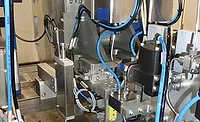
Besides the laser, a laser welding system consists of a power supply, a control unit, and optics to focus and deliver the laser beam. Depending on the application, the setup might also include a fixture to hold the parts; a cooling system; a light-proof, airtight enclosure; a nozzle for shielding gas; an exhaust system to remove any smoke produced during welding; a motion control system to manipulate the workpiece; a vision system to align the laser and inspect the weld; and a code reader so that welding data can be matched with specific assemblies.
To produce a seam weld around the circumference of a pacemaker case or other implantable device, the laser is paired with a four-axis CNC motion control system. As the assembly is rotated, the system keeps it at a fixed distance from the laser. This ensures that the entire weld receives a consistent amount of energy.
Once the parts are loaded into the fixture and the welding program is set, the vision system scans the assembly to align the laser. Then, the laser performs a few spot welds around the assembly to tack the parts in place. This keeps the parts from creeping due to the heat. Next, the laser performs the seam weld, and the assembly is inspected.
With most implantable devices, the case is assembled with a butt joint. The most significant requirement for reliable laser welding is a close fit at the joint interface, says Cicco. If the interface is too far apart, there will be insufficient weld material to bridge the gap or the weld will be undercut. For best results, the gap should be zero or an interference fit. If that's not possible, the gap should ideally be no more than 10 percent of the thinnest material in the joint.
Spot welds for medical devices are accomplished in much the same way as seam welds. However, instead of a series of overlapping pulses, the joint receives a single shot of energy.
Some pulsed Nd:YAG lasers have special features to increase the reliability and repeatability of the welding process, says Cicco. For example, real-time power feedback, through pulse width modulation of the source current, ensures that laser pulses remain constant throughout the life of the flash lamp. With another feature, power ramping, laser power is gradually increased at the beginning and end of the weld. This prevents cracking in seam welds and produces a more cosmetic weld. A third useful feature is pulse shaping. With this feature, the power applied by the laser during a single pulse can be adjusted to optimize the weld. For example, power can diminish gradually during the pulse. This minimizes thermal cycling during welding, which helps prevent cracking.
For both spot welds and seam welds, the quality of the joint is determined by the peak power density and duration of each laser pulse, says Cicco. For seam welds, several other factors are also important, including the the welding speed, the number of pulses per second, and how much each pulse overlaps.
Looking for a reprint of this article?
From high-res PDFs to custom plaques, order your copy today!