Digital Twins Streamline Auto Manufacturing
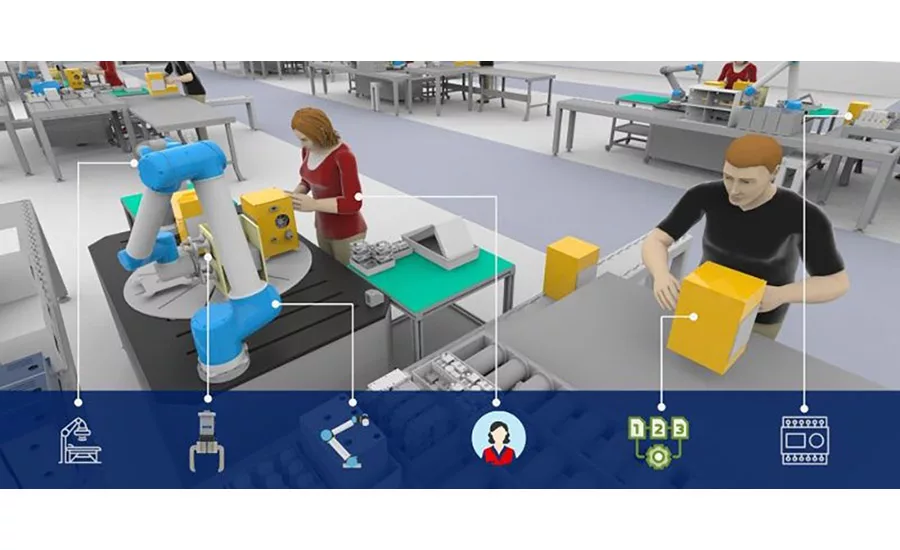
Digital twins and other Industry 4.0 technology enable manufacturers to improve assembly line efficiency.
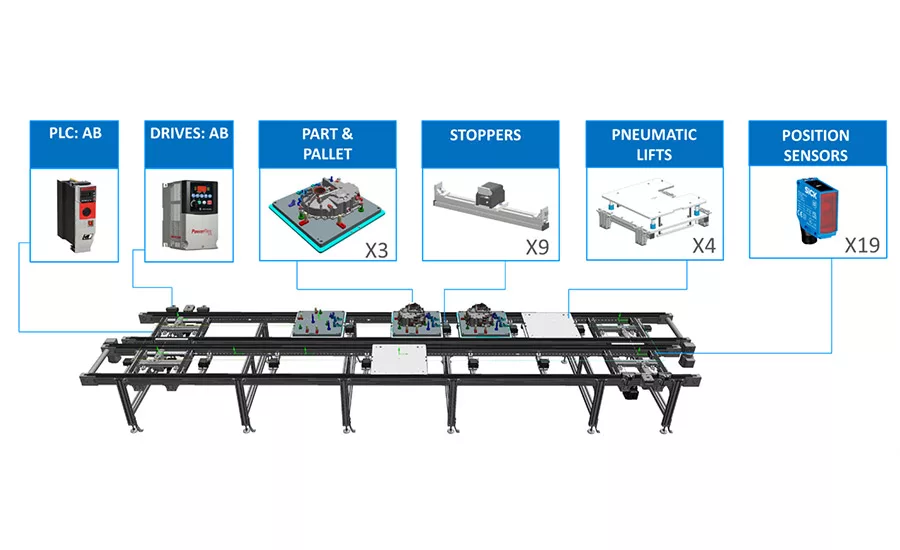
Simulations can be used to design, verify, optimize and validate operational dynamics.
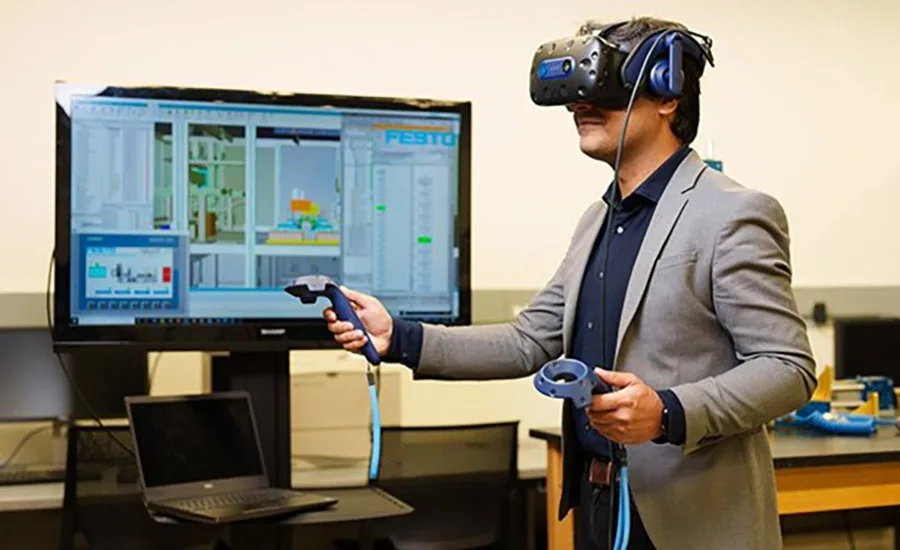
Oakland University’s Master of Science in Smart Manufacturing program integrates augmented and virtual reality, in addition to other state-of-the-art technology.
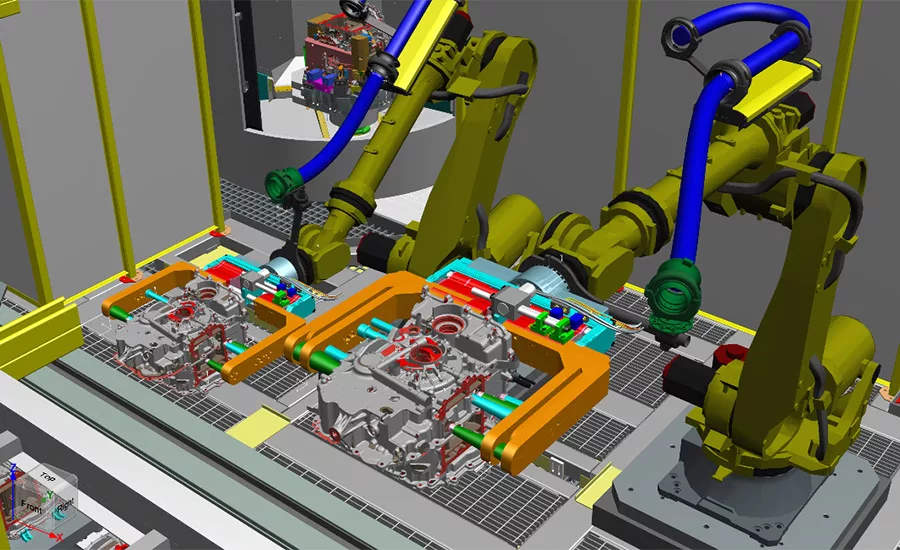
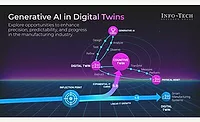
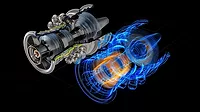
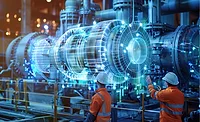
A digital twin is a virtual counterpart of a physical assembly system.
As human-robot collaboration increases, industrial automation becomes more complex. That limits the application of cobots in labor-intensive processes, such as automotive trim and final assembly lines.
When introducing new vehicle models, each launch can demand extensive reconfiguration of existing production lines. Timing is critical and every delay carries a significant cost. Digital twin technology can help engineers tackle that issue.
“In many ways, bringing a new vehicle to market has become a race against time,” says Ali Ahmad Malik, Ph.D., an assistant professor of industrial and systems engineering at Oakland University who has been studying the topic. “Behind the complexity lies a manufacturing system that must be commissioned, reconfigured, retested and revalidated—often under immense pressure.”
“Engineers work around the clock to integrate new robots, sensors and control systems while production deadlines loom,” explains Malik. “A control logic error or misaligned robot path can halt an entire line, costing the company thousands of dollars every minute.
“Ramp up and reconfigurations can lead to weeks of downtime, unexpected errors during commissioning and costly on-site troubleshooting,” Malik points out. “For example, introducing a new robotic welding cell may require hundreds of hours of manual code validation and safety testing.
“These challenges have only intensified with the shift toward innovative vehicle concepts—lightweight materials, autonomous driving technologies, compact yet powerful engines and software-defined cars,” claims Malik. “At the same time, new manufacturing paradigms, such as lights-out production, human-robot teams, industrial IoT and smart factories, are pushing manufacturers to rethink traditional processes at every level.”
Oakland University recently launched a Master of Science in Smart Manufacturing program that integrates Industry 4.0 technologies designed to create intelligent, adaptive and efficient production systems. The curriculum enables engineers to focus on several areas of specialization, including artificial intelligence, augmented/virtual reality, collaborative robotics and digital twins.
Looking for quick answers on assembly and manufacturing topics? Try Ask ASM, our new smart AI search tool. Ask ASM
“A digital twin is a virtual counterpart of a physical assembly system that is made as a ‘front runner’ for validation and control throughout its design, build and operation,” says Malik. “As a digital representation of both the components and dynamics of a physical system, digital twins are enabled by advancements in virtualization, sensing technologies and computing power.”
Malik’s recent research project, funded by a grant from Festo Corp., examined how digital twin technology can reduce development time, complexity and reconfiguration efforts. He explored how digital twins affect human-robot assembly systems at a manufacturing facility in Denmark.
Malik created a digital twin model of two interconnected spaces—one physical and one digital. The digital space was a three-dimensional virtual representation of the human and robot, while the physical space represented the real production system composed of humans, robots and other hardware.
In the design phase, a digital twin was used to select the resources of the assembly system corresponding to the production requirements and its relationship with the rest of the system. Dynamic simulation showed that the digital twin can continuously be evolved from manual data syncing to automated and real-time data, thus enabling greater usefulness at the system level.
“A digital twin can lead the optimized behavior of a physical system by creating its time-dependent accurate virtual model and simulating it,” says Malik. “With each change introduced in production parameters of the physical system, new variables are simulated to predict corresponding future behavior and highlight required optimizations.
“The behavior can be visualized and assessed without the risk of any financial loss or human injury that may otherwise be present in the real production,” Malik points out.
“The behavior can be visualized and assessed without the risk of any financial loss or human injury that may otherwise be present in the real production.”
– Ali Ahmad Malik, Ph.D.
“Advancements in virtualization, sensing technologies and computing power has evolved the concept of digital twins,” explains Malik. “A digital twin is a high-fidelity trustworthy and fit-for-purpose computational model of a complex manufacturing system.
“Simulations with highly accurate, perfectly rendered and polymorphic environments of large-scale real-time systems, when connected with smart sensor feedback and machine learning methods, can be regarded as digital twins,” claims Malik. “They can be used to design, verify, optimize and validate a manufacturing system’s operational dynamics during the early design phase, commissioning, reconfiguration and end-of-life stages.”
One application of digital twin technology is virtual commissioning. It’s implemented using software-in-the-loop and hardware-in-the-loop methods, which replace all or part of the hardware with simulated or emulated components to create a virtual manufacturing system as close to the real system as possible.
Virtual commissioning can accelerate changeovers and facilitate system reconfigurations. The same models can also be evolved to develop control programs, robot codes, safety system verification and codes for CNC machines.
“Developing a digital twin isn’t straightforward, due to various associated challenges,” notes Malik. “There’s no universally agreed-upon definition. Additionally, the nature and level of detail of a digital twin are determined by the specific use case for which it’s intended.
“A practical approach to digital twin development involves deploying standards to enable consistent digital representation, data exchange and interoperability,” says Malik. “Examples include ISO 23247 for virtual representations, IEC PAS 63088 for data modeling, ISO 10303-242 for 3D engineering data exchange and USCAR-53 for unified industrial communication in the automotive manufacturing sector.”
ISO 23247 defines the general architecture for digital twins in manufacturing. IEC 63278-1 (asset administration shell) provides structured digital representations of assets. ISO 10303-242 extends the STEP (STandard for the Exchange of Product model data) standard to improve semantic interoperability in industrial automation. SAE/USCAR-53 further supports standardized machine-level communication through data models and protocols such as MQTT (Message Queuing Telemetry Transport) and JSON (JavaScript Object Notation).
In one R&D project that Malik conducted with the United States Council for Automotive Research, a robotic assembly system for an automotive company was virtually optimized, debugged, verified and validated. It reduced the physical commissioning process by weeks.
The process involved building detailed simulations of automated conveyor lines, robotic cells with modular grippers and CNC machining centers. Multiple simulation and emulation tools from different vendors were integrated to create a high-fidelity digital twin.
It provided not only visualization and robot kinematics, but also interference checks, calibration with the real robot, offline robot programming, CNC emulation, control logic, drive systems, HMI interfaces and safety validations.
“A common concern among manufacturers is the return on investment of digital twins,” says Malik. “A systematic assessment compares development costs—including software, hardware, and expertise—with measurable benefits, such as reduced changeover times, fewer errors, faster commissioning and improved flexibility.
“When implemented effectively, the resulting gains in efficiency and quality can significantly outweigh the initial investment, clearly demonstrating the strong business case for digital twins,” adds Malik.
Looking for a reprint of this article?
From high-res PDFs to custom plaques, order your copy today!