Manufacturing History
25 People Who Shaped American Manufacturing
Key breakthroughs and innovations have transformed U.S. factories over the last 250 years.
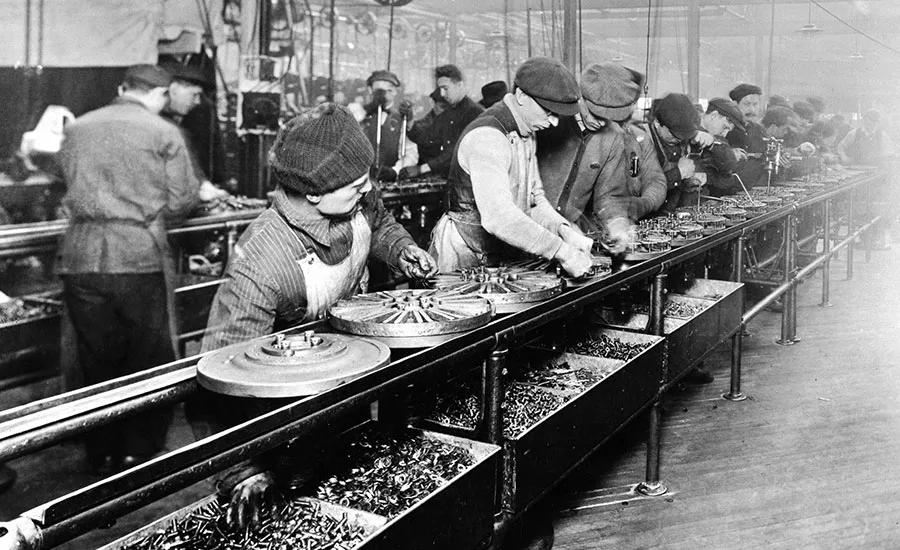
The history of American manufacturing, including the assembly line, can be traced through 25 innovators.
On Dec. 5, 1791, Alexander Hamilton delivered a “Report on the Subject of Manufactures” to the U.S. Congress in Philadelphia. In his remarks, he stressed, “Not only the wealth, but the independence and security of a country, appear to be materially connected to the prosperity of manufactures.” Hamilton’s goal was to break Britain’s manufacturing stranglehold on the United States.
This month, the U.S. is celebrating its semiquincentennial. Thanks to a variety of breakthroughs and innovations in the world of manufacturing, America today is much different than it was in the late 18th century.
In honor of the country’s 250th birthday, here’s a brief look at 25 people who were responsible for breakthroughs and innovations that helped U.S. manufacturers grow and thrive.
Some of the people are well known, such as Oliver Evans and Eli Whitney. Others, such as Thomas Blanchard and Alton Shaw, are more obscure and have been lost to history.
And, unlike similar lists that typically include Henry Ford, this one does not. That’s because Ford tended to take a lot of credit while others, such as Charles Sorensen, did the actual work and are often overlooked by historians and school children.
The list below includes people who impacted various aspects of manufacturing—everything from automation, continuous improvement, ergonomics and material handling to plant floor layout, product design, productivity and quality.
The list focuses on individuals who made contributions to manufacturing at least 25 years ago or more. Therefore, it does not include people like Chuck Hull, Ray Kurzweil and Gordon Gould who were responsible for technology that is currently transforming factories around the world such as additive manufacturing, artificial intelligence and laser welding.
Looking for quick answers on assembly and manufacturing topics? Try Ask ASM, our new smart AI search tool. Ask ASM
Compiling a list like this is a daunting task. Inevitably, someone will be unintentionally omitted. This list is in alphabetical order and is not meant to be exhaustive. It is merely an attempt to show how a diverse group of individuals from various backgrounds and eras tackled production challenges to help American manufacturers achieve Hamilton’s dream.
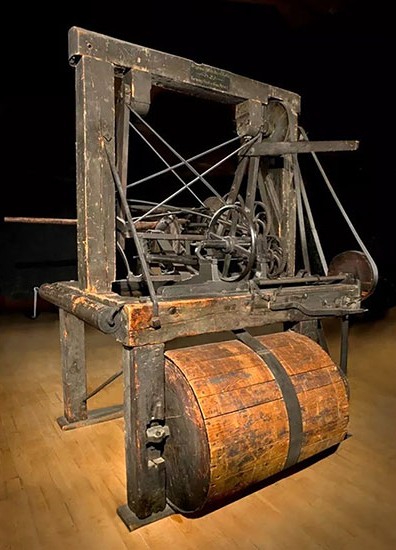
Thomas Blanchard’s lathe is credited with putting America on the road to industrialization. Photo courtesy Springfield Armory National Historic Site
Thomas Blanchard
Thomas Blanchard (1788-1864) was a prolific inventor who patented a wool-cloth shearing machine when he was only 25 years old. Several years later, he received a U.S. patent for a machine that could mass-produce 500 tacks a minute.
However, Blanchard’s greatest inventions revolutionized the firearms industry. For instance, he created a lathe that made it possible to mass-produce gun stocks and other wooden shapes.
Blanchard’s lathe coordinated the motions of a tracer pressing against a revolving model with a cutting wheel. It acted on a revolving workpiece so that the machine cut a three-dimensional copy of the model. By 1818, Springfield Armory had this machine in operation.
Blanchard’s lathe mechanized much of the traditional handwork of gunstock production. The machine was eventually applied to the commercial production of everything from axe handles to wagon wheel spokes.
“The invention and development of stockmaking machinery by Thomas Blanchard set American manufacturing firmly on the road toward mechanized production,” says David Hounshell, Ph.D., professor emeritus at Carnegie Mellon University and the author of From the American System to Mass Production, 1800-1932.
“But [this lathe] alone would not have so easily pointed the way had Blanchard not linked it sequentially with additional and more special-purpose machines that carried out the remainder of operations on the stocks, such as recessing for the barrel and lock, and mortising for the trigger mechanism,” claims Hounshell. “Hand labor was virtually eliminated.”
In 1826, Blanchard built the first American automobile, a 2,000-pound steam-powered machine that he drove in Springfield, MA.
Geoffrey Boothroyd
Geoffrey Boothroyd, Ph.D. (1932-2024) began conducting research in 1963 that focused on automatic feeding and orienting techniques for small parts. While serving as an engineering professor at the University of Massachusetts in the early 1970s, he began studying what would become the basis of the Design for Manufacture and Assembly (DFMA) method.
In 1982, Boothroyd wrote an article for ASSEMBLY magazine entitled “Design for Producibility—The Road to High Productivity.” It explained how Xerox Corp. achieved considerable reduction in assembly time by reducing parts count and “improving the assemblability of the remaining parts.” The article generated more than 1,000 letters from engineers eager to harness the power of computers.
Boothroyd teamed up with Peter Dewhurst, Ph.D., a professor at the University of Rhode Island, and founded Boothroyd Dewhurst Inc. in 1983 to commercialize DFMA methodologies. He also wrote several influential books, including Assembly Automation and Product Design, which espoused the principles of DFMA.
Boothroyd’s studies demonstrated that reducing the number of parts—rather than merely simplifying them—was the key to lowering assembly labor and overall costs. His work led to a paradigm shift in design thinking that influenced generations of engineers.
Joseph Brown
Joseph Brown (1810-1876) was a machinist who pioneered near-perfect screw threads and thousands-of-an-inch measurement instruments that made interchangeable parts and mass-production possible. He founded Brown & Sharpe Manufacturing Co.in Providence, RI, a firm that literally “shaped” American manufacturing by building standard jigs, fixtures and gauges that ensured precision.
Brown’s first significant invention was a pocket vernier caliper in 1851 that revolutionized portable precision measurement. In 1857, he introduced a standardized wire gauge system that formed the foundation of today’s American Wire Gauge (AWG). A decade later, Brown unveiled the world's first practical micrometer, which he called the Pocket Sheet Metal Gage.
Brown went on to invent a variety of precision tools, including the universal milling machine and the universal grinding machine. Both devices were created to enable the mass-production of sewing machines.
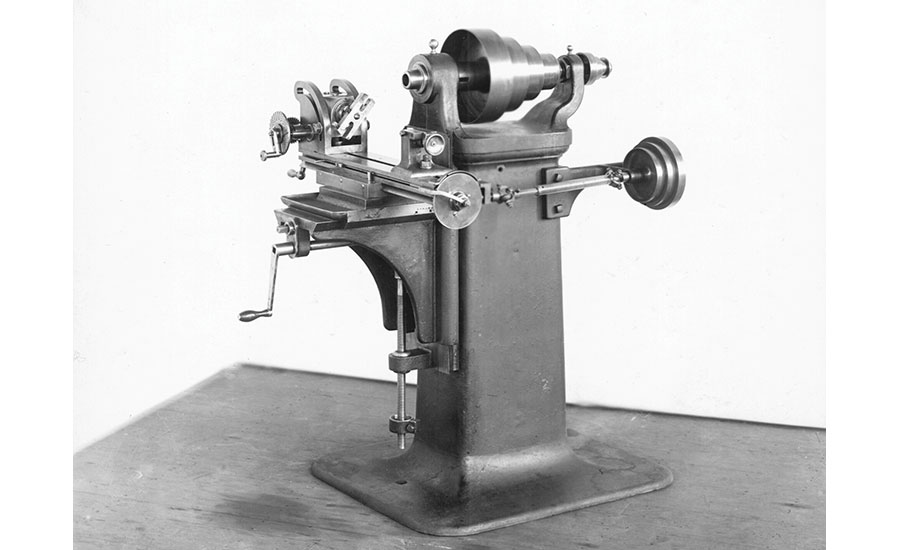
Joseph Brown invented several devices that made interchangeable parts and mass production possible, such as the universal milling machine. Photo courtesy Rhode Island Historical Society
Henry Burden
Henry Burden (1791-1871) developed an automated horseshoe manufacturing machine in Troy, NY, that received a U.S. patent in 1835. It could produce 60 horseshoes per minute or 3,600 per hour. It was hailed as one of the technical marvels of the age. The machine completed a finished shoe without the touch of a hand or external process.
The machine took a red-hot iron bar and cut off a correct length before a series of dies pressed the bar into shape, thinning the inner edge and pinching and thickening the heels, while forming the grooves and punching the nail holes. Some historians believe that Burden’s horseshoe machine is the reason why the Union Army won the U.S. Civil War in the early 1860s.
The Scots immigrant also invented a similar machine for mass-producing iron railroad spikes. He waged a decades-long patent battle over the device, which helped fuel the rapid expansion of railroads in the United States.
In addition, Burden built a giant iron water wheel to power his factory, which served as the inspiration behind the Ferris Wheel several decades later. And, the prolific inventor created a variety of iron-making machines that spurred the development of that industry.
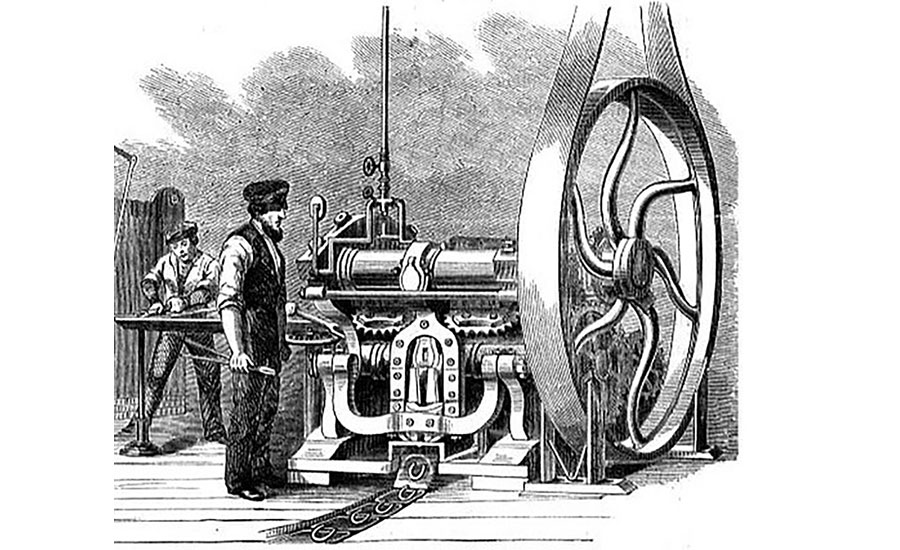
Henry Burden’s automated horseshoe manufacturing machine was hailed as one of the technical marvels of the 1830s. Illustration courtesy Hudson Mohawk Industrial Gateway
George Corliss
George Corliss (1817-1888) was “Mr. Steam.” He didn’t invent the stationary steam engine, but he improved upon it by developing a rotary valve mechanism that enabled machines to maintain an almost constant speed. Corliss steam engines were 25 percent more efficient than comparable machines.
The Corliss Steam Engine Works, formed in Providence, RI, in 1848, soon became the largest producer in the world. Corliss continued to perfect the steam engine and eventually held 69 U.S. patents.
Until electric motors began to replace steam power in factories starting in the 1890s, steam was supreme. The devices ran everything from textile mills and laundries to elevators and printing presses. They also powered drill presses, drop hammers, lathes, mills and other machine tools in factories through an elaborate network of overhead line shafts and leather belts.
In 1875, Corliss built a massive 1,400-horsepower machine that was 45 feet tall and weighed 56 tons. It was the star attraction of the 1876 Centennial Exhibition in Philadelphia.
When the world’s fair ended, the steam engine was purchased by George Pullman, dismantled and moved to Chicago in 35 freight cars. It remained in operation for 30 years until the company switched to electricity in 1910.
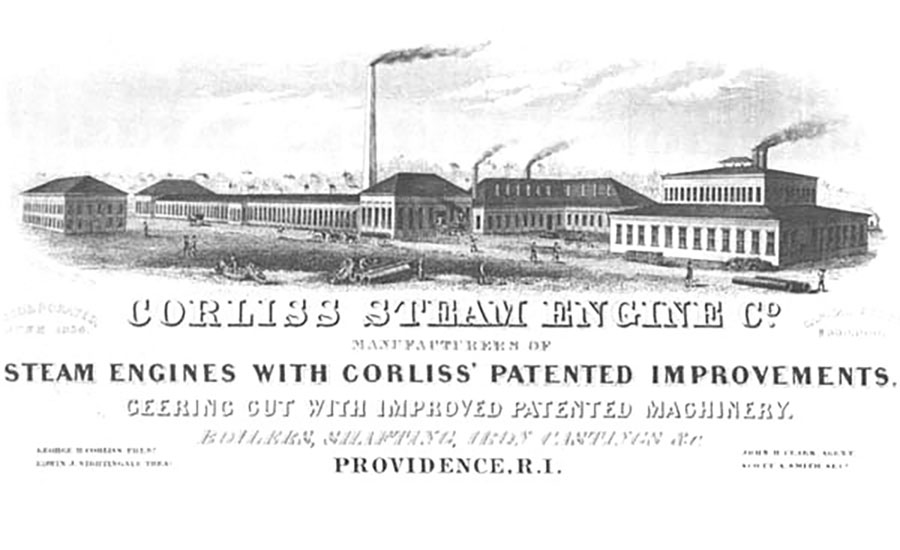
George Corliss perfected and mass-produced steam engines that were used by numerous manufacturers. Illustration courtesy New England Steam Museum
W. Edwards Deming
W. Edwards Deming (1900-1993) was “Mr. Quality.” He was best known for his pioneering work in Japan after World War II. Beginning in the summer of 1950, he taught engineers and managers methods for improving their operations.
As a trusted consultant, Deming significantly contributed to the dramatic turnaround of postwar Japanese industry and the country’s miracle rise to become a leading global economic power. Deming has been called the “father of the third wave of the industrial revolution.”
In 1980, a documentary film entitled “If Japan Can, Why Can’t We” reintroduced Deming to America. He quickly became the voice of quality and sparked a movement in U.S. manufacturing. Deming consulted with Ford, Xerox and other corporations whose businesses were revitalized after adopting his management methods.
Deming also wrote several influential books, including 14 Points for Management, in which he laid out his philosophy of continuous improvement and quality control.
Thomas DeVilbiss
Thomas DeVilbiss (1878-1928) invented the first practical handheld, air-powered industrial spray gun in 1907. He adapted a medical atomizer that his father, Dr. Allen DeVilbiss, had invented more than 15 years earlier to treat throat infections. By blowing compressed air across the top of a pickup tube submerged in liquid, DeVilbiss created a controllable pattern of atomized material.
The spray gun was quickly adopted in the automotive and furniture industries for painting and coating applications, because it dramatically improved productivity and reduced drying times from weeks to hours. The DeVilbiss Co. eventually developed a full line of spray guns, air compressors and paint booths that were used by a variety of manufacturers.
In the early 1920s, GM’s Oakland brand mass-produced the first car to be fully spray-painted, using a new fast-drying nitrocellulose lacquer developed by DuPont called Duco. Applied with DeVilbiss spray guns, this innovative method drastically reduced production times from days to hours, replacing slow brush-painting techniques with a more efficient, durable and lustrous finish.
Within a decade, DeVilbiss engineers developed automatic spray painting and finishing equipment that further increased productivity in the auto industry. The DeVilbiss Co. merged with Champion Spark Plug Co. in 1970 and was acquired by Illinois Tools Works in 1990.
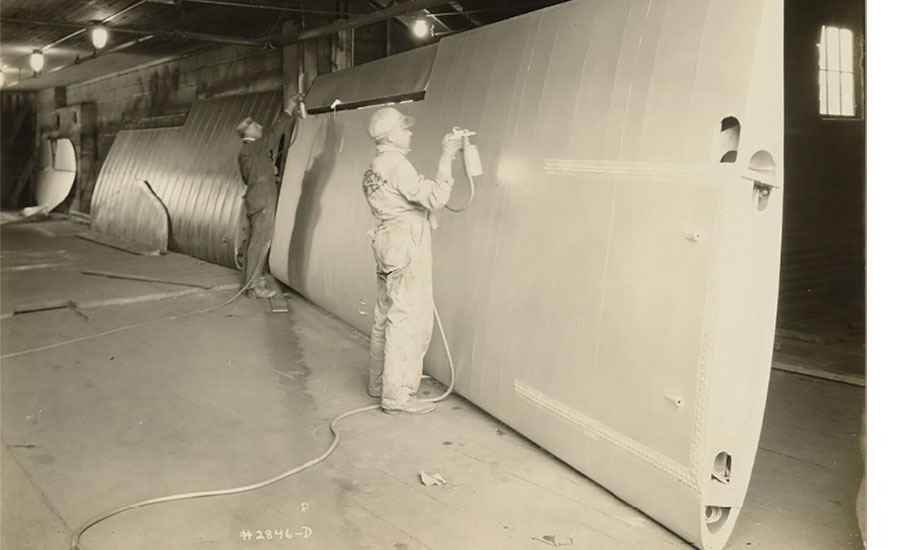
Thomas DeVilbiss invented the first practical handheld, air-powered industrial spray gun. Photo courtesy National Automotive History Collection, Detroit Public Library
Charles Engelberger
Charles Engelberger(1925-2015) is considered to be the other “father” of industrial robotics. In the mid-1950s, he was in charge of engineering at the aircraft parts division of Manning, Maxwell and Moore Co. in Stratford, CT, which produced a variety of analog gauges.
Working with George Devol Jr. (1912-2011), Engelberger experimented with various types of servo controls. The two engineers eventually developed a one-armed robot and formed a company called Unimation Inc. in 1956. Its first machine, dubbed the Unimate 1, used hydraulic pressure to extend an arm up to 4 feet. The end effector used compressed air to grasp objects that weighed up to 25 pounds.
The first industrial robot application took place at a General Motors plant in Ewing, NJ, in 1961. The machine was installed at the Ternstedt division plant (part of GM’s Fisher Body subsidiary) to sequence and stack hot metal parts from a die-casting machine. It sequenced and stacked castings that were used to make door handles, gear shift knobs, locks, wheel covers, window regulators, and other types of automotive hardware and trim parts.
Devol received a U.S. Patent for a “programmed article transfer” machine in 1961. Unimation’s business took off slowly, but eventually reached a milestone in the mid-1960s when GM ordered 66 spot welding robots for a new automated factory that it was building in Lordstown, OH. Unimation was acquired by Westinghouse in 1983 and was later absorbed into Stäubli Robotics.
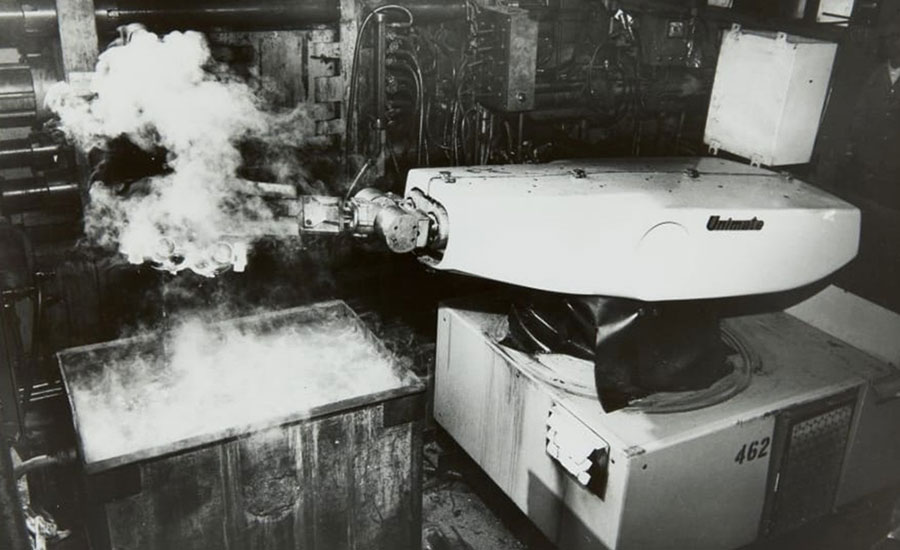
The first industrial robot application took place at a General Motors plant in the early 1960s. Photo courtesy The Henry Ford
Oliver Evans
Oliver Evans (1755-1819) was the first person in the U.S. to experiment with lights-out automation. He was an innovative millwright who created the world’s first continuous production line in 1784.
Evans used a variety of wooden shafts and gears, plus leather and canvas belts, and bucket elevators, to transfer power to a sequence of machines connected to the same waterwheel at flour mills in Newport, DE, and Occoquan, VA.
The automated system of milling made no changes in the way grain was cleaned, ground, cooled, sifted and packed. The main innovation was how grain was moved from one machine to the next in the mill.
Bucket elevators raised the grain from one level to the next in a multi-story mill. A horizontal screw conveyor moved wheat from one operation to another. As a result, the mill could operate with fewer humans than was typically required.
One person was stationed at the beginning of the process, where he poured the grain into a hopper. Another individual was positioned at the other end of the factory, filling sacks with the flour produced by the mill. All the intermediate operations were carried out automatically.
In 1790, Evans received one of the first patents issued in the United States (No. 3) for his automated process. He eventually became the first American manufacturer of stationary steam engines, operating a factory in Philadelphia that produced machines for flour and textile mills, ships and waterworks.
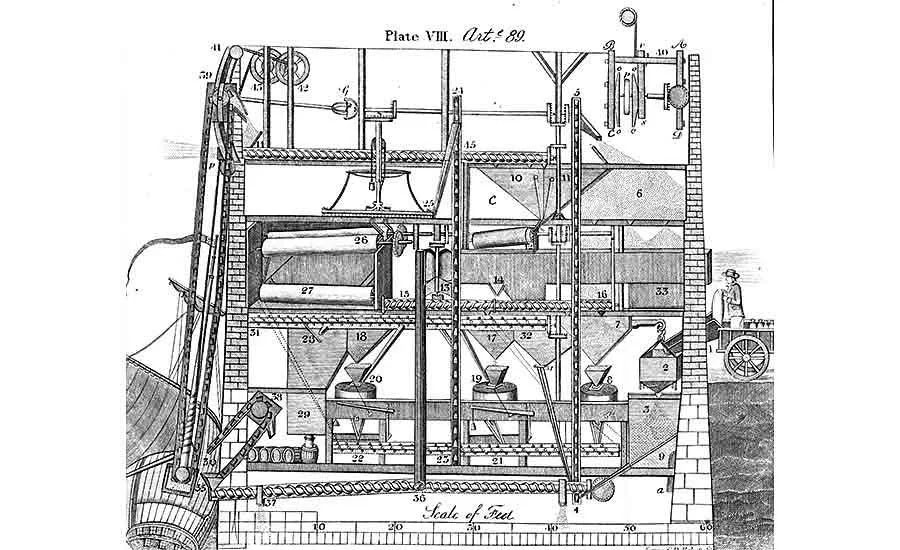
Oliver Evans created the world’s first continuous production line in 1784. Illustration courtesy Society for Industrial Archeology
Lillian Gilbreth
Lillian Gilbreth, Ph.D. (1878-1972) was part of a husband-and-wife team who pioneered production efficiency techniques. Along with Frank Gilbreth (1868-1924), she published a landmark work entitled Applied Motion Study in 1917. The book explained how hand and arm patterns can be studied to change work habits and eliminate wasted motion.
Gilbreth often worked in the shadow of her husband. For instance, only his name appears on a U.S. patent issued in 1916 for a “method and apparatus for the study and correction of motions.”
The Gilbreth’s broke tasks into steps to evaluate the efficiency of workplace processes. They developed process charts and used a motion picture camera to record workers in action. Studying the films enabled them to design equipment to improve efficiency and reduce fatigue, a concept that eventually developed into the field of ergonomics.
They attached lights to the hands of workers and photographed them. Then, they made three-dimensional wire models of the hand paths to help determine more efficient motion patterns.
In 1935, Gilbreth became the first female engineering professor at Purdue University and 30 years later was the first woman elected to the National Academy of Engineering. She also served on a variety of national committees under presidents Hoover, Roosevelt, Truman, Eisenhower, Kennedy and Johnson.
Two of Gilbreth’s 12 children wrote Cheaper by the Dozen, which was made into a popular movie in 1950 and 2003.
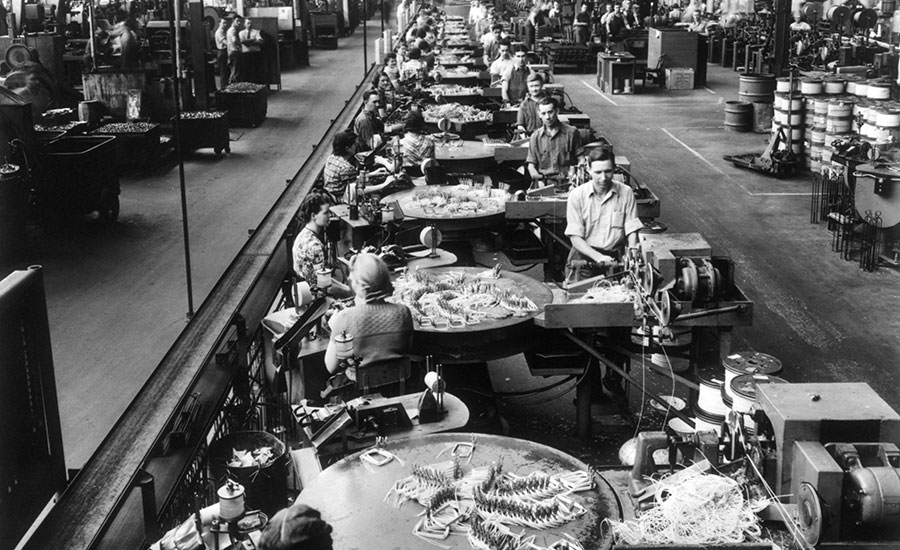
Lillian and Frank Gilbreth studied production efficiency techniques. Photo courtesy General Motors
Delmar Harder
Delmar Harder (1892-1973) created the Automation Department at Ford Motor Co. in 1947, when he served as the automaker’s vice president of manufacturing. Harder and his team of engineers devised an innovative system of electronic controls.
To meet postwar demand for cars, Ford built the world’s first two factories designed for extensive use of automation: the Buffalo Stamping Plant and the Cleveland Engine Plant and Foundry, which both opened in the early 1950s.
The new facilities featured “iron hand” devices that could automatically load and unload transfer machines and stamping presses making parts and components. In addition, they carried out other functions, such as inspection, gauging and weighing, that traditionally had been done by humans.
Automatic conveying equipment in the plants was controlled by a hard-wired control panel that used telephone-type relays. Power-and-free conveyors allowed for greater flexibility.
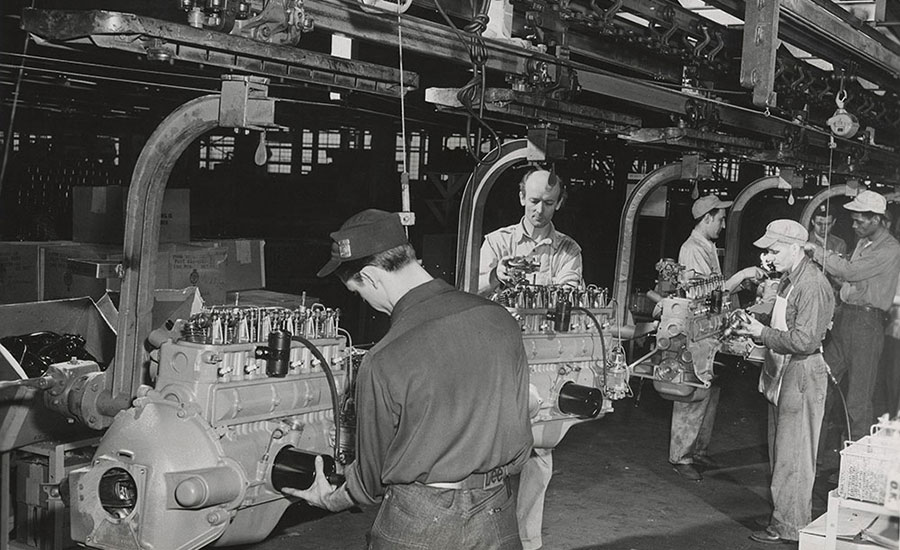
Ford Motor Co.’s Cleveland Engine Plant was one of the world’s first factories to feature extensive use of automation. Photo courtesy AACA Library & Research Center
In the machining department at the Cleveland Engine Plant, 41 inline, transfer-type machines comprising two basic lines were linked in a continuous process 1,200 feet long. Manual handling of engine blocks was necessary only once—at the loading point. This replaced an old method than required 150 separate machines and a worker for each.
Automation reduced direct labor minutes by 49 percent and required 17 percent less floor space than traditional assembly methods. Numerous journalists hailed the automated Cleveland plant as “revolutionary” and compared it to the manufacturing technology advancements made at Ford’s Highland Park factory, the birthplace of the moving assembly line 40 years earlier.
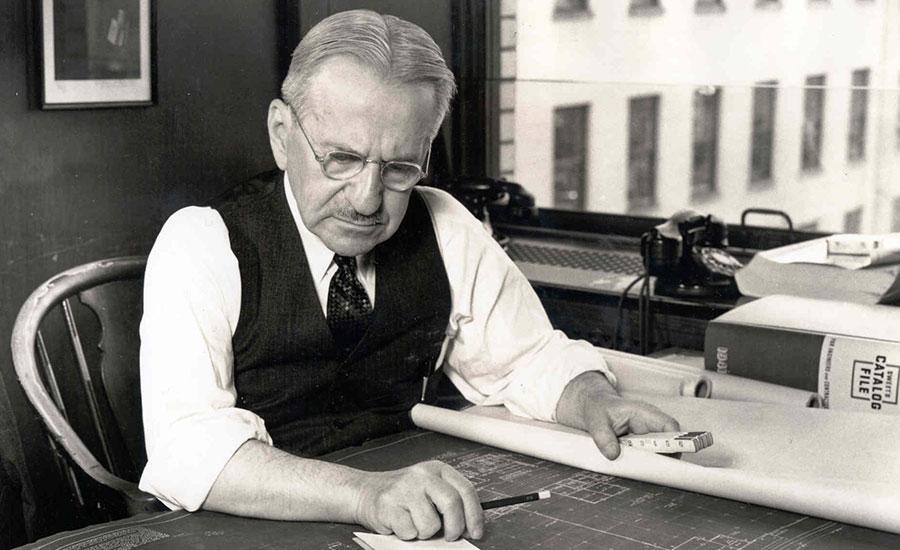
Albert Kahn pioneered the daylight factory concept, which featured large windows and saw-toothed roofs. Photo courtesy Albert Kahn Associates Inc.
Albert Kahn
Albert Kahn (1869-1942) was an architect who specialized in factories. The “architect of industry” is best known for his work in the automotive industry. Kahn, a German immigrant, pioneered the use of reinforced concrete and the daylight factory concept, which featured large windows and saw-toothed roofs.
Kahn designed factories for a who’s-who of clients, including Chrysler, Fisher Body, Ford, General Motors, Hudson, Packard, Pierce Arrow and Studebaker. He also did work for nonautomotive clients, such as Burroughs Adding Machine Co., Curtiss-Wright Corp., the Detroit News, EMD, Glenn Martin Aircraft, Mergenthaler Linotype Co., the Oliver Chilled Plow Co. and the University of Michigan.
Kahn and his colleagues designed economical buildings that could be rapidly constructed so that manufacturers could start production as soon as possible. Their plant floor layouts enhanced efficiency by minimizing material handling and reducing the amount of labor required.
Kahn’s biggest client was the Ford Motor Co., for which he designed hundreds of buildings, including several of his most famous: the Highland Park factory (1910), the Rouge complex (1918-1928) and the Willow Run bomber plant (1941).
Kahn’s most groundbreaking design was the four-story building in Highland Park, MI, that eventually became the birthplace of the moving assembly line in 1914. The “Crystal Palace” was famous for its extensive windows that enabled daylight to pour into the factory. The entire space between the building’s support columns was filled with glass, allowing better illumination and ventilation.
Kahn’s modern design employed a new type of window which replaced cantankerous double-hung assemblies with a simple steel sash supporting glass panes. This style was widely copied throughout the U.S. manufacturing industry.
NOTE: Part 2 of this article will appear in the August issue of ASSEMBLY.
ASSEMBLY ONLINE
For more information on the history of American manufacturing, visit www.assemblymag.com to read these articles.
Looking for a reprint of this article?
From high-res PDFs to custom plaques, order your copy today!