Assembly Magazine logo
search
Ask ASSEMBLY AI
cart
facebook twitter linkedin youtube
  • Sign In
  • Create Account
  • Sign Out
  • My Account
Assembly Magazine logo
  • TRENDS
    • Ask ASSEMBLY AI
    • Trends
    • News
    • New Products
  • INDUSTRIES
    • Aerospace
    • Appliance
    • DFMA Assembly
    • Medical Devices
    • Green Manufacturing
    • Lean Manufacturing
    • Machinery Assembly
    • Electronics Assembly
    • Automotive
  • TECHNOLOGIES
    • Adhesives & Dispensing
    • Assembly Presses
    • Automated Assembly Systems
    • Manufacturing Management
    • Manufacturing Software
    • Motion Control
    • Screwdriving & Riveting
    • Robotics
    • Test & Inspection
    • Plastics & Metal Welding
    • Wire Processing
    • Workstations
  • AUTONOMOUS & ELECTRIC MOBILITY
    • AEM Magazine Archives
    • Autonomy
    • Electrification
    • Mobility Services
    • Assembly & Testing
    • AV/EM News
  • MEDIA
    • Ask ASSEMBLY AI
    • Podcasts
    • Assembly News Now
    • Assembly TV
    • Webinars
    • eBooks
  • EVENTS
    • Calendar
    • The ASSEMBLY Show
  • MORE
    • Exclusives >
      • Plant of the Year
      • Capital Spending
    • Buyers Guide >
      • Supplier Insights
    • Classifieds
    • Featured Products
    • Newsletters
    • Store
    • White Papers
    • Columns
    • Sponsor Insights
  • INFOCENTER
    • Assembly & Test Solutions
  • EMAGAZINE
    • eMagazine
    • Archive Issues
    • Advertise
    • Contact Us
    • Sign Up
Assembly Breaking News Aerospace AssemblyRobotics Assembly

Assembler Robots Build Large Structures From Tiny Pieces

October 30, 2019

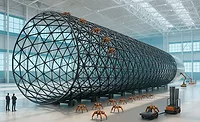
CAMBRIDGE, MA—Engineers at the Massachusetts Institute of Technology (MIT) have developed an army of tiny robots that can assemble large lattice structures, such as aircraft fuselages or wings.

“What’s at the heart of this is a new kind of robotics that we call relative robots,” says Neil Gershenfeld, director of MIT’s Center for Bits and Atoms. “Historically, there have been two broad categories of robotics—ones made out of expensive custom components that are carefully optimized for particular applications, such as factory assembly, and ones made from inexpensive mass-produced modules with much lower performance.

“The new robots, however, are an alternative to both,” claims Gershenfeld. “They’re much simpler than the former, while much more capable than the latter, and they have the potential to revolutionize the production of large-scale systems, from airplanes to bridges to entire buildings.”

According to Gershenfeld, the key difference lies in the relationship between the robotic device and the materials that it is handling and manipulating. “With these new kinds of robots, you can’t separate the robot from the structure,” he points out. “They work together as a system.

“For example, while most mobile robots require highly precise navigation systems to keep track of their position, the new assembler robots only need to keep track of where they are in relation to the small subunits, called voxels, that they are currently working on,” explains Gershenfeld. “Every time the robot takes a step onto the next voxel, it readjusts its sense of position, always in relation to the specific components that it is standing on at the moment.

“The underlying vision is that just as the most complex of images can be reproduced by using an array of pixels on a screen, virtually any physical object can be recreated as an array of smaller three-dimensional pieces (voxels), which can themselves be made up of simple struts and nodes,” adds Gershenfeld.

Gershenfeld and his colleagues have discovered that these components can be arranged to distribute loads efficiently. They are largely made up of open space so that the overall weight of the structure is minimized. The units can be picked up and placed in position next to one another by the simple assemblers, and then fastened together using latching systems built into each voxel.

Looking for quick answers on assembly and manufacturing topics? Try Ask ASM, our new smart AI search tool. Ask ASM →

The robots themselves resemble a small arm, with two long segments that are hinged in the middle, and devices for clamping onto the voxel structures on each end. The devices move around like inchworms, advancing along a row of voxels by repeatedly opening and closing their V-shaped bodies to move from one to the next.

As it works on assembling the pieces, each of the tiny robots can count its steps over the structure. Along with navigation, this lets the robots correct errors at each step, eliminating most of the complexity of typical robotic systems.

“It’s missing most of the usual control systems, but as long as [the robot] doesn’t miss a step, it knows where it is,” says Gershenfeld. “For practical assembly applications, swarms of such units could be working together to speed up the process.

“One advantage of such assembly is that repairs and maintenance can be handled easily by the same kind of robotic process as the initial assembly,” claims Gershenfeld. “Damaged sections can be disassembled from the structure and replaced with new ones, producing a structure that is just as robust as the original. This process can also be used to make modifications or improvements to the system over time.”

KEYWORDS: Massachusetts Institute of Technology robotics research

Share This Story

Looking for a reprint of this article?
From high-res PDFs to custom plaques, order your copy today!

Recommended Content

JOIN TODAY
To unlock your recommendations.

Already have an account? Sign In

  • Made in the U.S.A.

    Consumer Products Manufacturing: Made in the USA

    Supply chain lessons learned during the coronavirus...
    Automated Assembly Systems
    By: Austin Weber
  • Best Practices for Press-Fit Assembly

    Best Practices for Press-Fit Assembly

    In manufacturing, ironclad formulas for success are hard...
    Assembly Presses
    By: Jim Camillo
  • aem0523leader-tesla1.jpg

    Tesla Rethinks the Assembly Line

    Engineers at Tesla Inc. have developed a new process that...
    Electrification
    By: Austin Weber
Manage My Account
  • eMagazine Subscription
  • Assembly Newsletters
  • Online Registration
  • Subscription Customer Service
  • Manage My Preferences

More Videos

Sponsored Content

Sponsored Content is a special paid section where industry companies provide high quality, objective, non-commercial content around topics of interest to the ASSEMBLY audience. All Sponsored Content is supplied by the advertising company and any opinions expressed in this article are those of the author and not necessarily reflect the views of ASSEMBLY or its parent company, BNP Media. Interested in participating in our Sponsored Content section? Contact your local rep!

close
  • ultrasonic welding
    Sponsored bySonobond Ultrasonics

    Engineering Efficiency in High-Performance Assembly: How Ultrasonic Welding Enhances Throughput, Reliability and Quality

  • UV curing system
    Sponsored byDymax

    Why UV Intensity Alone Doesn’t Define Curing Performance

  • wooden pallets
    Sponsored byLEAN Manufacturing Products

    Eliminating Waste on the Shop Floor: Applying Lean Principles to Improve Manufacturing Efficiency

Popular Stories

Ferrari

Ferrari Unveils Four-Door EV

ASSEMBLY News Now, episode-30: Volvo Redesigns EV Manufacturing

Volvo Redesigns EV Manufacturing

automated consumer goods assembly system

Best Practices for Cycle Time Optimization

Watch the latest episode of ANN now!

Events

July 24, 2025

From Shop Floor to CFO: How Manufacturers Are Closing the Loop Between Operations and Finance

On Demand Learn how manufacturers are bridging the gap between the shop floor and ERP systems to gain real-time visibility, streamline operations, and kick-start digital transformation—without waiting years.

Sponsored by:

PicoStratusGreen
July 30, 2025

Buffer Analysis and Design Fundamentals for Manufacturing Excellence

On Demand In this presentation, Dr. Herman Tang shares practical insights from his industry experience and research on buffer management in manufacturing operations.

View All Submit An Event

Poll

Difficult Assembly Processes

Which assembly process gives you the most difficulty?
View Results Poll Archive

Products

Manufacturing Cost Policy Deployment (MCPD) Profitability Scenarios: Systematic and Systemic Improvement of Manufacturing Costs

Manufacturing Cost Policy Deployment (MCPD) Profitability Scenarios: Systematic and Systemic Improvement of Manufacturing Costs

See More Products
Register for webinar - Modernizing Automotive Assembly: Why Upgrading Legacy MES is a Business Imperative

Related Articles

  • New Technology Assembles Big Structures From Small Pieces

    See More
  • assembling a large airship with robotic swarms

    Robotic Swarms Will Assemble Large Aerospace Structures

    See More
  • SKC 11-17

    SKC to Build Large Semiconductor-Substrate Plant by 2023

    See More

Related Products

See More Products
  • history.jpg

    Faster, Better, Cheaper in the History of Manufacturing: From the Stone Age to Lean Manufacturing and Beyond

  • Kaizen Assembly: Designing, Constructing, and Managing a Lean Assembly Line

See More Products

Related Directories

  • One-Off Robotics

    One-Off Robotics is an advanced equipment manufacturer designing and building the world's most innovative robotic fabrication systems. We specialize in robotic metal additive manufacturing and robotic milling, offering both stationary and portable, field-deployable systems engineered for demanding production environments. Our technologies enable additive, subtractive, and hybrid fabrication processes, supporting applications across Defense, Aerospace, Research, and Specialized Production sectors.
  • Assembly & Automation Technology Inc.

    Assembly & Automation Technology delivers intelligent automation systems integrating machine learning, computer vision and smart robotics for industrial, medical and biotechnical applications. Our AI-enhanced assembly machines, robotic systems and vision-guided quality control optimize productivity while reducing human error. We engineer custom automated solutions that learn, adapt and continuously improve manufacturing processes.
  • Epson Robots

    DistributorsCALIFORNIAEpson Robots1650 Glenn Curtiss St.Carson,  CA(562) 290-5997  www.epsonrobots.cominfo@robots.epson.com
×

Never miss the latest news and trends driving the manufacturing industry

Stay in the know on the latest assembly trends.

JOIN TODAY!
  • RESOURCES
    • Advertise
    • Contact Us
    • Directories
    • Manufacturing Division
    • Store
    • Want More?
  • SIGN UP TODAY
    • Create Account
    • eMagazine
    • Newsletters
    • Customer Service
    • Manage Preferences
  • SERVICES
    • Marketing Services
    • Reprints
    • Market Research
    • List Rental
    • Survey/Respondent Access
  • STAY CONNECTED
    • LinkedIn
    • Facebook
    • Instagram
    • YouTube
    • X (Twitter)
  • PRIVACY
    • PRIVACY POLICY
    • TERMS & CONDITIONS
    • DO NOT SELL MY PERSONAL INFORMATION
    • PRIVACY REQUEST
    • ACCESSIBILITY

Copyright ©2026. All Rights Reserved BNP Media, Inc. and BNP Media II, LLC.

Design, CMS, Hosting & Web Development :: ePublishing