What’s New With Labels and Label Printers
Durable materials and proven printing methods ensure a high-quality label for any size part.
Like workers in other industries, those on assembly lines can never afford to take the wrong things for granted. Assuming that automation will always be reliable or that just-good-enough products will keep customers coming back definitely shows a lack of foresight.
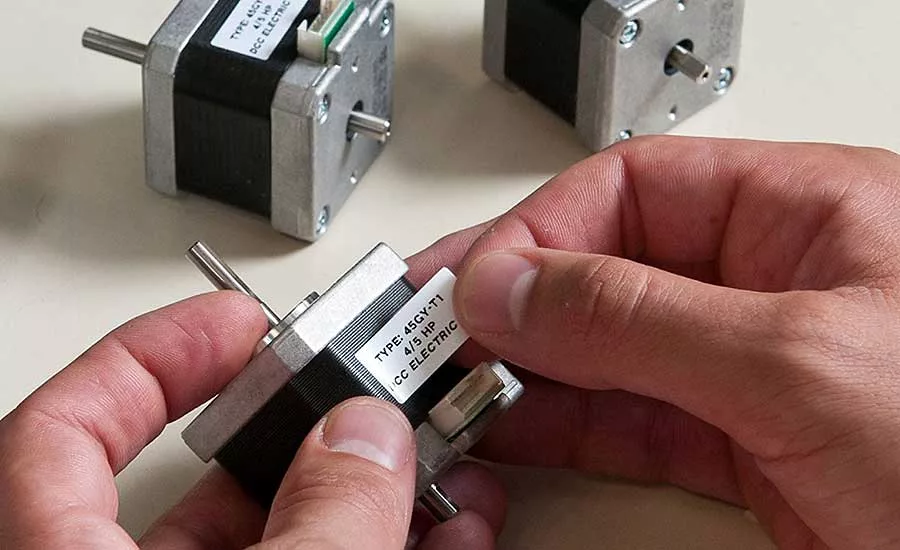
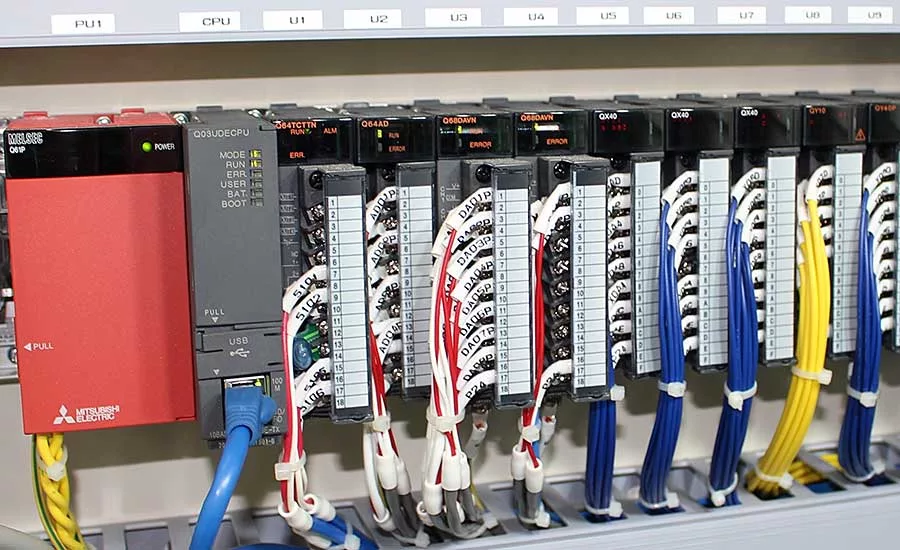
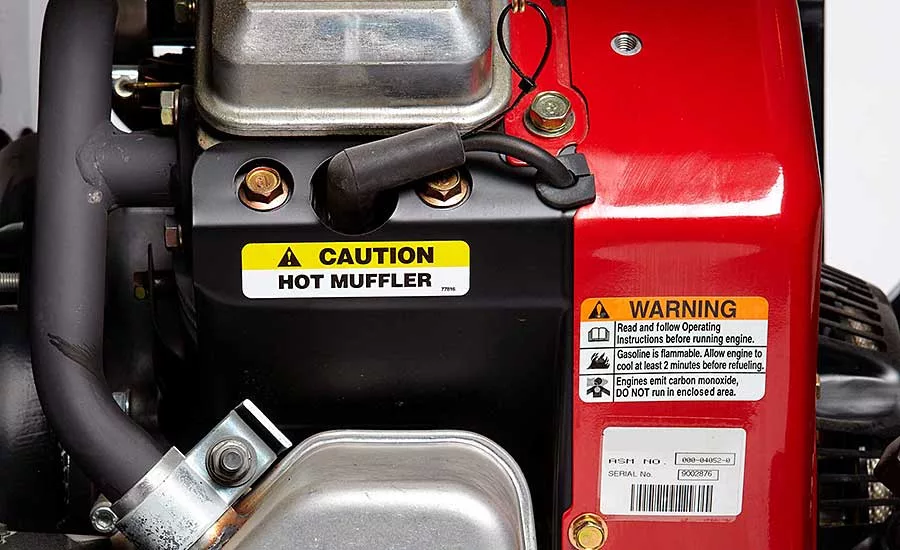
Another thing that assembly line workers should not take lightly is part labeling. Improperly applied labels make it harder for fellow workers to clearly see important information from any angle. Such labels also make it more difficult to scan the label bar code, which is an essential step for full part traceability and bringing up key part information on an HMI for the worker to validate.
“Accuracy is very important when labeling any part, regardless of its size,” says Tracy Tenpenny, vice president of sales at Tailored Label Products (TLP). “The label inside a car door jamb may be easier to apply than a label placed on a small switch, but both need to be done properly. A manual approach could work in either case. For the switch, a 3D-printed fixture could be set up to keep each label in place as the worker pushes the small part against it.”
Recently, an electric vehicle (EV) manufacturer’s exponential growth required it to find a label supplier with a proven record of adaptability. The manufacturer contacted TLP, which tested the construction of the customer’s current thermal transfer label, before introducing and testing an alternative label construction based on EV industry performance requirements.
TLP performed this testing in its own lab, as well as with a third party. According to Tenpenny, the results showed TLP’s alternate material outperformed the incumbent label and that the latter failed several performance requirements. Better yet, TLP’s alternate material costs 31 percent less.
Technology keeps advancing on both the label and label-printer side, and that’s a great thing. It not only lessens the challenge manufacturers face when finding the right printer to make the best labels for an application. It better enables them to properly and efficiently apply these labels to as many parts as needed.
How It’s Made Matters
“Think of a label as a sandwich with several thin layers,” explains Ali Arghavani, global product manager for product identification at Brady Corp. “At the bottom is the release liner, and above that is the pressure-sensitive adhesive, the film and topcoat.”
Looking for quick answers on assembly and manufacturing topics? Try Ask ASM, our new smart AI search tool. Ask ASM
The pull-off liner keeps dust and debris away from the adhesive, which affixes the label to the part. But, the real backbone of the label, according to Arghavani, is the film, also known as the face stock. Labels are made with multiple layers to meet customer needs depending on their applications, many of which are unique and complicated.
“The topcoat serves as the background for printing,” notes Arghavani. “Printed characters include text, numbers, 1D or 2D codes, images and logos. Sometimes, end-users even place an RFID tag between the adhesive and film for part-tracking applications.”
Adhesive formulations are proprietary, but usually based on a primary material of rubber, acrylic or both. The benefits of rubber-base adhesives include lower cost and excellent adhesion to low-energy surfaces, especially plastics. On the downside, these adhesives aren’t well-suited for hot or cold temperatures, or environments where they are exposed to plenty of sunlight.
Acrylic adhesives, in contrast, can withstand a wide temperature range, and resist most chemical solvents and UV light. They are difficult to remove and provide great long-term adhesion to nonplastic substrates like metal, glass and ceramic.
“We have hundreds of adhesive formulations to pick from to ensure proper label bonding to a substrate,” notes Matt Luger, global product manager for benchtop printers at Brady. “Having this ability is great when the application involves sticking a label to a part made of a low-surface-energy plastic like polyethylene or a highly textured surface.
“For each part-labeling application, we meet with the manufacturer and get answers to specific questions like: Which environmental conditions will the plastic be exposed to, and will it need approval by any standards or testing agency like UL,” Luger continues. “We then select a label material and adhesive that has gone through extensive testing and meets the customer’s unique application.”
To increase end-user flexibility, suppliers offer labels with permanent, removable, repositionable or temperature-specific adhesives. A permanent adhesive is nearly impossible to remove without damaging or distorting the label that has been applied. Before choosing this type of adhesive, the end-user needs to consider the type of substrate being labeled, as well as how much the adhesive will be exposed to UV light, moisture and extreme temperatures.
Removable adhesives leave behind little to no residue when removed and do not damage the substrate. Labels with repositionable adhesives are kind of like sticky notes: They allow the worker to remove and reposition the label as many times as needed to get it in the exact spot. Such labels are typically used on large products that need a flat, even application.
Some labels feature an adhesive that only stays adhered to the part surface when the ambient temperature is within a specific range. An all-temperature adhesive, on the other hand, allows the label to be applied to a surface at temperatures below freezing.
“Environmental regulations increasingly present a challenge for suppliers to develop the best adhesive that adheres well to the substrate,” notes Tenpenny. “In California, for example, Proposition 65 lists 850 chemicals that require new warning labels if used in any product, including adhesives, because of their health risks. Our reaction has been to work more closely with material suppliers and do more lab testing to offer end-users the best alternative product. One that performs as needed and still meets the regulation.”
The label film can be made of one of several materials, according to Arghavani. These include paper, polyester, cloth, vinyl, polyimide, polypropylene, polyolefin, acrylic, polycarbonate and other materials that can withstand heat, cold, moisture and chemicals.
As for the label topcoat, it is covered with a coating either before or after markings are printed. This coating improves the printability of a face material by enhancing its ink receptivity or promoting adhesion between the face material and ink during printing. Custom-made labels from a third party often feature a post-print-applied coating (gloss or matte laminate, lacquer or varnish) to extend label life.
Manufacturers have several printing methods to choose from when it comes to label printers. The most common methods are thermal transfer, direct thermal, ink-jet and laser, with each having its own benefits and drawbacks. Many printers come in large-format, tabletop and handheld versions to give end-users even more options.
In thermal transfer printing, a linear transfer printhead heats a resin or wax ribbon to transfer markings to the label material. This high-cost ribbon makes thermal transfer printing, in general, a more expensive process, but, it is also fast and durable.
In direct thermal printing, the printhead heats the label material itself to make the markings. The process is recommended for labels that are used in controlled environments and require a short life span. Parts in high turnover inventory or shipping labels are common applications.
The main drawback of direct-thermal-printed labels is they can’t withstand excessive heat. One supplier claims that such labels on parts stuck in a truck in excessive heat will completely turn black.
“Thermal transfer may or may not be more expensive than direct thermal, depending on the substrate and the ribbon used,” says Tenpenny. “However, thermal transfer labels definitely offer greater permanency and better resistance to abrasion, extreme temperatures and cleaners. They also perform great on high-surface-energy substrates like clean painted metals and nontextured plastic.”
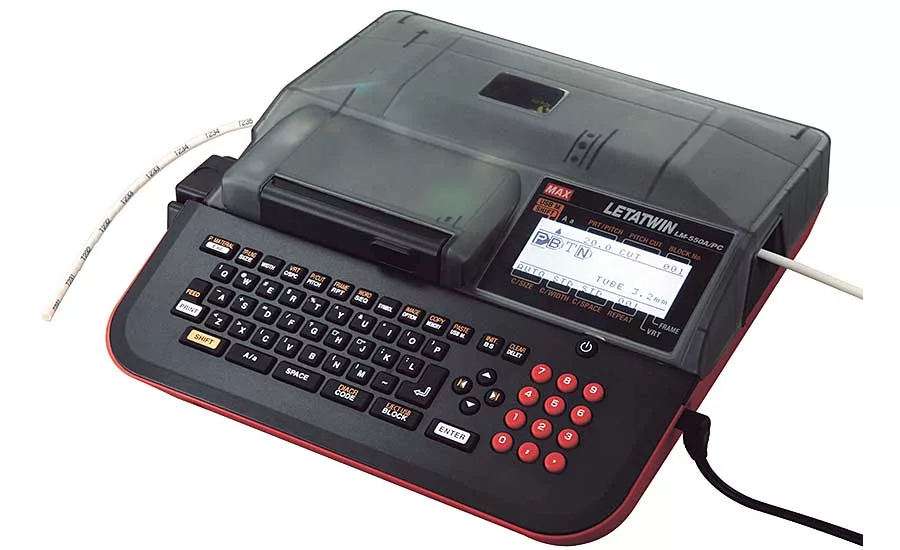
Max USA Corp. makes several thermal transfer label printers, including the LETATWIN and BEPOP series. The LETATWIN MAX LM-550A printer marks vinyl and heat shrink tubing, and MAX brand tape for wire and electrical panels used in various machines throughout a plant.
Steve Metcalf, national account executive at Max USA, says the printer has an enhanced feeding system that provides end-users with a marking speed of up to 1.5 inches per second. It is also capable of half-cutting tubing so a person can then manually tear the tubing in half. The depth of the half-cutting mechanism is easily adjusted from half-cut to full-cut. Ribbons are available in black and white for the LM-550A.
“Manufacturers are the largest users of our tabletop BEPOP machines, especially companies that make injection-molded and metal parts or subassemblies,” says Metcalf. “Our labels go directly onto these parts, which tend to be small, but can measure up to 8 inches high and 78 inches long. Labels are also used on front and back vehicle windshields.”
The BEPOP CPM-100HG5 printer makes 4-inch-wide labels and safety signs. It combines four-color process technology with PC-EX software to produce multiple-spot or full-color outputs. The software contains more than 1,400 symbols and templates that are easily imported and printed on the white tape roll.
“Another benefit is information from an end-user’s database can be saved in the comma-separated values (CSV) format and directly linked to its label designs,” explains Metcalf. “The unit prints high-definition labels at 400 dpi to provide visual clarity of the smallest font size and all graphics.”
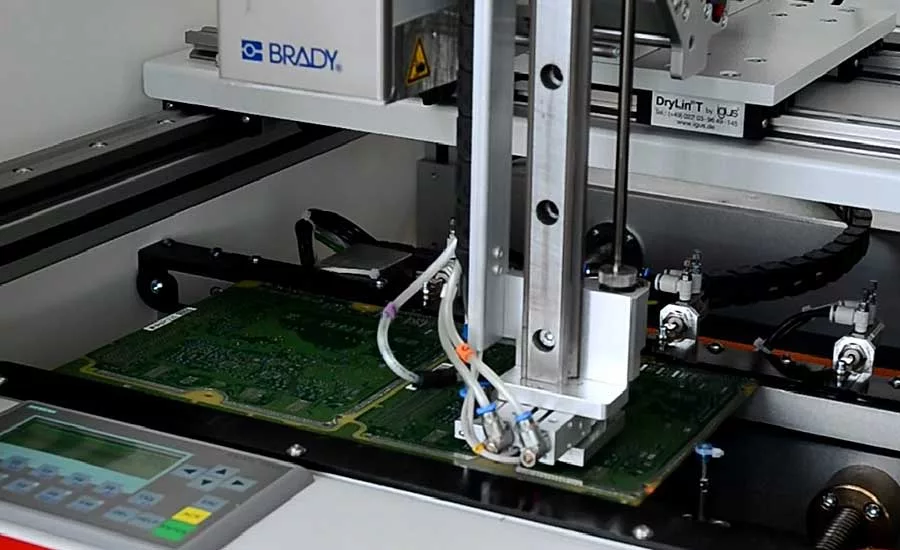
Introduced last year, the Brady A8500 thermal transfer print-and-apply system accurately prints and applies labels. Electronics manufacturers are the biggest users of this machine, according to Arghavani.
“It consistently prints and applies polyimide labels that can resist the entire PCB production process,” claims Luger. “High-resolution 600-dpi labels as tiny as 4 millimeters by 3.18 millimeters are accurately applied on PCBs at a cycle time quick enough to keep up with the pace of surface mount production lines. In addition, the printer can be installed anywhere along the line and receive label data from most ERP systems.”
Ink-jet printers spray thousands of droplets of ink onto the label to form text or an image. Droplet size and color can be altered to produce sharp, photo-realistic images. The printer’s dots per inch (dpi) measurement tells users how many droplets can fit along a single inch on the page. A higher dpi means the printer makes smaller individual dots and a sharper image.
On the plus side, ink-jet printers, cartridges and supplies are more available, and therefore cheaper, than their thermal counterparts. However, ink-based markings lack durability, and may smudge, stain, and run when exposed to moisture, sunlight, humidity and routine use. Another negative is these printers typically have more moving parts than thermal printers, increasing the chance of breakdowns that require repair or replacement.
Arghavani says that ink-jet printing is used for labels made of paper, vinyl or polyester. Brady’s extensive ink-jet printer offerings include the BradyJet J2000. This printer has a maximum label and tape width of 4 inches, with an output of up to 3,000 labels per day, depending on the label size. On-demand, mid-volume ink-jet capability allows users to create photo-quality color labels in a single pass. Even more impressive, according to Arghavani, the J2000 offers a wide range of color combinations.
Laser printers use colored powder and a laser to create markings on the label. The markings are clean and of a high definition, but need to be laminated to resist smudging, smearing and chemicals. Another problem is the high temperature of the printer’s fuser station can cause adhesive bleeding from the label, resulting in media jams until the adhesive residue is removed.
The biggest drawback is laser printers only use label-sheets. This means a whole sheet must be passed through the printer, even if the end-user wants print just one or two labels. Running the sheet back through to print the unused labels is not recommended, as it could jam the printer.
In-House vs. Outsourcing
Although choosing the best label printing method is an important decision for a manufacturer to make, it sometimes becomes a moot point. This happens when outsourcing label printing proves to be an easier, more reliable or more cost-effective approach.
Printing in-house does have its advantages. It allows assemblers to print labels in small quantities, vary the information printed on the label, and change label materials and specifications as needed. However, printing in-house requires an investment in hardware, software and training. Plus, printing and verifying label information adds time to the assembly process.
The advantage of buying preprinted labels is it requires no capital investment, and the quality of the labels is guaranteed. Should labeling requirements change, though, a manufacturer may be stuck with unusable inventory.
TLP has preprinted labels for automotive, industrial-equipment, aerospace, hydraulic-power and robotic-drive manufacturers since 1984. Tenpenny cites harsh application environments, difficult-to-label surfaces and the need for complex label prototypes as common reasons why companies turn to TLP.
“We are an engineering-based company that happens to manufacture labels and die-cut adhesives,” explains Tenpenny. “Our team is comprised of label and adhesive experts, including on-site mechanical and electrical engineers who are trained and experienced to look at each application from the ground up.”
Tenpenny attributes much of TLP’s success in recent years to a process the company follows called TAP3, which is short for Tailored Assessment of Production Printed Parts. He defines TAP3 as a rigorous step-by-step action plan focused on five things: data gathering, plant audits, specification organization, cost reduction project identification and formalized reporting.
“We often make simple but helpful recommendations during the audit,” adds Tenpenny. “For example, one customer had its workers pulling parts off a conveyor to label and then place them back on the conveyor. The problem was the workers were reaching up too much to grab and replace the parts, causing extra fatigue. We personally created new workstations with workers’ chairs about four inches higher to limit fatigue.”
Die-cut adhesives are made by using a die to cut label materials into the shapes required for a specific design. Application examples for die-cut labels and specialty adhesives, according to Tenpenny, include gaskets and seals, cushioning, sound dampening, electromagnetic and radio-frequency interference shielding, conductors and insulators, critical edge masking, protective films, and filters or covers.
Looking for a reprint of this article?
From high-res PDFs to custom plaques, order your copy today!