Assembly Magazine logo
search
Ask ASSEMBLY AI
cart
facebook twitter linkedin youtube
  • Sign In
  • Create Account
  • Sign Out
  • My Account
Assembly Magazine logo
  • TRENDS
    • Ask ASSEMBLY AI
    • Trends
    • News
    • New Products
  • INDUSTRIES
    • Aerospace
    • Appliance
    • DFMA Assembly
    • Medical Devices
    • Green Manufacturing
    • Lean Manufacturing
    • Machinery Assembly
    • Electronics Assembly
    • Automotive
  • TECHNOLOGIES
    • Adhesives & Dispensing
    • Assembly Presses
    • Automated Assembly Systems
    • Manufacturing Management
    • Manufacturing Software
    • Motion Control
    • Screwdriving & Riveting
    • Robotics
    • Test & Inspection
    • Plastics & Metal Welding
    • Wire Processing
    • Workstations
  • AUTONOMOUS & ELECTRIC MOBILITY
    • AEM Magazine Archives
    • Autonomy
    • Electrification
    • Mobility Services
    • Assembly & Testing
    • AV/EM News
  • MEDIA
    • Ask ASSEMBLY AI
    • Podcasts
    • Assembly News Now
    • Assembly TV
    • Webinars
    • eBooks
  • EVENTS
    • Calendar
    • The ASSEMBLY Show
  • MORE
    • Exclusives >
      • Plant of the Year
      • Capital Spending
    • Buyers Guide >
      • Supplier Insights
    • Classifieds
    • Featured Products
    • Newsletters
    • Store
    • White Papers
    • Columns
    • Sponsor Insights
  • INFOCENTER
    • Assembly & Test Solutions
  • EMAGAZINE
    • eMagazine
    • Archive Issues
    • Advertise
    • Contact Us
    • Sign Up
ColumnsAutomotive AssemblyOn CampusAutonomy

Penn Program Promotes Scaled-Down Autonomous Vehicle Racing
By Austin Weber
asb0123campus1.jpg

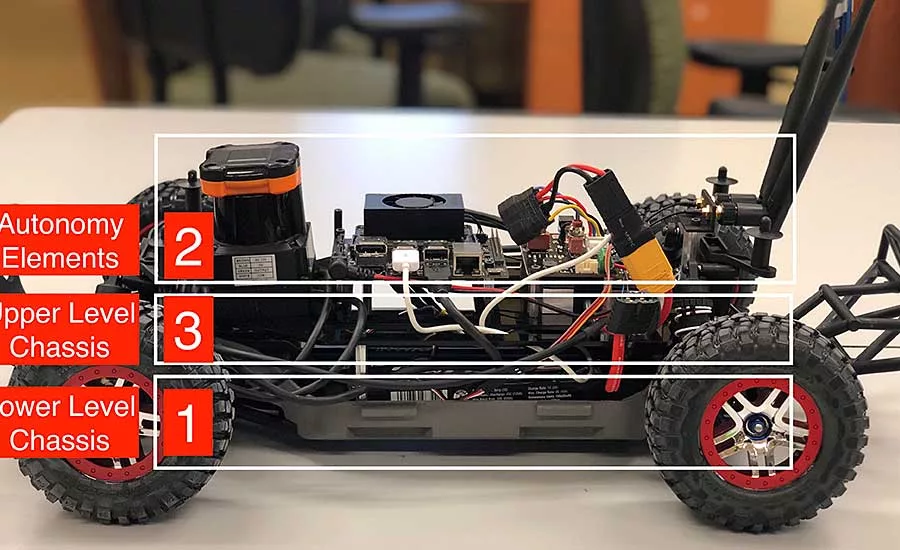
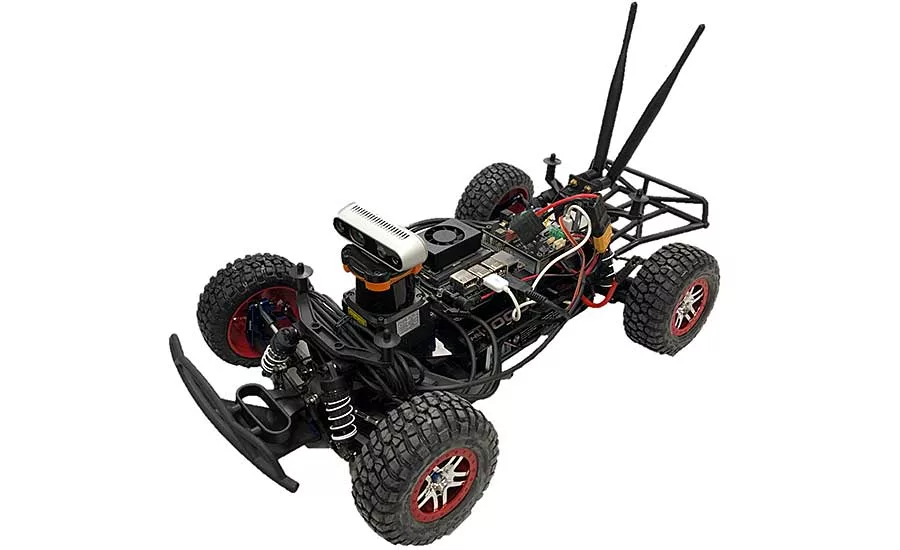
Each F1TENTH team uses a standardized chassis that includes a battery, controller, motor, drivetrain and wheels. Photo courtesy University of Pennsylvania

asb0123campus2.jpg

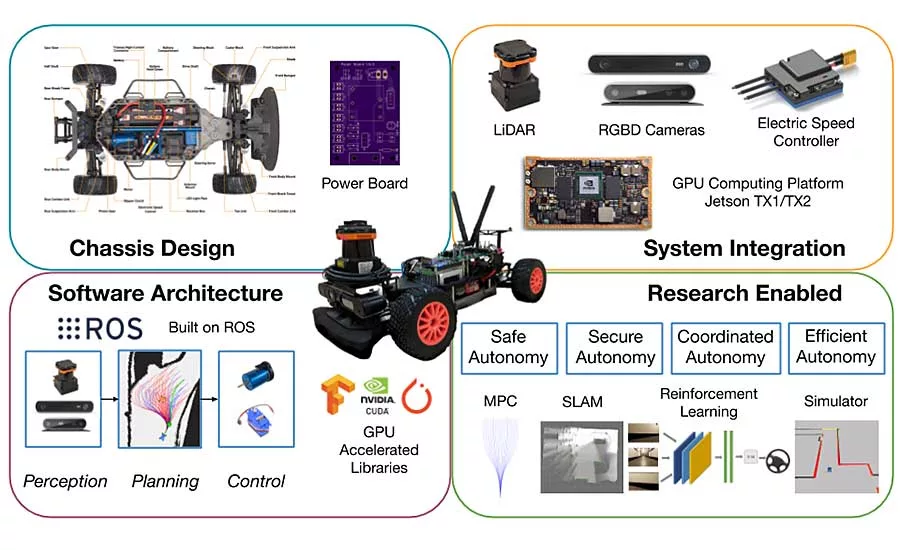
Students add cameras, lidar and other sensors that enable autonomous operation. Illustration courtesy University of Pennsylvania
asb0123campus3.jpg

By focusing on a racing environment, students learn how to develop self-driving algorithms that operate on the edge of vehicle dynamics. Photo courtesy University of Pennsylvania
asb0123campus1.jpg
asb0123campus2.jpg
asb0123campus3.jpg
January 25, 2023

For more than 120 years, racing has been used to improve the performance and safety of automobiles. Along the way, numerous innovations developed for use on the race track have trickled down to road cars. That tradition continues today, as engineers push the boundaries of autonomous systems technology.

Thanks to a big-time collegiate competition called F1TENTH, some of those breakthroughs are occurring on a small scale. The organization was founded in 2016 at the University of Pennsylvania to foster interest and innovation in the field of autonomous systems.

Students from around the world develop algorithms and program battery-powered 1:10 scale cars equipped with sensors that enable autonomous operation. Each team uses a standardized chassis that includes a battery, controller, motor, drivetrain and wheels.

But, software programming is what sets each team apart. It enables the vehicles to compete in head-to-head competition over challenging courses full of twists and turns that emulate real-life grand prix racing circuits.

“We focus on racing, because it is both competitive and fun,” says Rahul Mangharam, Ph.D., an associate professor in the department of electrical and systems engineering at the University of Pennsylvania, and one of the developers of the F1TENTH program. “It pushes racers to the limits of their performance.

“[F1TENTH] introduces universities to the idea of autonomy and studying across multiple disciplines,” explains Mangharam. “Education is traditionally siloed. You study mechanical engineering, but you may also want to learn about control engineering.

“When you design a racecar for F1TENTH, you need to know all different elements of engineering,” notes Mangharam. “This program allows students to develop a well-rounded set of skills that sets [them] up for future robotics-focused positions in various companies.”

Looking for quick answers on assembly and manufacturing topics? Try Ask ASM, our new smart AI search tool. Ask ASM →

In fact, Penn engineers who participated in autonomous racing in the past are now working at companies such as Amazon, Honda, Nvidia, Rivian and Tesla.

“We push the limits of agility and handling, while balancing safety and performance,” claims Mangharam. “Racing with full-size cars is expensive and dangerous. Instead, we use a low-cost, open-source platform that enables students to learn. We also use simulation systems to predict how the cars will perform in a race.

“F1TENTH is a platform that allows [students] to develop prototypes on a smaller scale,” adds Mangharam, who also heads up Penn’s General Robotics, Automation, Sensing and Perception (GRASP) Lab and the Autoware Center of Excellence located at the Pennovation Center. “It is a stepping stone for students to develop larger autonomous commercial and industrial vehicles.”

The main focus of the F1TENTH organization is on designing and maintaining a powerful and versatile open-source platform for autonomous systems research and education. This includes numerous autonomous racecar competitions that bring together an international community of students and educators.

“In motorsports, there is a saying that ‘if everything seems under control, then you are not going fast enough,’” says Mangharam. “Expert racing drivers have split-second reaction times and routinely drive at the limits of control, traction and agility under high speed and close proximity.

“Autonomous racing presents unique opportunities and challenges in designing algorithms and hardware that can operate firmly on the limits of perception, planning and control,” explains Mangharam. “Autonomous racing has the potential to serve as the litmus test for self-driving software.

“While a large portion of autonomous vehicle research and development is focused on handling routine driving situations, achieving safety benefits also requires a focus on driving at the limits of the control of the vehicle,” notes Mangharam.

According to Mangharam, balancing performance and safety are crucial to deploying autonomous vehicles in multi-agent environments. “In particular, autonomous racing is a domain that penalizes safe but conservative policies, highlighting the need for robust, adaptive strategies,” he points out. “If you are too conservative, you will lose the race. But, if you are too aggressive, you can crash.”

Mangharam teaches a popular 15-week course at Penn that focuses on F1TENTH racing. Engineering students engage in hands-on projects that are focused on applied machine learning, artificial intelligence, control theory, motion planning, sensor technology and other topics.

They learn about the fundamentals of autonomous driving, such as localization, mapping, object detection, perception and trajectory path planning. By focusing on a racing environment, students discover how to develop algorithms that operate on the edge of vehicle dynamics with high accelerations, high velocities and high computation frequencies.

In addition to F1TENTH, Mangharam is also involved in a collegiate competition called AV Gokart that involves autonomous go kart racing.

Each F1TENTH chassis is 16 inches long and weighs approximately 6 pounds. It is available as either a kit or built-up version from a company called RACECAR/J. The chassis contains mounting points for cameras and other sensors. Teams also use state-of-the-art lidar technology donated by SICK.

“Lidar is the dominant sensor on board the racecar,” says Mangharam. “It uses a point cloud to determine how fast it can be driven around the racetrack and still navigate around others.”

The most recent F1TENTH event in the United States was held in Philadelphia in May 2022 in conjunction with the IEEE International Conference on Robotics and Automation (ICRA). It featured 23 teams from a variety of schools, including Carnegie Mellon, Clemson, Lehigh, Penn, Rice, the University of Texas, Virginia Tech and the University of California at San Diego. The race also attracted participants from Austria, Canada, Italy, Malaysia, Poland, South Korea and Switzerland.

Similar races were held recently in Germany and South Korea. The next international event will take place in London as part of ICRA on May 29-June 2.


KEYWORDS: autonomous vehicles

Share This Story

Looking for a reprint of this article?
From high-res PDFs to custom plaques, order your copy today!

Austinweber headshot
Austin has been senior editor for ASSEMBLY Magazine since September 1999. He has more than 21 years of b-to-b publishing experience and has written about a wide variety of manufacturing and engineering topics. Austin is a graduate of the University of Michigan.

Recommended Content

JOIN TODAY
To unlock your recommendations.

Already have an account? Sign In

  • Made in the U.S.A.

    Consumer Products Manufacturing: Made in the USA

    Supply chain lessons learned during the coronavirus...
    Automated Assembly Systems
    By: Austin Weber
  • Best Practices for Press-Fit Assembly

    Best Practices for Press-Fit Assembly

    In manufacturing, ironclad formulas for success are hard...
    Assembly Presses
    By: Jim Camillo
  • aem0523leader-tesla1.jpg

    Tesla Rethinks the Assembly Line

    Engineers at Tesla Inc. have developed a new process that...
    Automotive Assembly
    By: Austin Weber
Manage My Account
  • eMagazine Subscription
  • Assembly Newsletters
  • Online Registration
  • Subscription Customer Service
  • Manage My Preferences

More Videos

Sponsored Content

Sponsored Content is a special paid section where industry companies provide high quality, objective, non-commercial content around topics of interest to the ASSEMBLY audience. All Sponsored Content is supplied by the advertising company and any opinions expressed in this article are those of the author and not necessarily reflect the views of ASSEMBLY or its parent company, BNP Media. Interested in participating in our Sponsored Content section? Contact your local rep!

close
  • ultrasonic welding
    Sponsored bySonobond Ultrasonics

    Engineering Efficiency in High-Performance Assembly: How Ultrasonic Welding Enhances Throughput, Reliability and Quality

  • UV curing system
    Sponsored byDymax

    Why UV Intensity Alone Doesn’t Define Curing Performance

  • wooden pallets
    Sponsored byLEAN Manufacturing Products

    Eliminating Waste on the Shop Floor: Applying Lean Principles to Improve Manufacturing Efficiency

Popular Stories

ASSEMBLY News Now, episode-30: Volvo Redesigns EV Manufacturing

Volvo Redesigns EV Manufacturing

Boeing CEO Kelly Ortberg announces 1 billion investment

Boeing Plans $1 Billion Wichita Investment, Workforce Training Center

GE Appliances Worker on Line

GE Appliances Expands Factory AI With 800 Gemini Enterprise Agents

Watch the latest episode of ANN now!

Events

July 24, 2025

From Shop Floor to CFO: How Manufacturers Are Closing the Loop Between Operations and Finance

On Demand Learn how manufacturers are bridging the gap between the shop floor and ERP systems to gain real-time visibility, streamline operations, and kick-start digital transformation—without waiting years.

Sponsored by:

PicoStratusGreen
July 30, 2025

Buffer Analysis and Design Fundamentals for Manufacturing Excellence

On Demand In this presentation, Dr. Herman Tang shares practical insights from his industry experience and research on buffer management in manufacturing operations.

View All Submit An Event

Poll

Difficult Assembly Processes

Which assembly process gives you the most difficulty?
View Results Poll Archive

Products

Manufacturing Cost Policy Deployment (MCPD) Profitability Scenarios: Systematic and Systemic Improvement of Manufacturing Costs

Manufacturing Cost Policy Deployment (MCPD) Profitability Scenarios: Systematic and Systemic Improvement of Manufacturing Costs

See More Products
Register for webinar - Modernizing Automotive Assembly: Why Upgrading Legacy MES is a Business Imperative

Related Articles

  • Florida Poly Drives Autonomous Vehicle Research

    See More
  • Austin Weber

    California Strengthens Autonomous Vehicle Regulations

    See More
  • Waymo2.png

    New Federal Rules Aim to Spur Autonomous Vehicle Development

    See More

Related Products

See More Products
  • Kaizen Assembly: Designing, Constructing, and Managing a Lean Assembly Line

  • assembly march 2020

    ASSEMBLY March 2020 Issue

  • essentials.jpg

    Essentials of Supply Chain Management, 5th Edition

See More Products

Related Directories

  • AutonomouStuff

  • PennEngineering

    DistributorsAero-Space Computer Supplieswww.ascs.comAero-Space Southwest Inc.www.aerospacesw.comsales@aerospacesw.comAssembly Fasteners Inc.www.afi.ccsales@afi.ccBlair Engrg. Inc.www.blaireng.comBlair Engrg. S.E. Inc. www.blaireng.comColorado Electronic Hardware Inc.www.cehi.comD.B. Roberts...
×

Never miss the latest news and trends driving the manufacturing industry

Stay in the know on the latest assembly trends.

JOIN TODAY!
  • RESOURCES
    • Advertise
    • Contact Us
    • Directories
    • Manufacturing Division
    • Store
    • Want More?
  • SIGN UP TODAY
    • Create Account
    • eMagazine
    • Newsletters
    • Customer Service
    • Manage Preferences
  • SERVICES
    • Marketing Services
    • Reprints
    • Market Research
    • List Rental
    • Survey/Respondent Access
  • STAY CONNECTED
    • LinkedIn
    • Facebook
    • Instagram
    • YouTube
    • X (Twitter)
  • PRIVACY
    • PRIVACY POLICY
    • TERMS & CONDITIONS
    • DO NOT SELL MY PERSONAL INFORMATION
    • PRIVACY REQUEST
    • ACCESSIBILITY

Copyright ©2026. All Rights Reserved BNP Media, Inc. and BNP Media II, LLC.

Design, CMS, Hosting & Web Development :: ePublishing