Assembly Magazine logo
search
Ask ASSEMBLY AI
cart
facebook twitter linkedin youtube
  • Sign In
  • Create Account
  • Sign Out
  • My Account
Assembly Magazine logo
  • TRENDS
    • Ask ASSEMBLY AI
    • Trends
    • News
    • New Products
  • INDUSTRIES
    • Aerospace
    • Appliance
    • DFMA Assembly
    • Medical Devices
    • Green Manufacturing
    • Lean Manufacturing
    • Machinery Assembly
    • Electronics Assembly
    • Automotive
  • TECHNOLOGIES
    • Adhesives & Dispensing
    • Assembly Presses
    • Automated Assembly Systems
    • Manufacturing Management
    • Manufacturing Software
    • Motion Control
    • Screwdriving & Riveting
    • Robotics
    • Test & Inspection
    • Plastics & Metal Welding
    • Wire Processing
    • Workstations
  • AUTONOMOUS & ELECTRIC MOBILITY
    • AEM Magazine Archives
    • Autonomy
    • Electrification
    • Mobility Services
    • Assembly & Testing
    • AV/EM News
  • MEDIA
    • Ask ASSEMBLY AI
    • Podcasts
    • Assembly News Now
    • Assembly TV
    • Webinars
    • eBooks
  • EVENTS
    • Calendar
    • The ASSEMBLY Show
  • MORE
    • Exclusives >
      • Plant of the Year
      • Capital Spending
    • Buyers Guide >
      • Supplier Insights
    • Classifieds
    • Featured Products
    • Newsletters
    • Store
    • White Papers
    • Columns
    • Sponsor Insights
  • INFOCENTER
    • Assembly & Test Solutions
  • EMAGAZINE
    • eMagazine
    • Archive Issues
    • Advertise
    • Contact Us
    • Sign Up
ColumnsAutomated Assembly SystemsRobotics Assembly

System Automates Assembly of Test Cartridges
By John Sprovieri
asb0223medicalfocus1.jpg

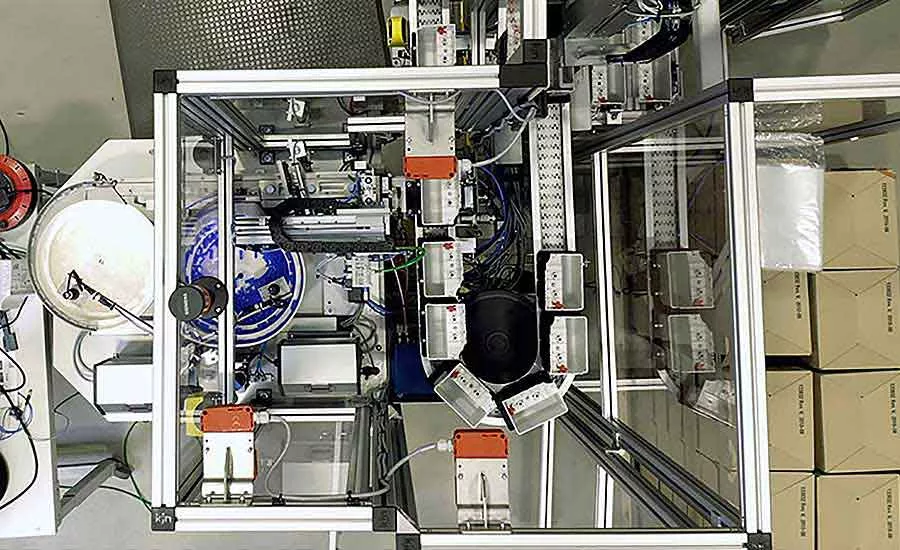
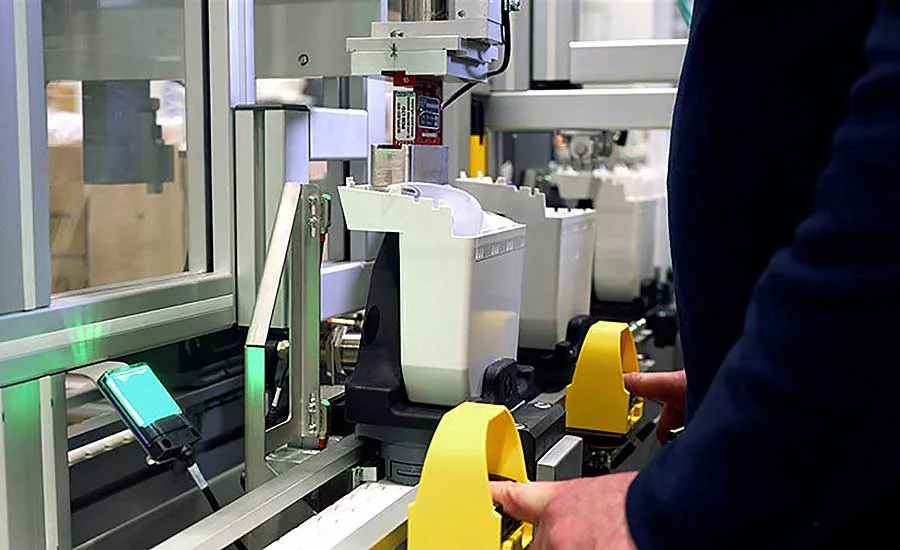
In RNA’s cartridge assembly system, robots handle some tasks, while people handle others. Photo courtesy RNA Automation Ltd.

asb0223medicalfocus2.jpg

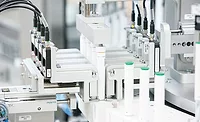
The pallet-transfer conveyor is a recirculating loop. Various mechanisms ensure that the pallets are precisely located at each assembly station. Photo courtesy RNA Automation Ltd.

asb0223medicalfocus3.jpg

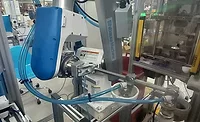
At this station, a press installs a clip into the cartridge housing. The press measures the force applied with reference to the distance travelled by the ram to ensure the waste bag has been loaded and fitted correctly. Photo courtesy RNA Automation Ltd.
asb0223medicalfocus1.jpg
asb0223medicalfocus2.jpg
asb0223medicalfocus3.jpg
February 3, 2023

Blood gas analyzers measure gases dissolved in the blood, such as oxygen and carbon dioxide. Such information is vital when caring for patients with critical illnesses or respiratory infections, such as COVID-19. These analyzers rely on various disposable cartridges to process blood samples. Millions of these cartridges must be assembled each year.

A blood gas analyzer works by pumping a blood sample through a measurement cartridge, which has multiple sensors to measure pH and the partial pressures of oxygen and carbon dioxide. The bicarbonate concentration is also calculated. Many blood-gas analyzers will also report concentrations of lactate, hemoglobin, several electrolytes, oxyhemoglobin, carboxyhemoglobin, and methemoglobin. These results are usually available for interpretation within five minutes.

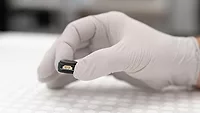
These cartridges last for 28 days or a specific number of samples.Once a sample has been analyzed, the sample path must be cleaned before the next sample can be analyzed. This is done with a “wash/waste cartridge,” which has a cleaning fluid and bag to capture the waste. This is then disposed of after nine days or a certain number of samples.

Once a sample has been analyzed, the sample path must be cleaned before the next sample can be analyzed. This is done with a “wash/waste cartridge,” which has a cleaning fluid and bag to capture the waste. This is then disposed of after nine days or a certain number of samples.

RNA Automation Ltd., a systems integrator in Birmingham, UK, recently designed and built an multistation system to automate assembly of wash/waste cartridges for blood gas analyzers. The customer, a global medical technology company, had previously been assembling the cartridges manually.

RNA’s system does not do away with manual labor entirely. Rather, automation and people work together at the same time within a limited workspace. The efficient integration of robots and vision into the assembly line adds significant value due to their reliability and repeatability, resulting in increased throughput and productivity.

At the start of the line, an operator loads cartridge bases through a poke-yoke aperture onto a two-lane declined conveyor. The cartridge bases are taken down a track to a stop, where they are picked and placed into a nest on a pallet-transfer conveyor. The vertical axis of the pick-and-place unit is pneumatic actuator, while the horizontal axis is a servo-driven actuator.The pallet-transfer conveyor is a recirculating loop. Various mechanisms ensure that the pallets are precisely located at each assembly station.

Looking for quick answers on assembly and manufacturing topics? Try Ask ASM, our new smart AI search tool. Ask ASM →

At the start of the line, an operator loads cartridge bases through a poke-yoke aperture onto a two-lane declined conveyor. The cartridge bases are taken down a track to a stop, where they are picked and placed into a nest on a pallet-transfer conveyor. The vertical axis of the pick-and-place unit is pneumatic actuator, while the horizontal axis is a servo-driven actuator. The pallet-transfer conveyor is a recirculating loop. Various mechanisms ensure that the pallets are precisely located at each assembly station.

The pallet-transfer conveyor is a recirculating loop. Various mechanisms ensure that the pallets are precisely located at each assembly station.

At the next station, septa are fed and orientated by two vibratory bowl feeders and are then picked and placed into the housing. A vision check confirms that the septa are in the correct port (they are color-coded), that they are completely seated within the cartridge, and that a red tab is present. A sensor checks that the tab is correctly in place.

An operator manually loads and fits a waste bag before pressing a two-finger start, which enables a press to extend and push a clip into the cartridge housing. The press measures the force applied with reference to the distance travelled by the press to ensure the waste bag has been loaded and fitted correctly.

At the next station, an operator manually loads and fits a wash bag and supports before actuating a whisker switch for the pallet to be released to the next station. Then, a vision system checks that the top half of the wash and waste bags are within the perimeter of cartridge base.

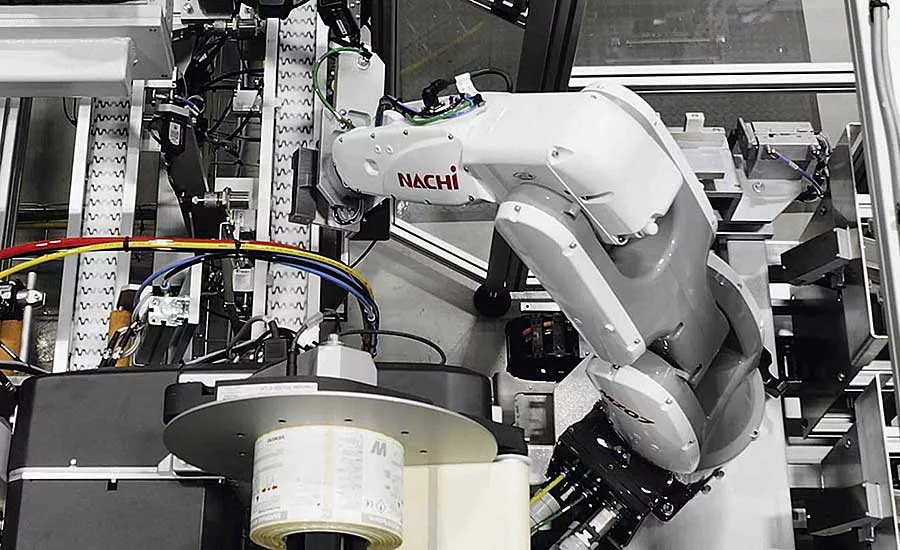
At the next station, lids are loaded by an operator into one of two magazine drawers. The magazines can be topped up independently. The magazine, once returned within the cell, is picked from the top of the stack by a six-axis robot and placed into a datum station. Once the lid is accurately located it is picked again by the robot and assembled to the cartridge base. Once fitted, a presence check for lid ‘tabs’ is completed.

Assembled cartridges arrive underneath a label applicator, where a label is printed and applied to the cartridge. The sides of the label are wiped down, and then a vision sensor performs an OCR check and a test scan to check the bar code.

Once assembled, cartridges are picked from the pallet and placed onto an outfeed gravity track, where they travel to an off-load area.

If a failure is detected at any station, no further value is added to the assembly. The assembly continues to index around to the off-load station, where it is placed into the failure lane. This lane is accessed at the back of the pack station, so that it’s completely isolated from the operator who is accessing good cartridges. Failed cartridges can be removed from the cell without interrupting production.

At the packaging station, an operator offloads cartridges and loads them into either a single or quad box. The box is then loaded into the printing drawer and a two-hand start is activated for the drawer to retract into the station. Inside the station the box is automatically located to a datum position, a label is applied, and the label position and bar code are checked. The operator then activates the two-hand start again and the drawer opens for the operator to remove the box.

For more information on automated assembly systems, visit www.rnaautomation.com.

KEYWORDS: assembly machine factory automation

Share This Story

Looking for a reprint of this article?
From high-res PDFs to custom plaques, order your copy today!

John has been with ASSEMBLY magazine since February 1997. John was formerly with a national medical news magazine, and has written for Pathology Today and the Green Bay Press-Gazette. John holds a B.A. in journalism from Northwestern University, Medill School of Journalism.

Recommended Content

JOIN TODAY
To unlock your recommendations.

Already have an account? Sign In

  • Made in the U.S.A.

    Consumer Products Manufacturing: Made in the USA

    Supply chain lessons learned during the coronavirus...
    Automated Assembly Systems
    By: Austin Weber
  • Best Practices for Press-Fit Assembly

    Best Practices for Press-Fit Assembly

    In manufacturing, ironclad formulas for success are hard...
    Assembly Presses
    By: Jim Camillo
  • aem0523leader-tesla1.jpg

    Tesla Rethinks the Assembly Line

    Engineers at Tesla Inc. have developed a new process that...
    Automotive Assembly
    By: Austin Weber
Manage My Account
  • eMagazine Subscription
  • Assembly Newsletters
  • Online Registration
  • Subscription Customer Service
  • Manage My Preferences

More Videos

Sponsored Content

Sponsored Content is a special paid section where industry companies provide high quality, objective, non-commercial content around topics of interest to the ASSEMBLY audience. All Sponsored Content is supplied by the advertising company and any opinions expressed in this article are those of the author and not necessarily reflect the views of ASSEMBLY or its parent company, BNP Media. Interested in participating in our Sponsored Content section? Contact your local rep!

close
  • ultrasonic welding
    Sponsored bySonobond Ultrasonics

    Engineering Efficiency in High-Performance Assembly: How Ultrasonic Welding Enhances Throughput, Reliability and Quality

  • UV curing system
    Sponsored byDymax

    Why UV Intensity Alone Doesn’t Define Curing Performance

  • wooden pallets
    Sponsored byLEAN Manufacturing Products

    Eliminating Waste on the Shop Floor: Applying Lean Principles to Improve Manufacturing Efficiency

Popular Stories

ASSEMBLY News Now, episode-30: Volvo Redesigns EV Manufacturing

Volvo Redesigns EV Manufacturing

Boeing CEO Kelly Ortberg announces 1 billion investment

Boeing Plans $1 Billion Wichita Investment, Workforce Training Center

automated consumer goods assembly system

Best Practices for Cycle Time Optimization

Watch the latest episode of ANN now!

Events

July 24, 2025

From Shop Floor to CFO: How Manufacturers Are Closing the Loop Between Operations and Finance

On Demand Learn how manufacturers are bridging the gap between the shop floor and ERP systems to gain real-time visibility, streamline operations, and kick-start digital transformation—without waiting years.

Sponsored by:

PicoStratusGreen
July 30, 2025

Buffer Analysis and Design Fundamentals for Manufacturing Excellence

On Demand In this presentation, Dr. Herman Tang shares practical insights from his industry experience and research on buffer management in manufacturing operations.

View All Submit An Event

Poll

Difficult Assembly Processes

Which assembly process gives you the most difficulty?
View Results Poll Archive

Products

Manufacturing Cost Policy Deployment (MCPD) Profitability Scenarios: Systematic and Systemic Improvement of Manufacturing Costs

Manufacturing Cost Policy Deployment (MCPD) Profitability Scenarios: Systematic and Systemic Improvement of Manufacturing Costs

See More Products
Register for webinar - Modernizing Automotive Assembly: Why Upgrading Legacy MES is a Business Imperative

Related Articles

  • Machine Automates Assembly of Insulin Pens

    Machine Automates Assembly of Insulin Pens

    See More
  • asb1222aia1.jpg

    Robot Automates Assembly of Cricket Balls

    See More
  • miniaturized motion control products

    Delta Robot Automates Assembly of Encoders

    See More

Related Products

See More Products
  • Joining and Assembly of Medical Materials and Devices, 1st Edition

  • gf test

  • Kaizen Assembly: Designing, Constructing, and Managing a Lean Assembly Line

See More Products

Related Directories

  • PrimeTest Automation

    PrimeTest Automation is a manufacturer of custom assembly, process, and test automation systems for manufacturing facilities. We are a full-service systems integration company with a talented in-house engineering team featuring mechanical, electrical, and software engineers. All systems are modeled using the latest in 3D design software, thoroughly reviewed with the customer, and manufactured in our facility located in Fort Lauderdale, Florida.
  • Automated Assembly Corp.

    Automated Assembly Corporation stands at the forefront of the manufacturing industry, specializing in roll-to-roll assembly capabilities that range from low to high-volume production. Our advanced automation systems are engineered to handle diverse production requirements with precision and efficiency, making us the ideal partner for businesses needing scalable assembly solutions.
×

Never miss the latest news and trends driving the manufacturing industry

Stay in the know on the latest assembly trends.

JOIN TODAY!
  • RESOURCES
    • Advertise
    • Contact Us
    • Directories
    • Manufacturing Division
    • Store
    • Want More?
  • SIGN UP TODAY
    • Create Account
    • eMagazine
    • Newsletters
    • Customer Service
    • Manage Preferences
  • SERVICES
    • Marketing Services
    • Reprints
    • Market Research
    • List Rental
    • Survey/Respondent Access
  • STAY CONNECTED
    • LinkedIn
    • Facebook
    • Instagram
    • YouTube
    • X (Twitter)
  • PRIVACY
    • PRIVACY POLICY
    • TERMS & CONDITIONS
    • DO NOT SELL MY PERSONAL INFORMATION
    • PRIVACY REQUEST
    • ACCESSIBILITY

Copyright ©2026. All Rights Reserved BNP Media, Inc. and BNP Media II, LLC.

Design, CMS, Hosting & Web Development :: ePublishing