Assembly Magazine logo
search
Ask ASSEMBLY AI
cart
facebook twitter linkedin youtube
  • Sign In
  • Create Account
  • Sign Out
  • My Account
Assembly Magazine logo
  • TRENDS
    • Ask ASSEMBLY AI
    • Trends
    • News
    • New Products
  • INDUSTRIES
    • Aerospace
    • Appliance
    • DFMA Assembly
    • Medical Devices
    • Green Manufacturing
    • Lean Manufacturing
    • Machinery Assembly
    • Electronics Assembly
    • Automotive
  • TECHNOLOGIES
    • Adhesives & Dispensing
    • Assembly Presses
    • Automated Assembly Systems
    • Manufacturing Management
    • Manufacturing Software
    • Motion Control
    • Screwdriving & Riveting
    • Robotics
    • Test & Inspection
    • Plastics & Metal Welding
    • Wire Processing
    • Workstations
  • AUTONOMOUS & ELECTRIC MOBILITY
    • AEM Magazine Archives
    • Autonomy
    • Electrification
    • Mobility Services
    • Assembly & Testing
    • AV/EM News
  • MEDIA
    • Ask ASSEMBLY AI
    • Podcasts
    • Assembly News Now
    • Assembly TV
    • Webinars
    • eBooks
  • EVENTS
    • Calendar
    • The ASSEMBLY Show
  • MORE
    • Exclusives >
      • Plant of the Year
      • Capital Spending
    • Buyers Guide >
      • Supplier Insights
    • Classifieds
    • Featured Products
    • Newsletters
    • Store
    • White Papers
    • Columns
    • Sponsor Insights
  • INFOCENTER
    • Assembly & Test Solutions
  • EMAGAZINE
    • eMagazine
    • Archive Issues
    • Advertise
    • Contact Us
    • Sign Up
TechnologiesAdhesives & Dispensing AssemblyRobotics AssemblyTest and Inspection Assembly

Adhesive Dispensing Is Focus of New Program at Eastern Michigan University
By Austin Weber
training adhesive dispensing engineers

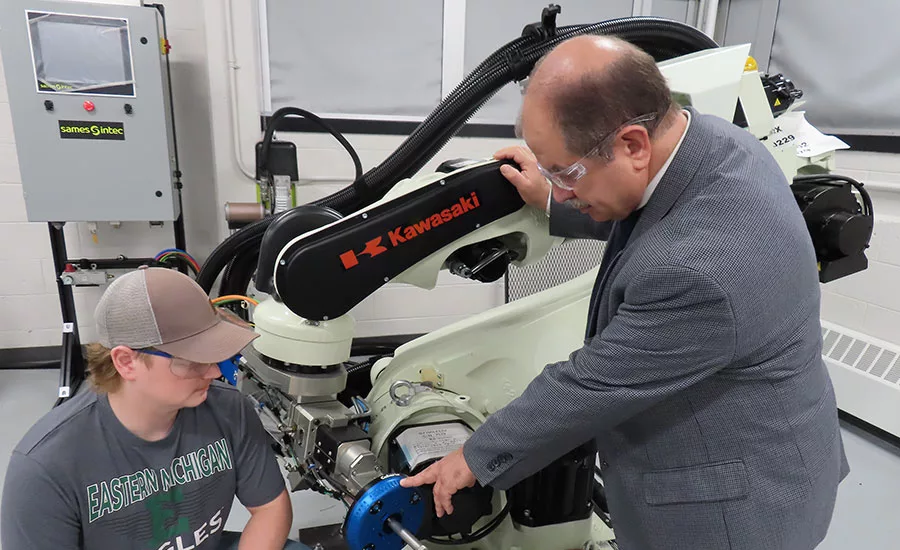
A new program at Eastern Michigan University is developing the next generation of adhesive dispensing engineers. Photo courtesy Eastern Michigan University

hands-on training for adhesive dispensing engineers

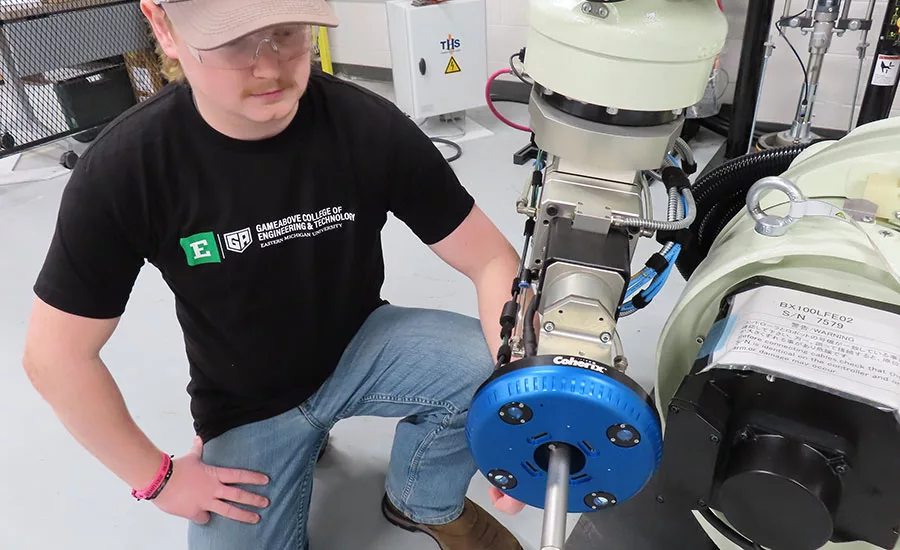
Students are learning how to harness robotics, computer vision and adaptive process control systems. Photo courtesy Eastern Michigan University

virtual reality training for adhesive dispensing engineers

Hands-on learning is combined with virtual reality tools. Photo courtesy Eastern Michigan University

student using a robotic adhesive dispenser

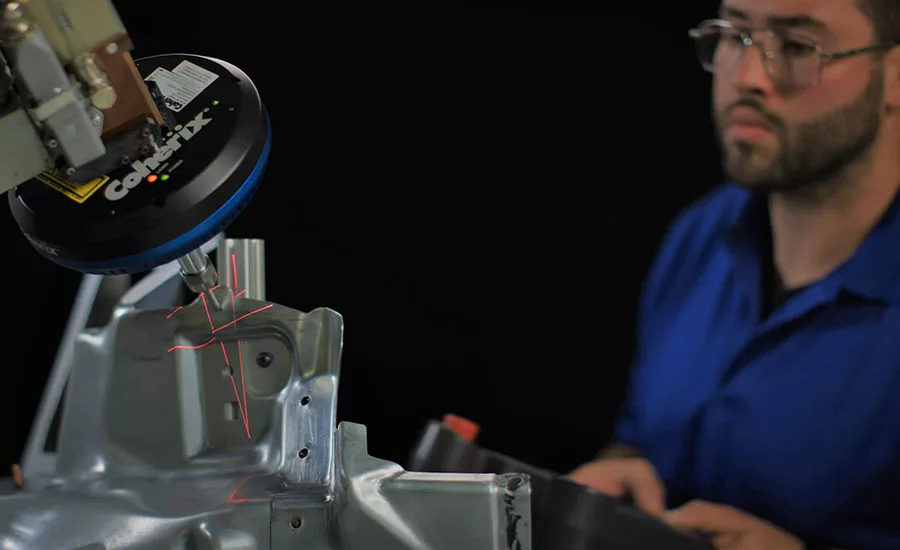
Students are studying how artificial intelligence technology can improve robotic adhesive dispensing applications. Photo courtesy Eastern Michigan University
training adhesive dispensing engineers
hands-on training for adhesive dispensing engineers
virtual reality training for adhesive dispensing engineers
student using a robotic adhesive dispenser
May 3, 2024

Adhesives are used to assemble a variety of products, including automotive and aerospace parts, appliances, consumer goods, electronics, furniture and medical devices. Among other attributes, adhesive bonding is ideal for joining dissimilar materials, such as glass, metal and plastic.

To improve throughput, boost quality and reduce waste, more manufacturers are using robotic dispensing. However, many engineers and operators lack the knowledge they need to harness the full benefits of the technology.

Eastern Michigan University (EMU) recently launched a program to address the issue. It’s applying state-of-the-art tools to develop the next generation of adhesive engineers by focusing on “factory of the future” manufacturing and assembly technology.

Last fall, Coherix Inc. donated $358,000 to establish the program. The company, which is based nearby in Ann Arbor, MI, provided 3D computer-vision technology to the school. In addition, it lent engineers to EMU to help set up the lab, which includes equipment provided by Kawasaki Robotics; Sames Group, a supplier of sealant and dispensing pumps and equipment; and the Gonzalez Group, a local systems integrator.

The goal of the new three-year program is to expand the use of computer vision, virtual reality and adaptive process control systems in the automotive, electronics and medical industries.

“The program will provide our students with experience in the programming and use of industrial robots to dispense adhesives and sealants in the manufacture of cars, medical devices and consumer electronics—technology that could save billions of dollars in manufacturing costs,” says Mohamad Qatu, Ph.D., P.E., dean of EMU’s GameAbove College of Engineering and Technology.

“We are looking forward to partnering with Eastern Michigan University,” adds Dwight Carlson, chairman and CEO of Coherix. “Our goal is to provide engineering students at the university with advanced factory of the future training, as well as access to the latest dispensing system technology under development at Coherix.

Looking for quick answers on assembly and manufacturing topics? Try Ask ASM, our new smart AI search tool. Ask ASM →

“One thing holding up the factory of the future is that automation cannot see well enough or think fast enough to run autonomously,” says Carlson. “That’s something that we’re trying to solve with 3D computer vision and adaptive process control.

“We also need to accelerate the process of getting young engineers into the factory of the future,” claims Carlson. “Right now, I estimate that there’s a need for around 200 dispensing system engineers just here in Southeastern Michigan.

“One thing holding up the factory of the future is that automation cannot see well enough or think fast enough to run autonomously. That’s something that we’re trying to solve with 3D computer vision and adaptive process control.”

– Dwight Carlson, chairman & CEO, Coherix

“Fortunately, other companies feel the same way, so we’ve teamed up to form a nonprofit organization called the Engineering and Manufacturing Alliance,” explains Carlson. “Our mission is to provide research into advanced digital manufacturing methods, while disseminating information regarding research to business and industry.”

EMU’s new program is part of that initiative. Over the next three years, more than 70 graduate and undergraduate students are expected to participate in the curriculum developed and directed by Emad Tanbour, Ph.D., associate professor of mechanical engineering.

“There has been a big increase in demand for using robots to dispense industrial adhesives,” says Tanbour. “3D vision technology enables the dispensing process to be more accurate and precise, while responding to changes in product variation. It also allows for visualization and measurement, enabling the economic analysis of adhesives, which can be very expensive.

“This one-of-a-kind program utilizes virtual reality for both educational and research purposes,” notes Tanbour. “Among other things, students will study the impact of artificial intelligence technology when dispensing adhesives with robotics.”

There are currently 13 undergrad engineers and two graduate students participating in the program, which was launched in September 2023. The facility is housed within part of the 1,500-square-foot Virtual Reality Lab at EMU. In addition to hands-on learning with dispensing robots, virtual reality tools enable students to artificially add complexity to joints or change part designs to examine various what-if scenarios.

Students are divided into three teams that are each working on a different project. One adhesive bonding application involves a scaled-down car door, while the others include an industrial gearbox housing and an electronic medical device. The undergrad students are working with 3D-printed plastic components, but the grad students are examining how adhesives interact with dissimilar materials, such as metals and plastics.

Due to safety requirements, engineers use a make-believe material instead of actual adhesive. It’s a petroleum gel that has all of the viscosity and material properties of an industrial adhesive. This enables students to repeatedly apply the material to their parts and conduct experiments to optimize various assembly processes.

EMU is located in the shadow of larger and more prestigious schools known for their engineering prowess, such as the University of Michigan and Wayne State University. However, Carlson believes those institutions are not necessarily producing the type of engineers desperately needed by manufacturers today. “We need more engineers with a different kind of attitude who are ready to step foot into the factory of the future,” he points out.

“Eventually, I’d like to see more of our peer universities in the region involved in similar programs, so that we can replicate our efforts and expand the footprint,” adds Tanbour.

See more articles from our May 2024 issue!

KEYWORDS: Artificial Intelligence (AI) factory automation machine vision systems robotic dispensing

Share This Story

Looking for a reprint of this article?
From high-res PDFs to custom plaques, order your copy today!

Austinweber headshot
Austin has been senior editor for ASSEMBLY Magazine since September 1999. He has more than 21 years of b-to-b publishing experience and has written about a wide variety of manufacturing and engineering topics. Austin is a graduate of the University of Michigan.

Recommended Content

JOIN TODAY
To unlock your recommendations.

Already have an account? Sign In

  • Made in the U.S.A.

    Consumer Products Manufacturing: Made in the USA

    Supply chain lessons learned during the coronavirus...
    Automated Assembly Systems
    By: Austin Weber
  • Best Practices for Press-Fit Assembly

    Best Practices for Press-Fit Assembly

    In manufacturing, ironclad formulas for success are hard...
    Assembly Presses
    By: Jim Camillo
  • aem0523leader-tesla1.jpg

    Tesla Rethinks the Assembly Line

    Engineers at Tesla Inc. have developed a new process that...
    Automotive Assembly
    By: Austin Weber
Manage My Account
  • eMagazine Subscription
  • Assembly Newsletters
  • Online Registration
  • Subscription Customer Service
  • Manage My Preferences

More Videos

Sponsored Content

Sponsored Content is a special paid section where industry companies provide high quality, objective, non-commercial content around topics of interest to the ASSEMBLY audience. All Sponsored Content is supplied by the advertising company and any opinions expressed in this article are those of the author and not necessarily reflect the views of ASSEMBLY or its parent company, BNP Media. Interested in participating in our Sponsored Content section? Contact your local rep!

close
  • ultrasonic welding
    Sponsored bySonobond Ultrasonics

    Engineering Efficiency in High-Performance Assembly: How Ultrasonic Welding Enhances Throughput, Reliability and Quality

  • UV curing system
    Sponsored byDymax

    Why UV Intensity Alone Doesn’t Define Curing Performance

  • wooden pallets
    Sponsored byLEAN Manufacturing Products

    Eliminating Waste on the Shop Floor: Applying Lean Principles to Improve Manufacturing Efficiency

Popular Stories

ASSEMBLY News Now, episode-30: Volvo Redesigns EV Manufacturing

Volvo Redesigns EV Manufacturing

Boeing CEO Kelly Ortberg announces 1 billion investment

Boeing Plans $1 Billion Wichita Investment, Workforce Training Center

automated consumer goods assembly system

Best Practices for Cycle Time Optimization

Watch the latest episode of ANN now!

Events

July 24, 2025

From Shop Floor to CFO: How Manufacturers Are Closing the Loop Between Operations and Finance

On Demand Learn how manufacturers are bridging the gap between the shop floor and ERP systems to gain real-time visibility, streamline operations, and kick-start digital transformation—without waiting years.

Sponsored by:

PicoStratusGreen
July 30, 2025

Buffer Analysis and Design Fundamentals for Manufacturing Excellence

On Demand In this presentation, Dr. Herman Tang shares practical insights from his industry experience and research on buffer management in manufacturing operations.

View All Submit An Event

Poll

Difficult Assembly Processes

Which assembly process gives you the most difficulty?
View Results Poll Archive

Products

Manufacturing Cost Policy Deployment (MCPD) Profitability Scenarios: Systematic and Systemic Improvement of Manufacturing Costs

Manufacturing Cost Policy Deployment (MCPD) Profitability Scenarios: Systematic and Systemic Improvement of Manufacturing Costs

See More Products
Register for webinar - Modernizing Automotive Assembly: Why Upgrading Legacy MES is a Business Imperative

Related Articles

  • watch

    Wearable Tech Is Focus of Rice Research Project

    See More
  • Boatbuilding Is Focus of Maine Composites Center

    See More
  • asb1122campus1.jpg

    New Program at Arizona State Focuses on Next-Generation Manufacturing

    See More

Related Products

See More Products
  • Testing Adhesive Joints: Best Practices

  • OIP.jpg

    Is Quality Just a Word We Use?

  • Welding and Joining of Aerospace Materials, 1st Edition

See More Products

Related Directories

  • Dispense Works Inc.

    Dispense Works Inc. is a full-service manufacturer specializing in robotic dispensing and automated assembly systems, including advanced robotic capping and filling machines. All of our products are proudly designed and manufactured in-house at our McHenry, Illinois facility. Made in the USA
  • EXACT Dispensing Systems

    DistributorsMAINEEXACT Dispensing Systems1130 Rt.1Newcastle,  ME(207) 563-2299  www.exactdispensing.commarketing@exactdispensing.com
×

Never miss the latest news and trends driving the manufacturing industry

Stay in the know on the latest assembly trends.

JOIN TODAY!
  • RESOURCES
    • Advertise
    • Contact Us
    • Directories
    • Manufacturing Division
    • Store
    • Want More?
  • SIGN UP TODAY
    • Create Account
    • eMagazine
    • Newsletters
    • Customer Service
    • Manage Preferences
  • SERVICES
    • Marketing Services
    • Reprints
    • Market Research
    • List Rental
    • Survey/Respondent Access
  • STAY CONNECTED
    • LinkedIn
    • Facebook
    • Instagram
    • YouTube
    • X (Twitter)
  • PRIVACY
    • PRIVACY POLICY
    • TERMS & CONDITIONS
    • DO NOT SELL MY PERSONAL INFORMATION
    • PRIVACY REQUEST
    • ACCESSIBILITY

Copyright ©2026. All Rights Reserved BNP Media, Inc. and BNP Media II, LLC.

Design, CMS, Hosting & Web Development :: ePublishing