How to Specify a Leak Test System
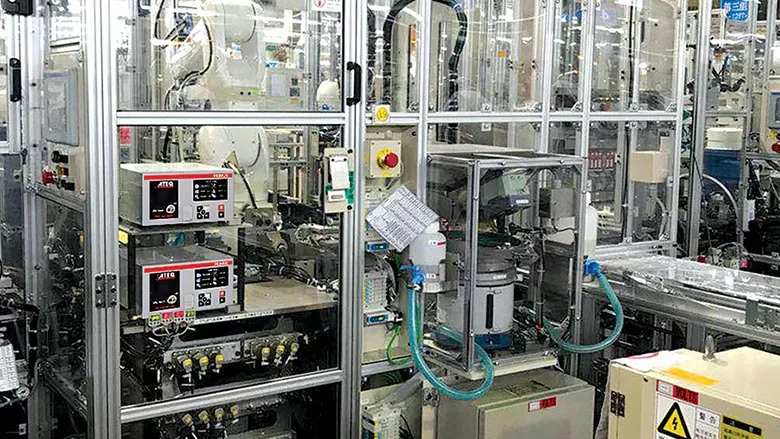
Engineers can get the best test system for their application if they provide as much detail about their project as possible. Photo courtesy ATEQ Corp.
Successful implementation of a leak test system in a production environment starts with clearly stated requirements. Some specifications are relatively easy: cycle time, test volume and how the parts will be handled. Others are less clear. What is the best method for testing the assembly? What is the leak-tightness requirement?
Engineers can get the best test system for their application if they ask vendors the right questions and provide as much detail about their project as possible. The key is to submit a clear and concise request for proposal (RFP). Failure to do so can cause headaches or delays, and lead to expensive mistakes.
Unfortunately, many engineers approach the process the wrong way.
“Leak testing is much different than other types of production equipment, because so many things influence the outcome,” says Thomas Parker, automotive market sales manager at Inficon Inc. “They are complex systems. Pressures and temperatures greatly influence testing.”
“The most common problem engineers encounter is not getting the leak testing system they hoped for, thinking that many things were implied, while they needed to be written down,” adds Anne-Marie Dewailly, technical director at ATEQ Corp. “We are experiencing a lot more problems with people who have no leak test experience not knowing what to specify.
“Leak testing is not taught in schools, and many [people we encounter] do not even have the basic [knowledge or experience] to understand a leak test,” claims Dewailly. “Our team of experts spend a lot of time trying to formalize in testing terms what the customer really wants without expressing it.”
“Many customers don’t know the technology best suited for testing their product,” adds Gordon Splete, global product manager at Cincinnati Test Systems Inc. “They only know that they have a part of subassembly that needs to be tested for leaks. Without a specified criteria, those engineers have to correlate what the criteria must be and validate the information. “This can be a lengthy process,” warns Splete. “They’ll end up producing multiple parts each with escalating leak rates from low levels to high levels, and then functionally testing each to prove that the material that shouldn’t leak does or does not leak from or into the part. “Engineers that just guess at the testing technique or technology might later find that their system is either too sensitive or not sensitive enough for finding their leak rates once they get feedback from their customers,” Splete points out.
Looking for quick answers on assembly and manufacturing topics? Try Ask ASM, our new smart AI search tool. Ask ASM
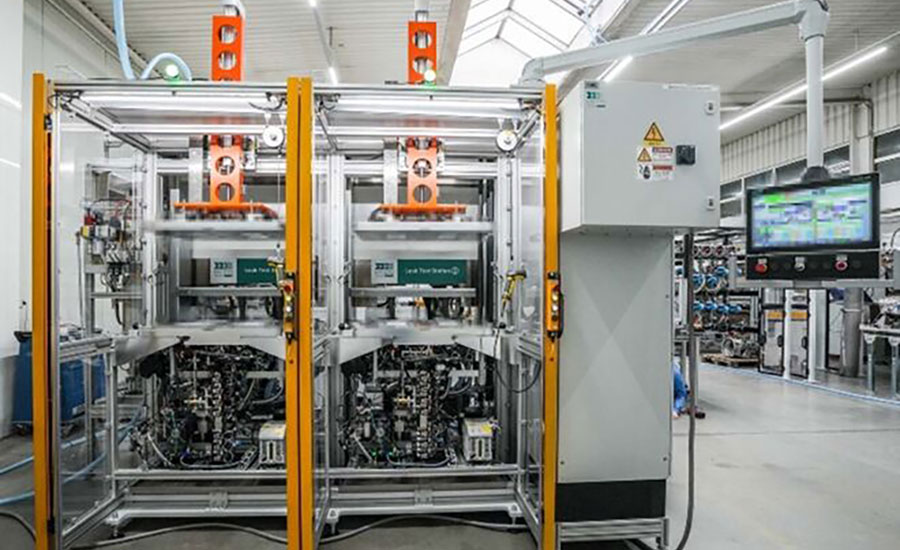
Leak testing is much different than other types of production equipment, because many factors influence the outcome. Photo courtesy Inficon Inc.
Several factors are to blame for lackadaisical leak test specifications.
“We are seeing more loose specifications,” says Parker. “For example, someone will submit something that says ‘leakage not to exceed 0.1 ounce per year,’ but then fail to specify important details like ‘of what material at what condition leaking into what?’ It just seems like the details are missing. They also do not specify firm cycle time.”
According to Parker and other observers, the knowledge gap is getting wider, because many veteran engineers have retired in recent years.
“Information is not being passed down from the retiring generation to the younger one, and there is ego involved on both sides,” claims Parker. “One is saying ‘let them figure it out,’ while the other says ‘why should I listen to a boomer?’”
“There’s a lot of ignorance on the part of younger engineers who don’t know what they should be looking for in a leak testing RFP,” says Parker. “I’ve seen more projects lately where the customer has a project time of say 45 seconds, but at the end of the runoff they suddenly change that number to 30 seconds. In other words, they try to squeeze the project at the end.
“Ever since Covid, many system integrators and machine builders that traditionally have not done leak testing are now quoting and winning projects,” laments Parker. “We’ve seen several disasters over the last few years because people on both sides didn’t know what they were doing.
“Some young engineers mistakenly think that if they write a loose specification, they’ll get a cheaper price on a leak testing machine or line,” notes Parker. “They deliberately use it as a strategy to help drive down the cost and try to get more for less.”
What to Include in a RFP
No matter what type of part or component needs to be tested for leaks, every RFP should include a basic set of parameters.
“The most important criteria necessary for specifying a leak test system is identifying the reject leak rate and test pressure,” claims Splete. “Those are the first two questions we ask when a customer calls us to help identify the technology and methods for a specific leak test system. “The best way to specify a system is to understand the physics related to what shouldn’t leak into or out of the part,” says Splete. “Then, correlate that to a specified leak rate (volumetric flow over time) with a test pressure. The goal is to choose the best technology that accommodates three things:
- Repeatably measuring the leak.
- Meeting production throughput, remembering that test cycle times vary based on technology and part types.
- Helping accommodate budgets with manual sealing devices or automated test systems.”
Splete believes seven key criteria should always be included in a RFP:
- What shouldn’t leak into or out of the part?
- What are the test specifications, including leak rate and test pressure?
- What is the current production rate?
- What is the size of the part?
- What are the sealing locations and characteristics of each?
- How many different part designs are being tested on the same line?
- What is the budget for the project?
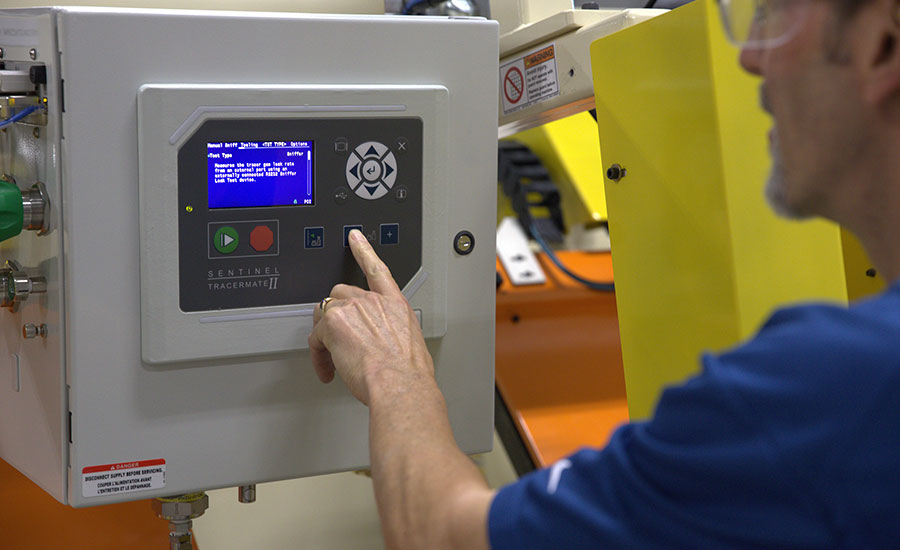
The most important criteria necessary for specifying a leak test system is identifying the reject leak rate and test pressure. Photo courtesy Cincinnati Test Systems Inc.
“The basic information we look for is what is being tested,” adds ATEQ’s Dewailly “Plus, the material, size, shape and geometry of the part.”
According to Dewailly, other important questions include the following:
- What needs to be contained?
- Is there a test medium preference, such as argon, dry air pressure, helium, hydrogen or vacuum?
- Is there an already set test specification involving pressure and leak rate?
- Is there a measurement repeatability requirement?
- What is the production rate and allowed test cycle time?
- What is the test environment?
- What level of automation is desired?
- Is a test data collection system needed?
- Are there any limitations on the material that can be in contact with the product tested?
“Providing a specific rate, the pressure conditions during the test and the amount of cycle time will make or break a project,” adds Inficon’s Parker. “Other things to consider include what gage R&R levels are required, cycle time and the intended robustness of the system. How many times a day will a calibrated leak be checked? Is the leak in the part?
“Cycle time and throughput must be understood to be separate,” notes Parker. “What about yield and false judgments? Even the leak rate is hard to determine. For instance, look at liquid water ingress in a battery pack. Leak rates are all over the place and some nowhere near IP67.
“It’s not just about what size leak you want to find,” says Parker. “It’s also how fast do you want to find it and how repeatable do you want the measurement? In other words, what sort of metrology do you want behind that measurement?”
Sample parts are also important, especially when it comes to understanding physical characteristics. How solid is it? What are some of the possible problem areas for sealing?
“Sample parts help identify test specifications,” says Splete. “Drawings and CAD files are great, but they don’t always show what a surface area is going to be like or where you’re going to have interferences.
“We are seeing more 3D-printed parts used as samples,” Splete points. “They’re always helpful, but nothing compares to an actual production part.”
“Printed parts will behave differently,” warns Parker. “When we do a feasibility analysis, we always want real-world parts so that we know the characteristics of the material and how it behaves.”
“Documentation is also very important,” claims Parker. “Even with digital RFPs, you need to have a ‘paper trail.’ Otherwise, you could get engaged in a game of finger pointing. The documentation process must be transparent, well tracked and carefully managed.”
For more information on leak testing, read these articles:
Leak Testing Battery Packs
Dealing With the Helium Shortage
Leak Testing Appliances
Looking for a reprint of this article?
From high-res PDFs to custom plaques, order your copy today!