Are Unions Making a Comeback?
The UAW's success last fall has other unions looking for similar results.
For a variety of reasons, union membership has declined over the past 40 years. According to the latest data from the U.S. Bureau of Labor Statistics, the union membership rate—the percent of wage and salary workers who were members of unions—was 10 percent in 2023, little changed from the previous year. The number of wage and salary workers belonging to unions, at 14.4 million, also showed little movement over the year. In 1983, the first year for which comparable data are available, the union membership rate was 20.1 percent, and there were 17.7 million union workers.
This is a little surprising—or not, depending on whether you’re labor or management—given that nonunion workers had median weekly earnings that were 86 percent of earnings for workers who were union members ($1,090 vs. $1,263).
Be that as it may, union membership could get a boost in the next few years. From Oct. 1, 2023, to Sept. 30, 2024, the National Labor Relations Board (NLRB) received 3,286 union election petitions, up 27 percent since fiscal year (FY) 2023, when the agency received 2,593 petitions. This is more than double the number of petitions received since FY 2021, when the NLRB received 1,638 petitions.
Similarly, from FY 2023 to FY 2024, charges of unfair labor practices increased 7 percent (from 19,869 to 21,292 cases). In sum, the NLRB’s field offices received a total of 24,578 cases, the highest total number in more than a decade.
“Union election petitions are way up because the COVID recession, rapid economic recovery, labor shortages, and high inflation shifted power to workers who were organized,” observes Robert Anthony Bruno, Ph.D., professor and director of the labor education program at the University of Illinois Urbana-Champaign. “Workers have had substantial economic grievances for more than 40 years. Now, the ‘union premium’ is elevated.”
“A tight labor market has reduced the trepidation many workers have about trying to organize a union,” adds Paul F. Clark, Ph.D., a professor of labor and employment relations at Penn State University. “American employers usually aggressively oppose their workers’ efforts to organize. Workers know their employer will look unfavorably at them if they try to form a union. [Many organizing drives fail because] employers will illegally fire employees involved in the unionization effort. When unemployment is low and many companies are desperate to hire, workers are less fearful about unionizing, because other jobs are available should they lose theirs.
“The Biden Administration is probably the most pro-union administration in U.S. history,” he continues. “[The NLRB] is much more sympathetic to unions than it was when Republicans controlled the White House. Even though…the National Labor Relations Act is weak, it makes a difference if it is interpreted in a way that favors unions.”
Looking for quick answers on assembly and manufacturing topics? Try Ask ASM, our new smart AI search tool. Ask ASM
Public opinion on unions is also trending up. A Gallup poll published in September found that seven in 10 Americans approve of labor unions, essentially tying the 71 percent reading in 2022, which was the highest since 1965. Gallup first measured the public’s approval of labor unions in 1936 and found the highest support (75 percent) in the 1950s. Approval of unions has only fallen below 50 percent once—a 48 percent reading in 2009 after the Great Recession. The latest reading, 70 percent, marks the eighth consecutive reading above 60 percent, the longest streak at this level since the 1960s.
Ironically, young people are giving unions a boost, too.
“Gen Z workers coming into the workforce expect much more out of their work than past generations,” says Clark. “And, if they don’t get it, they are not shy about pushing employers to improve things. Unions provide a mechanism for Gen Z workers in some industries to try to improve their conditions at work. That’s why much of the organizing we are seeing is in places with a young workforce, such as Starbucks, Trader Joe’s, Amazon and social media companies.”
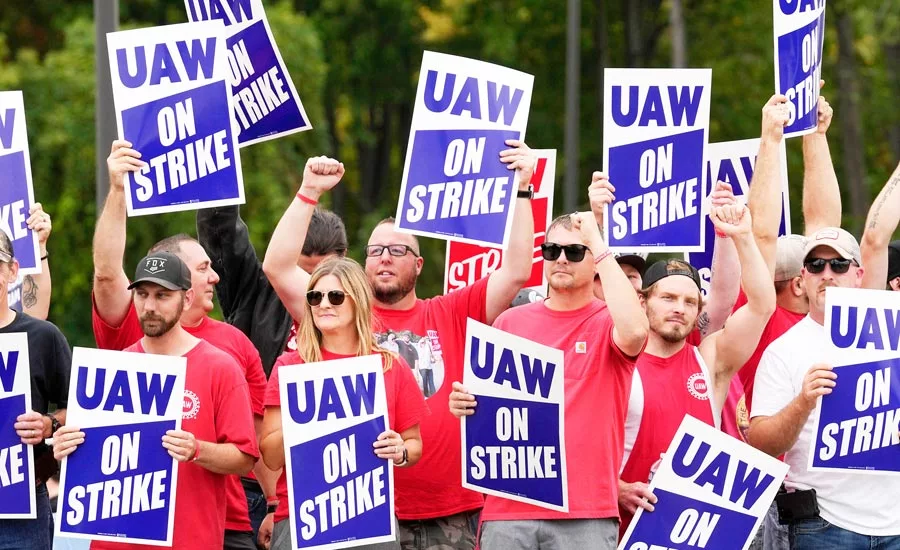
Certainly, another contributing factor has to be the United Auto Workers huge success last fall in negotiating new contracts with the Detroit Three automakers. The contracts include a 27 percent wage increase, a revival of cost-of-living adjustments, a shorter timeline to the top wage, rollover commitments for temporary workers, and a pathway for workers at future battery plants to be represented by the union.
That deal prompted automotive OEMs with nonunion workforces to increase pay, as well—the so-called “UAW bump.” Tesla raised wages by 10 percent for some hourly workers at its battery factory in Nevada. Volkswagen raised pay by 11 percent for nonunion workers at its assembly plant in Tennessee. Nissan increased top wages for workers at its U.S. assembly plants by 10 percent. Hyundai will increase wages for nonunion workers at its Alabama factory by 25 percent by 2028. Honda gave workers at its U.S. factories an 11 percent pay hike, while Toyota handed its workforce a 9 percent raise.
That success has unions feeling their oats for the first time in years. Consider what's happening in the Pacific Northwest. More than 33,000 machinists at Boeing went on strike Sept. 13, the first by the union since 2008. Boeing has offered a 30 percent pay increase over four years, plus $9,360 a year in contributions to employee 401(k)s and lower healthcare premiums. But the International Association of Machinists and Aerospace Workers is refusing to settle for less than a 40 percent raise and restoration of the defined-benefit pensions that the company scrapped a decade ago.
Boeing Commercial Airplanes President and CEO Stephanie Pope released a statement claiming that the union has “made non-negotiable demands far in excess of what can be accepted if we are to remain competitive as a business.”
The strike has been disastrous for Boeing, which is already reeling from quality concerns and Congressional hearings. By some estimates, the strike is costing Boeing $1.3 billion in capital a month. In response, Boeing plans to slash its workforce by 10 percent, or about 17,000 workers, in the coming months. It also announced $3 billion in charges related to its commercial jet program and $2 billion on its defense and space division, largely owing to delays caused by the work stoppage as well as higher costs.
Just weeks after the machinists walked off the job, the International Longshoremen’s Association (ILA) went on strike Oct. 1. The strike involved more than 47,000 port workers and affected 36 ports across the United States, primarily along the East Coast and Gulf Coast. Thankfully, dockworkers reached a tentative deal just two days later, and the union agreed to suspend its strike until Jan. 15 to negotiate the finer points of a new contract. The tentative deal gives workers a 61.5 percent wage increase over the next six years and includes language to protect workers from being replaced by automation.
In a highly competitive labor market, manufacturers are well-advised to share the wealth and strive for a more cooperative relationship with their workforce.Looking for a reprint of this article?
From high-res PDFs to custom plaques, order your copy today!