Assembly Magazine logo
search
Ask ASSEMBLY AI
cart
facebook twitter linkedin youtube
  • Sign In
  • Create Account
  • Sign Out
  • My Account
Assembly Magazine logo
  • TRENDS
    • Ask ASSEMBLY AI
    • Trends
    • News
    • New Products
  • INDUSTRIES
    • Aerospace
    • Appliance
    • DFMA Assembly
    • Medical Devices
    • Green Manufacturing
    • Lean Manufacturing
    • Machinery Assembly
    • Electronics Assembly
    • Automotive
  • TECHNOLOGIES
    • Adhesives & Dispensing
    • Assembly Presses
    • Automated Assembly Systems
    • Manufacturing Management
    • Manufacturing Software
    • Motion Control
    • Screwdriving & Riveting
    • Robotics
    • Test & Inspection
    • Plastics & Metal Welding
    • Wire Processing
    • Workstations
  • AUTONOMOUS & ELECTRIC MOBILITY
    • AEM Magazine Archives
    • Autonomy
    • Electrification
    • Mobility Services
    • Assembly & Testing
    • AV/EM News
  • MEDIA
    • Ask ASSEMBLY AI
    • Podcasts
    • Assembly News Now
    • Assembly TV
    • Webinars
    • eBooks
  • EVENTS
    • Calendar
    • The ASSEMBLY Show
  • MORE
    • Exclusives >
      • Plant of the Year
      • Capital Spending
    • Buyers Guide >
      • Supplier Insights
    • Classifieds
    • Featured Products
    • Newsletters
    • Store
    • White Papers
    • Columns
    • Sponsor Insights
  • INFOCENTER
    • Assembly & Test Solutions
  • EMAGAZINE
    • eMagazine
    • Archive Issues
    • Advertise
    • Contact Us
    • Sign Up
TechnologiesColumnsAutomated Assembly SystemsRobotics AssemblyThe Editorial

Automation and Jobs: The Debate Continues
By John Sprovieri
automation in manufacturing

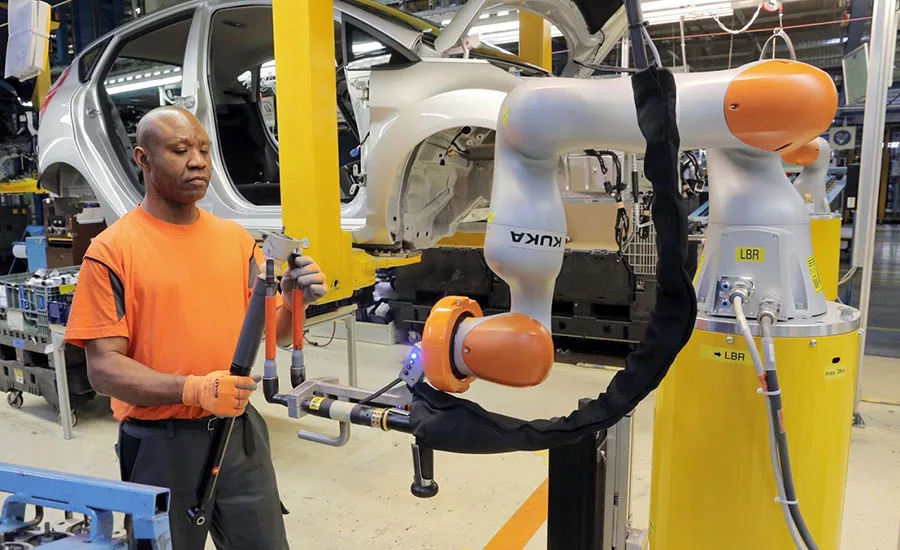
A new study finds that workers are more apt to report potential benefits from new technologies like robots and AI than to report potential costs.

Photo courtesy Ford Motor Co.

December 13, 2024

On Oct. 1, longshoremen went on strike for the first time in nearly 50 years. The strike involved more than 47,000 port workers who are part of the International Longshoremen’s Association (ILA). The strike affected 36 ports across the United States, primarily along the East and Gulf coasts.

The main sticking point was, of course, money. The ILA sought a 77 percent wage increase over the six-year term of the contract. The United States Maritime Alliance, the employers’ group, offered raises of nearly 50 percent.

Thankfully, dockworkers agreed to suspend the strike just three days later, with their current contract extended until Jan. 15, 2025, as negotiations continue. On wages, both sides met in the middle, agreeing to a 62 percent wage hike. So that, at least, is settled. But, the union said it would return to the bargaining table “to negotiate all other outstanding issues.”

High on the list of those issues is the use of automation in the ports and its impact on jobs. At ports, automation can take the form of driverless vehicles to shuttle containers around the wharf, cranes to stack boxes without much human intervention, and “automated gates” to process trucks. The latter uses RFID, machine vision and other technologies to document trucks and cargo entering and exiting a port. The gates automatically capture data on the driver, truck, trailer and containers. They then automatically tell drivers where to go to pick up or drop off their loads.

Proponents of the technology say that it improves traffic flow, decreases congestion, and reduces emissions from idling vehicles. The ILA complains that the technology reduces the need for gate clerks.

Indeed, talks between the ILA and port operators broke off in June after the union discovered a gate at a port in Mobile, AL, that was using technology to process trucks automatically without the involvement of dockworkers. The ILA argued that use of the gate violated its contract, which permits “semi-automated” technology, but not equipment “devoid of human interaction.” Port operators say “modernization”—in other words, automation—is necessary to ensure the efficient flow of cargo.

Automation vs. jobs. It’s an age-old debate that’s been raging since the Luddite movement in the UK in the early 19th century. I remember chatting once with a long-time manufacturing guy who used to be a manager at a GM assembly plant in the early ’70s. He recalled how union workers would sabotage robots at the plant, fearing that the machines would take their jobs.

Looking for quick answers on assembly and manufacturing topics? Try Ask ASM, our new smart AI search tool. Ask ASM →

Thankfully, that’s not really an issue now. Workers are happy to concede “dirty, dull and dangerous” jobs to robots, and they mostly recognize the need and value of automation.

Indeed, new research from the Massachusetts Institute of Technology suggests that workers have a more optimistic, nuanced perspective on automation. Led by Ben Armstrong, Ph.D., executive director at the Industrial Performance Center at MIT, the researchers surveyed more than 9,000 workers across nine countries in 2024. They found that more workers report potential benefits from new technologies like robots and AI than report potential costs. They believe that automation benefits their safety and comfort at work, their pay, and their autonomy on the job.

Workers with jobs that ask them to solve complex problems, workers who feel valued by their employers, and workers who are motivated to move up in their careers are all more likely to see new technologies as beneficial. Ironically, more formal education is, in some cases, associated with more negative attitudes toward automation and its impact on work.

Perhaps things are different on the docks. But, in manufacturing, at least, employers today are less concerned about reducing head count than they are about keeping the workers they already have. With factories having difficulty hiring, managers are increasingly deploying robots to handle easy, mundane tasks, such as machine tending, so that the few people who are on the payrolls are free to do things only people can do.

It will be interesting to see if automation comes up as a bargaining chip in future labor negotiations.
KEYWORDS: factory automation Jobs

Share This Story

Looking for a reprint of this article?
From high-res PDFs to custom plaques, order your copy today!

John has been with ASSEMBLY magazine since February 1997. John was formerly with a national medical news magazine, and has written for Pathology Today and the Green Bay Press-Gazette. John holds a B.A. in journalism from Northwestern University, Medill School of Journalism.

Recommended Content

JOIN TODAY
To unlock your recommendations.

Already have an account? Sign In

  • Made in the U.S.A.

    Consumer Products Manufacturing: Made in the USA

    Supply chain lessons learned during the coronavirus...
    Automated Assembly Systems
    By: Austin Weber
  • Best Practices for Press-Fit Assembly

    Best Practices for Press-Fit Assembly

    In manufacturing, ironclad formulas for success are hard...
    Assembly Presses
    By: Jim Camillo
  • aem0523leader-tesla1.jpg

    Tesla Rethinks the Assembly Line

    Engineers at Tesla Inc. have developed a new process that...
    Industries
    By: Austin Weber
Manage My Account
  • eMagazine Subscription
  • Assembly Newsletters
  • Online Registration
  • Subscription Customer Service
  • Manage My Preferences

More Videos

Sponsored Content

Sponsored Content is a special paid section where industry companies provide high quality, objective, non-commercial content around topics of interest to the ASSEMBLY audience. All Sponsored Content is supplied by the advertising company and any opinions expressed in this article are those of the author and not necessarily reflect the views of ASSEMBLY or its parent company, BNP Media. Interested in participating in our Sponsored Content section? Contact your local rep!

close
  • ultrasonic welding
    Sponsored bySonobond Ultrasonics

    Engineering Efficiency in High-Performance Assembly: How Ultrasonic Welding Enhances Throughput, Reliability and Quality

  • UV curing system
    Sponsored byDymax

    Why UV Intensity Alone Doesn’t Define Curing Performance

  • wooden pallets
    Sponsored byLEAN Manufacturing Products

    Eliminating Waste on the Shop Floor: Applying Lean Principles to Improve Manufacturing Efficiency

Popular Stories

ASSEMBLY News Now, episode 30: Volvo Redesigns EV Manufacturing

Volvo Redesigns EV Manufacturing

ASSEMBLY News Now, Episode 29: Mercedes-Benz to Invest $4 billion in Alabama Assembly Plant

Mercedes-Benz to Invest $4 billion in Alabama Assembly Plant

Boeing CEO Kelly Ortberg announces 1 billion investment

Boeing Plans $1 Billion Wichita Investment, Workforce Training Center

Watch the latest episode of ANN now!

Events

July 24, 2025

From Shop Floor to CFO: How Manufacturers Are Closing the Loop Between Operations and Finance

On Demand Learn how manufacturers are bridging the gap between the shop floor and ERP systems to gain real-time visibility, streamline operations, and kick-start digital transformation—without waiting years.

Sponsored by:

PicoStratusGreen
July 30, 2025

Buffer Analysis and Design Fundamentals for Manufacturing Excellence

On Demand In this presentation, Dr. Herman Tang shares practical insights from his industry experience and research on buffer management in manufacturing operations.

View All Submit An Event

Poll

Difficult Assembly Processes

Which assembly process gives you the most difficulty?
View Results Poll Archive

Products

Manufacturing Cost Policy Deployment (MCPD) Profitability Scenarios: Systematic and Systemic Improvement of Manufacturing Costs

Manufacturing Cost Policy Deployment (MCPD) Profitability Scenarios: Systematic and Systemic Improvement of Manufacturing Costs

See More Products
Register for webinar - Modernizing Automotive Assembly: Why Upgrading Legacy MES is a Business Imperative

Related Articles

  • Flaggers, bridges, automation and jobs

    See More
  • ford splits in two

    Ford Announces 6,200 New Jobs in the Midwest

    See More
  • Oregon Assembler Shows Why China May Lose Jobs to the U.S.

    See More

Related Products

See More Products
  • Assembly Processes: Finishing, Packaging, and Automation

  • history.jpg

    Faster, Better, Cheaper in the History of Manufacturing: From the Stone Age to Lean Manufacturing and Beyond

See More Products

Related Directories

  • Sankyo Automation

    Sankyo Automation has been a worldwide leader in cam-driven indexing technology, and continues to develop new and innovative technology in motion control. The high quality of Sankyo products is a direct result of innovative design, strict process control and a continual effort to strive for improvement. These attitudes and technology are managed from our facility located in Sidney, OH.
  • Assembly & Automation Technology Inc.

    Assembly & Automation Technology delivers intelligent automation systems integrating machine learning, computer vision and smart robotics for industrial, medical and biotechnical applications. Our AI-enhanced assembly machines, robotic systems and vision-guided quality control optimize productivity while reducing human error. We engineer custom automated solutions that learn, adapt and continuously improve manufacturing processes.
  • Kahle Automation

    Kahle is a worldwide supplier of high speed automation, for the Medical Device and Pharmaceutical Industries. Kahle designs and builds equipment for the custom assembly, inspection and process of all types of medical devices and drug delivery products with complete equipment validation services.
×

Never miss the latest news and trends driving the manufacturing industry

Stay in the know on the latest assembly trends.

JOIN TODAY!
  • RESOURCES
    • Advertise
    • Contact Us
    • Directories
    • Manufacturing Division
    • Store
    • Want More?
  • SIGN UP TODAY
    • Create Account
    • eMagazine
    • Newsletters
    • Customer Service
    • Manage Preferences
  • SERVICES
    • Marketing Services
    • Reprints
    • Market Research
    • List Rental
    • Survey/Respondent Access
  • STAY CONNECTED
    • LinkedIn
    • Facebook
    • Instagram
    • YouTube
    • X (Twitter)
  • PRIVACY
    • PRIVACY POLICY
    • TERMS & CONDITIONS
    • DO NOT SELL MY PERSONAL INFORMATION
    • PRIVACY REQUEST
    • ACCESSIBILITY

Copyright ©2026. All Rights Reserved BNP Media, Inc. and BNP Media II, LLC.

Design, CMS, Hosting & Web Development :: ePublishing