Tips for Feeding and Driving Small Screws
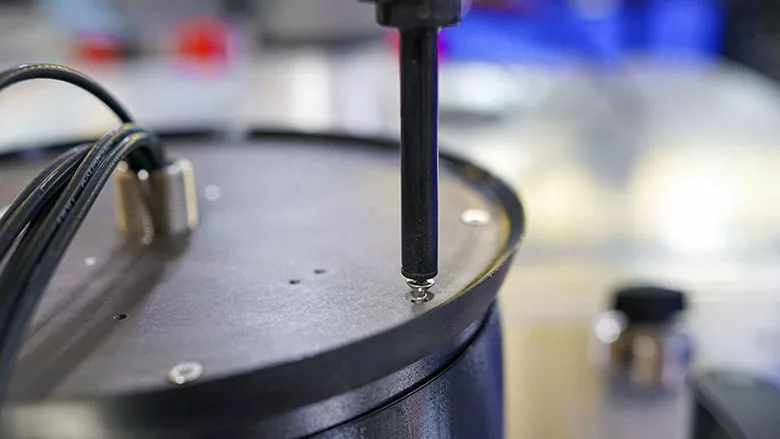
Engineers are well-advised to design products to facilitate automatic screwdriving.
Photo courtesy Robotiq
As products get smaller, so too must the threaded fasteners that hold those products together. Fasteners with shaft diameters as small as 0.8 millimeter are used in products such as smartphones, toys, hearing aids and eyewear.
On an assembly line, automated equipment is often a necessity for driving screws with shaft diameters of less than 4 millimeters. For example, as many as 120 small-diameter threaded fasteners may be required to fasten the lid on a filter box for a cellular phone tower.
But, driving small-diameter threaded fasteners with automated equipment can be problematic. Compared with the tolerances for bigger fasteners, the manufacturing tolerances for small screws are looser, relative to their dimensions. The small size and weight of the fasteners necessitate special equipment to feed them, hold them in place on the bit, and limit the amount of torque applied. And because the screw holes are small, operators may need help locating the targets. Indeed, operators may not be able to find the holes consistently, and the fasteners may need to be driven by a robot or fixed automation.
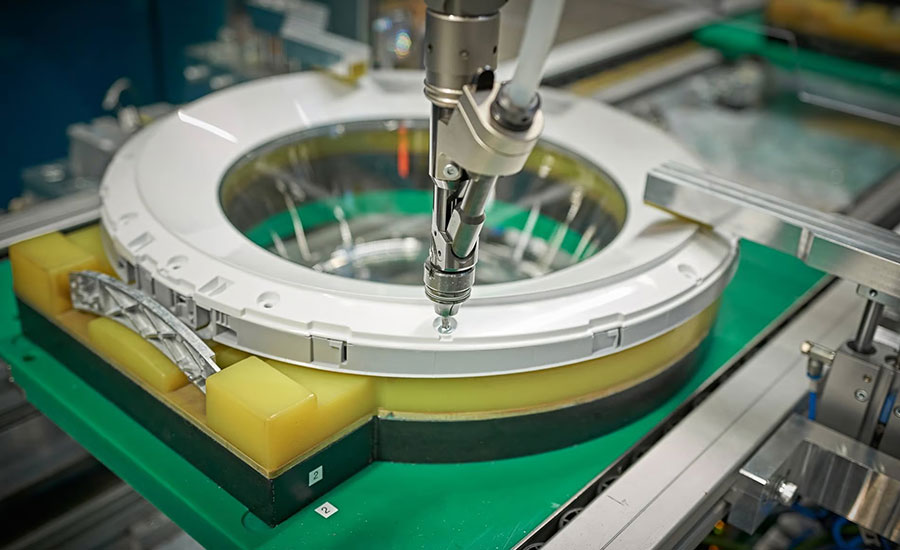
With robotics, assemblers can ensure that a fastener isn’t missed or installed in the wrong area. Photo courtesy Kuka
Design Issues
When deciding to automate the fastening process, assemblers should start with the screw. In most cases, the material the screw is made from is not critical to the fastening process. Both ferrous and nonferrous metals are acceptable, but there are some caveats. If manufacturers don’t have to use magnetics, it’s best to use nonferrous fasteners. Ferrous screws can become magnetized in a feeder bowl.
The choice of fastener material also may be affected by what type of sensor is built into an automated fastening machine. If the equipment uses proximity switches to sense the presence of a screw, stainless steel fasteners might not be a good choice, since many sensors work on the magnetic properties of the screw.
As for drive style, suppliers of automatic screwdriving equipment recommend fasteners with self-centering drives, such as Torx, Phillips and hex screws. Cam out—the tendency of the bit to slip from the fastener head during rundown—is less of a problem with these types of fasteners. Slotted screws are difficult to use with automated equipment because the bit picks up the fastener only once every 180 degrees. In addition, Torx and other internal drive styles require less downward force from the operator.

Automated equipment is often a necessity for driving screws with shaft diameters of less than 4 millimeters.Photo courtesy Visumatic
Regardless of the material or drive style, suppliers urge assemblers to use high-quality fasteners. Shop-floor problems with automated fastening equipment are almost always related to the fastener. The better the screw, the better the machine will run.
Looking for quick answers on assembly and manufacturing topics? Try Ask ASM, our new smart AI search tool. Ask ASM
Part design is another consideration. Manufacturers typically start assembling a product without automation. As production volume increases, they may adopt automatic screwfeeding equipment, and eventually they may even implement a fully automatic process. To avoid problems down the road, engineers are well-advised to consider designing products to facilitate automated assembly. This should be done early in the design stage, before molds are cut and parts are specified.
For automated fastening, it’s best to have an unobstructed path to the screw hole. Screw holes should be far enough away from ribs and walls to provide room for the nosepiece of the driver.
Driving a screw in a deep recess may require special equipment to hold the screw in the bit. It’s preferable to have the collet on the nosepiece hold the screw, but a vacuum may have to be added. Magnetics should be avoided.
When specifying an automated fastening system, assemblers should give their suppliers as much information as possible. What is the desired production rate? How much torque will be applied to the fastener? How accurately must the torque be applied? How often can the feeder be replenished? Can the parts be scratched? Will the fastening machine interface with other equipment? It’s helpful to provide sample parts and fasteners.
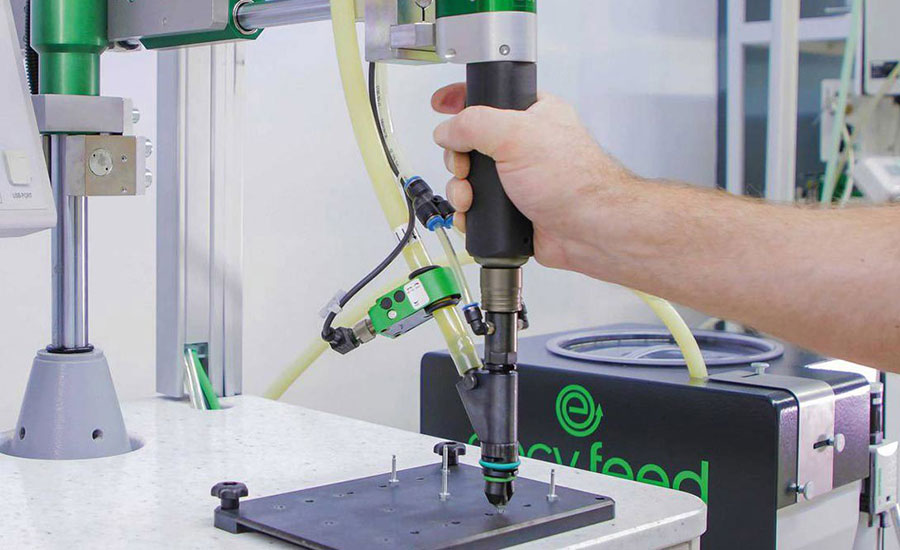
Small fasteners require special equipment to feed them, hold them in place on the bit, and limit the amount of torque applied. Photo courtesy Deprag
Feeding Options
The simple action of picking a screw out of a bin, sticking it at the end of a bit, and driving it into the part is not that simple with small fasteners. As a result, automation engineers recommend automatic screwfeeders. Vibratory bowls are the most popular choice for feeding small screws. With a #10 pan-head screw, a vibratory bowl can feed as many as 80 screws per minute. That’s important, because an experienced operator can install 60 screws per minute.
The escapement for the screws can be shorter with feeder bowls than with other types of feeders. This decreases the overall footprint of the automated fastening system.
But, using vibratory bowls to feed small screws is not without problems. For example, the weight of the fastener is very low in relation to the intensity of the vibration. Screws are literally jumping all over the place and often won’t make it to the top spiral and the separator. To solve this problem, it’s best to use a feeder bowl with small diameter.
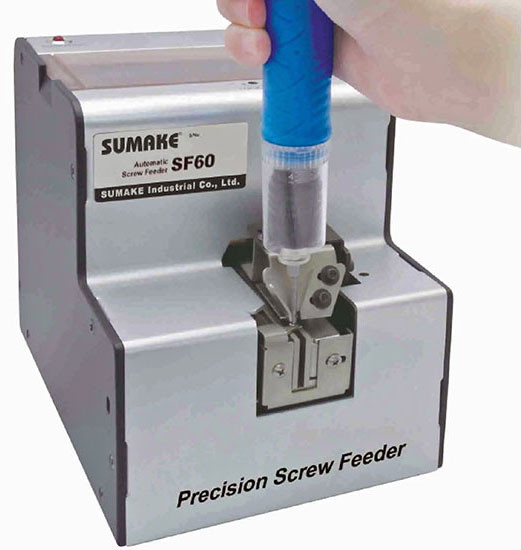
It’s much easier for assemblers to retrieve a small screw from a screw presenter than a bin full of loose fasteners. Photo courtesy Sumake
Screws also can become magnetized while in the bowl, inhibiting correct feeding. To overcome this problem, bowls are best made from high-grade plastic materials and stainless steel. Lining the bowl with plastic also makes it quieter.
Manufacturers should avoid vibratory bowls for feeding coated fasteners, since the screws will rub against each other in the bowl, which could damage the coating.
One alternative to vibratory bowls is the sword, or blade, feeder. In this type of feeder, a notched blade pulls screws from the bottom of a funnel-shaped hopper and deposits them onto a rail. When all the screws on the rail have been used, a sensor triggers the blade to get more.
One advantage of the sword feeder is that all the fasteners in the hopper get used. With a vibratory feeder, screws may sit in the bowl for days before being used, which increases the chances that they could be damaged.
Cassettes are another option for feeding screws to automated fastening equipment. This lets assemblers change fasteners simply by changing cassettes. Assemblers can keep separate cassettes for each type of screw they use.
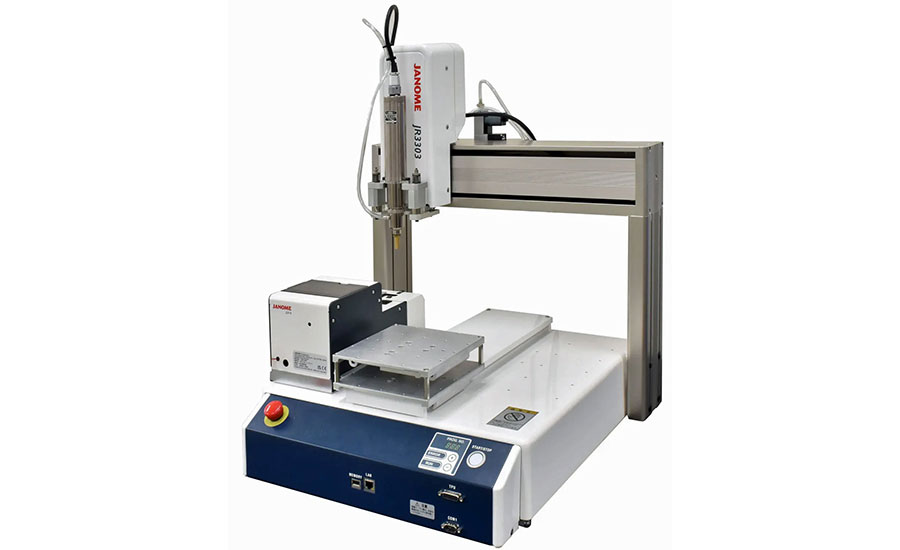
For automated fastening, many manufacturers prefer semiautomatic robotic workcells over in-line, fixed automation. Photo courtesy Janome
From Bowl to Driver
Once the screw has been singulated, the next step is getting it to the head of the screwdriver. Again, there are two main options: blow feeding and track feeding.
In blow feeding, the screws are blown through a flexible tube to the drive head. For optimal feeding, the length of the screw should be at least 1.5 times the width of the head. Shorter screws tend to tumble in the feed tube, causing jams. Pointed screws usually can’t be blow-fed, because the points can stick in the soft material of the tube.
Assemblers should limit how much the tube shakes during operation. Too much shaking can cause jams.
Track feeding is just that—fasteners travel to the drive head along a steel track. It’s an option for screws that can’t be fed through a tube. The screws can be fed directly to the head, or the head can travel to the track to pick and place individual screws. With a pick-and-place operation, the driver has the added ability of unfastening screws to repair rejected assemblies or backing them out a preset distance to assemble wiring points for relays or switches.
Track feeding doesn’t offer specific advantages over blow feeding. The only exception may be applications in which the part is presented to a fixed driver, as opposed to the driver going to the part. However, track feeding adds size to the head of the tool.
Driving It Home
Once the screw is on the bit, the next step is to drive it. Because the target is so small, aligning the fastener with the screw location prior to insertion must be done carefully. Missing the hole might result in a scratched and rejected part. Templates are one solution to this problem.
The template is attached to the parts fixture with a hinge. Holes in the template correspond to the screw holes in the part. Prior to fastening, the parts are placed in the fixture and the template is laid over them. The screws can then be driven through the holes in the template, which are tapered to direct the nosepiece of the driver into the screw holes. This makes it easier for the operator to find the holes.
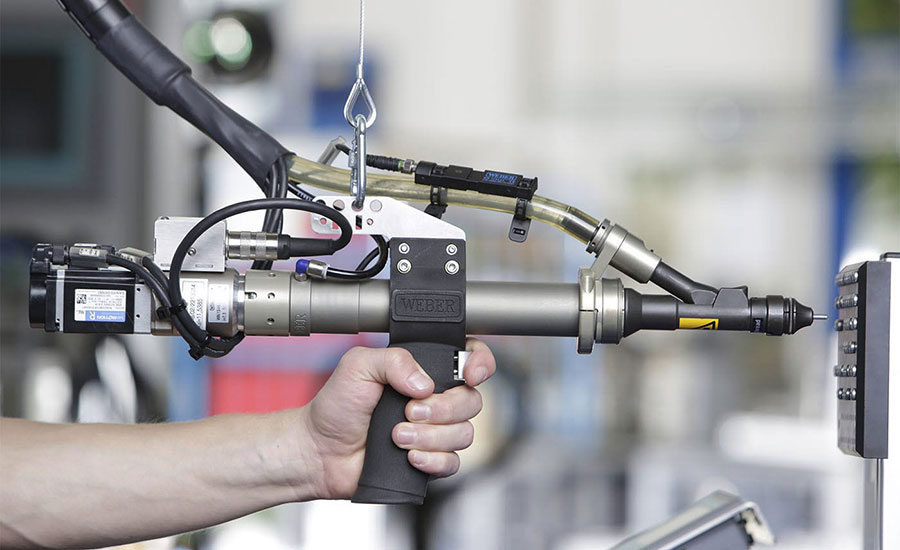
Suppliers of automatic screwdriving equipment recommend fasteners with self-centering drives, such as Torx, Phillips and hex screws. Photo courtesy Weber Screwdriving
Torque control is another issue. It’s not difficult to strip or even break a small-diameter threaded fastener with a hand tool, much less with a pneumatic or electric tool. Suppliers have answered this need with screwdrivers that can drive fasteners with torque as low as 2 newton-centimeters.
In-line torque monitoring for small screws is tricky. The torque that is being verified might be smaller than the tolerance of the available test equipment. At the same time, if the test equipment is too sensitive, it can easily be damaged during use, or its readings can be thrown off by environmental conditions.
Equipment Choices
Deciding to automate the process of driving small-diameter threaded fasteners is more than just an issue of meeting production rates. With manual fastening, changes in downward pressure or the orientation of the driver can affect the quality of the joint. A robot automatically determines how fast the screwdriver needs to descend to stay in contact with the screw during tightening.
Ergonomics is another issue. Installing hundreds or thousands of screws per day can lead to musculoskeletal problems.
For automated fastening, many manufacturers prefer semiautomatic robotic workcells over in-line, fixed automation. If a hard-tooled line goes down, production stops. But, if assembly is being done by six robots, even if one robot goes down, the company still has five others working. Robots can also be retooled more easily than fixed automation. With robotics, assemblers can ensure that a fastener isn’t missed or installed in the wrong area.
For more information on screwdriving, read these articles from ASSEMBLY:
Challenges in Automatic Screwdriving
New Technology for Automatic Screwdriving
Assembly With Small Screws: Q&A With Design Tool Inc.
Looking for a reprint of this article?
From high-res PDFs to custom plaques, order your copy today!