How to Overcome the Technology “Value Void” in Manufacturing
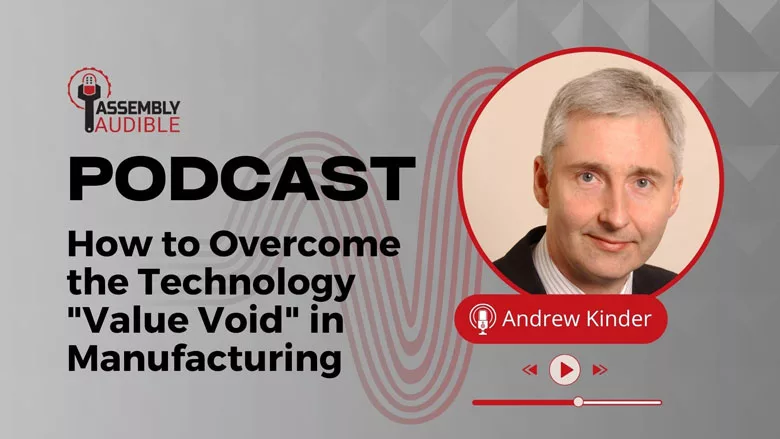
Have you heard of an effect of digital transformation called a value void? It's the gap between technology's promise and what is so often delivered. In a recent conversation with Andrew Kinder, senior vice president for industry strategy at software supplier Infor, we learned about the value void in advanced manufacturing settings, how the most productive organizations are closing the gap, and how you can apply these insights in your organization today. These responses are based on Infor's recent report, How Possible Happens: Overcome the ‘Value Void’ Through Technology-Driven Productivity.
Q: Tell us about the report. What was the purpose of the study? How was it conducted?
Kinder: We commissioned the report about this time last year. We were trying to understand how manufacturers are using technology to become leaders, become more productive, more efficient, and innovate in their businesses. Because we're a technology company, we obviously wanted to understand our customers.
We wanted it to be rich, substantial, and multi-geographical. So, we commissioned this survey across 14 countries and seven industries. So that included industrial manufacturers, automotive manufacturers, defense, food and consumer products, and even some healthcare industries.
It was pretty broad ranging. And it went out to 3,600 respondents. So, it makes it one of the largest and most complete surveys on the market. We decided it should be conducted in an independent fashion. We worked with the director of innovation at Goldsmiths, University of London in the UK. They helped create the survey, commission it, and interpret the findings.
Q: What were some of the key results?
Kinder: Let me take the very highest good news and bad news. We were trying to establish whether manufacturers particularly get the link between technology and competitive improvement and efficiency. And if so, are they doing anything about it? So, let's start with the good news.
Sevent-five percent of respondents see the link between technology and productivity and efficiency. And about the same number expected to increase their investment in technology by more than 20 percent over the next three years. That's the good news. The not-so-good news is that 25 percent of companies, therefore, have no plans to invest in new technology.
This is both physical automation and digital automation. That was a bit of a concern for us, given our vested interest in manufacturing. This is not a set of technologies that you want to get too far behind on. And what we could see, opening up in the results, is almost like a digital divide—basically a divide between companies that have been investing, intend to invest in technology, and their business performance and results, and those companies that are not.
Looking for quick answers on assembly and manufacturing topics? Try Ask ASM, our new smart AI search tool. Ask ASM
That was a wake-up call for a few of us. We need to work with our customers to help them understand the value new technologies can bring and to help them get there so they can take advantage, because there is clearly a benefit to deploying these technologies.
Now let's get into more of the details. So, we were looking at what leaders did well and what characteristics they had in regard to their use of technology vs. those companies that were not leaders. And we found four characteristics:
Characteristics of companies with leaders who are using technology to excel:
- They are intently focused on their processes internally. They really know how those processes work, and therefore they know how to streamline and make differences to become more efficient. They have a very strong focus on their processes and process adherence.
- The second thing is that they tend to use technology to become more agile. And by more agile, I mean they're always up to date. They're using new technologies to do things faster, cleaner, and more efficiently. They're using shop-floor technologies and integrating them into their core systems and business systems, so they're making intelligent decisions much faster. So, it's all about agility. Agility is really the only antidote to the amount of volatility that we have in our business.
- The third thing is that those companies are very focused on data acquisition and data harvesting. They don't see data as a problem. They see data as a rich source for future decision-making.
- And the fourth one, like every good manufacturer and every good business should be, was intently focused on its customers. How can I understand the whole aspect of the customer relationship? Why do they buy from me? Why did they repeat buy? How are the products being used? Are we servicing them? And are we innovating products for the future of our customers?
Those were the four characteristics that stood out the most to us.
Q: So, for the 25 percent who said they did not intend to invest. Did they list a reason why?
Kinder: Always, when you're conducting a survey, you always wish you'd asked the follow-up questions first.
Regarding the 75 percent that are investing, they are tooling up on the shop floor. They're using that data. They're using newer technologies like AI and robotics to automate processes that either are not very human-friendly or that automation can do better, faster and cheaper.
So, these are things that the market is turning toward. You don't want to be a slow follower. Fast followers will be okay, but you don't want to ignore technology, either.
Q: For those manufacturers who are planning on adopting new technologies, what are some challenges that they can expect to face?
The first challenge—and probably a best practice tip—is to remind yourself that it is not a technological deployment. This is a business transformation aided and supported by technology. Don't make technology the reason why you're doing something.
What technologies can I leverage to help me solve that business challenge? So make it about the business and business value.
The first thing you want to do is make sure you understand where the value is in your business, or where you feel the cost is the highest, or the efficiencies are the worst. And focus your tech project on that. And it might not even be tech. In some cases it might just be simple straight business streamlining.
But since we're talking about technology today, the message is:
- Don't lead with technology; lead with the business and follow up with technology.
- Don't underestimate the data challenge. There is a lot of data out there, but there's also a lot of data missing, and you'll have a lot of quality deficiencies in your data. But the other side is also true. Don't make it an excuse not to start. The data will never be perfect. The data probably doesn't even have to be perfect because newer technologies like AI are also very good at interpreting data outliers, and in some cases, they're also very good at filling in the missing data in an intelligent way. So don't put this off. Don’t spend a year doing data that's probably not so good either. Work with what you've got, and then you will know where you need to improve.
- Bring your people with you. This is not about people replacement; this is about people augmentation. And the best way to do that is to involve them right from the beginning. They need to trust that whatever automation you put in place is doing as good a job or better than they're doing today. And then they will adopt it and promote it. They will be fulfilled by it. It's not a people-replacement project; it's all about augmentation, helping people make better decisions, and having a more fulfilling life.
Q: What is a value void, and how does it show up in advanced manufacturing settings?
Kinder: Value void is just a missed promise. It's when you decide you want to do a digital transformation project and you have high aspirations for it.
The survey showed that 70 percent of CEOs or CFOs expected fantastic returns in terms of productivity and efficiency, but only 30 percent actually claimed that. In other words, there was a gap between the 70 percent who expected something when they started and the 30 percent who said they actually did get those results. That is the value void. It is the difference between your aspirations and what you tangibly measure.
Q: How can a manufacturer avoid the value void?
Kinder: Know where the value comes from. What are your aspirations? What are you trying to achieve with the project? Let me give you an example that brings it to life.
We worked with one company for whom the value of that particular transformation was that they wanted to improve their percentage of online business because, although they were a B2B manufacturer, they did see and understand that more online direct purchases to their business, rather than through the dealer network, was something that their competition was doing. It's something that they felt they had to do. At the time, only 10 percent of their business was online, and they aspired to make it 25 percent. And so that became the North Star for that transformation. So, ignore everything else. What technologies do I need to make that customer experience?
Something that would attract people to make online purchases. Therefore, it's not just one technology. If you imagine the range of technologies involved, it was clearly a website and a portal that they could go to with all their products and business processes around shipment and returns.
If you think about going online, returns become an important thing. Speed, because the expectation is that if you're buying online, I'm afraid Amazon has set those bars. It's got to be done. You know, shipped out today.
How do you round out the customer experience, so customers keep coming back to you? How do I make you see me as your first choice for technology? You can ignore everything else, be single-minded and focused on that one business objective, and then you will not have a value void.
You have an expectation, you have a target, you measure against it. You're going to use the right technologies to deliver that.
Focus on the business problem first. All of this—understanding your business processes and what data will support the business processes you're looking for.
A good way of progressing at speed is to be prepared to experiment, compile, and be prepared to fail. Give yourself the freedom to fail. It's not a bad thing. It's a learning experience, particularly if you're thinking about AI and machine learning projects.
These are new tools for us as manufacturers. We're still learning them. So it's okay to have a few pilots that don't change the world for you as a manufacturer. But whilst you're doing so, you're learning. Give yourself the freedom to fail.
Q: I read this statement. “The report shows a 22.7 percent gap in skilled worker access between the most and least productive manufacturers, a disparity that could widen if workforce investment doesn't keep pace.” Could you discuss those findings and their broader implications?
Kinder: This is a huge topic. I was presenting at a manufacturing event last week. And through the magic of audience polling, I asked the audience what their top issues were this year, and I gave them a list of 15 to choose from.
Talent shortages was No. 1 on the list. The audience was European and US. Why is that? There are all sorts of reasons: a retiring workforce, difficulty in recruiting for manufacturing. But there are a couple of other things. The shop floor is becoming more sophisticated, with more physical automation. So you need a higher level of skill. To make matters worse, the average tenure of factory workers is coming down.
You used to go into manufacturing and stay there for a decade or two, now, it might be less than two or three years. Technology can help by institutionalizing knowledge. These days, operators are also frontline engineers. They're the ones who are doing the basic maintenance.
So again, the focus of technology investment must be helping the worker become more productive, produce quality products, stay safe, be more efficient, and be more fulfilled. That combination of technologies is coming together on the shop floor. And I think it's a relatively new space where technology is emerging, because until now, a lot of the efficiencies have been in back-office or supply-chain efficiencies.
But now we're focusing on the operator. We're focusing on how the operator can work with robotics and data, because they're an important part of how we deliver productivity. Nothing is more flexible than a human being.
Q: Is there anything that you would like to close with today before we end the podcast?
Kinder: I think the whole conversation of technologies supporting manufacturing is so important and invigorating because there are more technologies and help than ever before. We're all trying to bring manufacturing closer to the customer and, therefore, closer to home.
But we face inherent challenges when it comes to costs: high taxes, high operating costs, high production costs, and high employee costs. So we have some inherent challenges, which led to outsourcing to different countries in the first place.
But the one thing you can do to lower costs and bring manufacturing back is to invest more in physical and digital automation. That is how you can level the playing field again. So dive in, take advantage of it. Most of these projects, like AI projects, deliver results incredibly fast. We're talking weeks and months, not months and years. It is something you can make rapid progress on. And the projects just get bigger and more valuable the more you do and the more confidence you have. And don't worry about making mistakes. It's fine.
Looking for a reprint of this article?
From high-res PDFs to custom plaques, order your copy today!