Focus on Medical Device Assembly
Lasers Etch Precise Marks on Small Titanium Devices
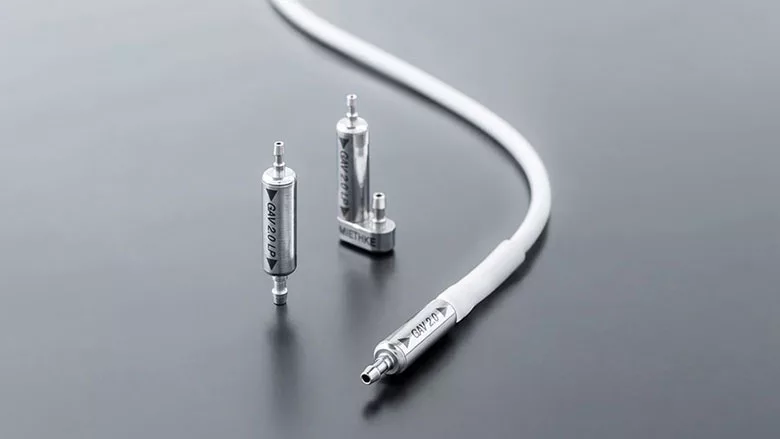
Lasers create durable, black marks on titanium that can survive multiple sterilization cycles.
Hydrocephalus is the buildup of cerebrospinal fluid in cavities called ventricles deep within the brain. Normally, this fluid flows through the ventricles and bathes the brain and spinal column. But the pressure of too much fluid can damage the brain. It can even be fatal.
Colloquially known as “water on the brain,” hydrocephalus can happen at any age, but it occurs more often among infants and adults aged 60 and older. Diagnosis involves a neurological examination and imaging tests to assess the size of the ventricles and the flow of cerebrospinal fluid. Treatment often includes surgical interventions, such as the placement of a shunt to drain excess fluid and relieve pressure on the brain.
Christoph Miethke GmbH & Co. is a pioneer in the design and manufacture of implants for treating hydrocephalus. Based in Potsdam, Germany, the company was founded in 1992 by engineer Christoph Miethke, who is still the company’s CEO. Miethke’s innovation was a drainage system comprising a cerebral ventricle catheter, a valve, and a draining catheter that runs throughout the body.
The company produces the tubes as well as the delicate valve that regulates drainage of the cerebrospinal fluid. The company’s high-tech assemblies have improved the quality of life for thousands of people.
“Hearing how much better life is for people thanks to our products is a fantastic motivation to give our very best each and every day,” says Christian Gleumes, a mechanical engineer in the R&D department at Miethke.
Located within a historical, 19th century building, Miethke manufactures each implant individually using state-of-the-art technology.
Like all medical device manufacturers, Miethke must apply permanently legible, corrosion-resistant identification codes to its titanium valves for traceability. During marking, no foreign matter can be introduced into the assembly, so the biocompatibility of the implant is not impaired.
Looking for quick answers on assembly and manufacturing topics? Try Ask ASM, our new smart AI search tool. Ask ASM

A technician inspects marks made on small titanium parts. Photo courtesy Trumpf
Laser marking is the only option. But, the size and shape of the valves present a challenge to laser marking systems. Few laser systems can consistently apply high-quality markings to the delicate valves, which usually have a curved surface. High-volume production only adds to the challenge.
TruMicro Mark laser systems from Trumpf met all of Miethke’s requirements. Ultrashort laser pulses are ideal for creating matte-black, corrosion-free markings on titanium, stainless steel, and other metals used in medical devices. Extreme peak pulse power changes only the surface structure of the metal. There is no material ablation. Because processing is contact-free with only a small heat-affected zone, the component does not change its shape and its metallic structure remains virtually unchanged. This retains the biocompatibility of the titanium.
“If you want to produce high-quality results, you need to purchase premium tools that can create that high quality. And that’s why we came straight to Trumpf,” says Jörg Knebel, head of quality management at Christoph Miethke GmbH.
The Trumpf laser creates deep-black, high-contrast markings on the valves, such as the implant’s direction in the form of an arrow. These markings remain legible even under highly reflective surgery lamps.

Christoph Miethke GmbH & Co. is a pioneer in the design and manufacture of implants for treating hydrocephalus. Photo courtesy Trumpf
Due to the low heat exposure, enough free chromium remains in the surface to promote the self-healing process of the passive layer, which is why the passivation process step can be omitted. The marking is so durable that no signs of wear are visible, even if the device is sterilized hundreds of times and clinically processed.
Miethke uses ultrashort laser pulses for more than marking. The laser is also used for precision cutting of the valve’s microtechnology components.
The TruMicro Mark allows flexible setting of the pulse duration to cover a wide range of applications. This includes black marking, high-quality engravings, and precise drilling and cutting. With high average power, a small focal diameter and telecentric lenses, the TruMicro Mark is well-equipped for precise and efficient processing. The laser’s highly dynamic optical Z-axis, in combination with a scanner optics unit, enables the system to mark the small, round contours of the valves and stents.

During marking, no foreign matter can be introduced into the assembly, so the biocompatibility of the implant is not impaired. Photo courtesy Trumpf
A dialog between equal partners is how Miethke summarizes its partnership with Trumpf. Engineers from Trumpf and Miethke “tinkered” in Trumpf’s Laser Application Center in Ditzingen, Germany, until they found the perfect sample part and the optimum process settings.
“Trumpf provided us with a detailed application consultation, which was crucial, since it meant the laser configuration is tailored to our needs, and we were able to build up considerable expertise,” says Christian Gleumes, facilities and engineering project leader at Christoph Miethke GmbH.
In the future, Miethke hopes to integrate data processing into its marking process. Trumpf is already offering products for this and continues to develop its technology further.
For more information on laser marking, welding and cutting technology, visit www.trumpf.com.
Learn about new products for medical device assembly
High-Speed and Low-Speed Solutions for Medical Parts
For more information on lasers, read these articles:
Self-Programming Robot Sets its Own Weld Path
New Laser Process Improves EV Battery Recycling
Lasers for Lightweighting
Looking for a reprint of this article?
From high-res PDFs to custom plaques, order your copy today!