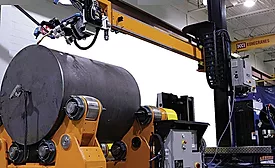
When it comes to the oil and gas industry, bigger is always better. This statement applies not only to the equipment used for site preparation and production, and the amount of usable natural resources removed from the ground—but also to the metal containers that are required to store the radioactive waste material that naturally occurs during exploration and drilling.
Manufacturers have known the importance of being discreet since the start of the Industrial Revolution. History has definitely shown this approach to be the best way to safeguard all of a company’s technological, production and assembly secrets.
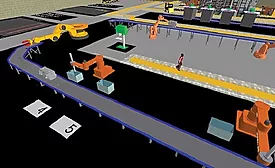
Robots are being used for a variety of assembly and inspection applications, which is enabling the operation of lean, efficient and automated systems where more than one product type or model can be produced on a single assembly line.
Multiple T-slot framing, pipe-and-joint and square-tube systems let engineers get creative when building workstations, flow racks and other production structures
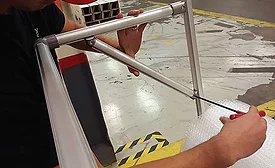
Lessons learned in childhood often last a lifetime. The same can be said of acquired skills, such as building things with Erector Sets, Legos and Lincoln Logs. Individuals who mastered and enjoyed these classic toys may very likely be the same people who use T-slot extrusion framing, pipe-and-joint and square-tube systems to build modular workstations, flow racks and other production structures for manufacturers.
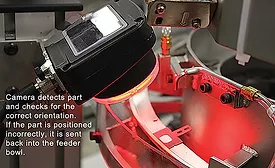
The manufacturer needed to present thin steel blades down an assembly line in a specific orientation. However, the parts were essentially symmetrical, with the exception of a small notch that had to be presented on the right side. With no real differences in the part other than this notch, feeding them to an assembly mechanism with 100 percent accuracy was a challenge.
To handle simple material handling tasks in automated workcells, engineers typically opt for linear axes. However, assembling multiple linear axes into a Cartesian motion system can be a time-consuming process. You must connect each module to the next one, assembling subcomponents as you go, then wire each module, connect each axis to an external controller, and finally program the system.
JACKSON, MN--Farmers never take a day off. Nor do their tractors. Growers rely on their machines to plow, plant, till, spray, bale and harvest a wide variety of crops in all sorts of conditions.
Ultrasonic welding can handle most plastics assembly applications. Other friction-based processes, such as vibration welding and spin welding, can usually tackle the rest. However, that necessitates investing in three separate machines at considerable cost.
The one constant thing about technology is that it is constantly changing and evolving. Don’t think so? In that case, ask the people who rushed out to buy the latest iteration of a smartphone, but then find themselves standing in line waiting to purchase the latest new-and-improved version just six months later.
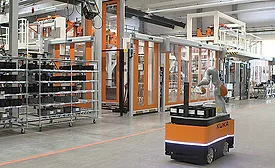
Robots used to be thought of strictly as stationary machines. They were bolted to a floor, table, ceiling or wall and that’s where they stayed. But, that’s beginning to change.