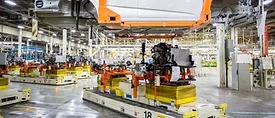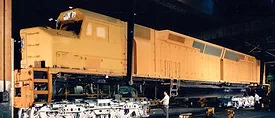

For decades, General Motors was king of the highway and queen of the rails. In addition to mass-producing buses, cars and trucks, the automaker was once the largest locomotive builder in the world. At a massive factory just west of Chicago, GM’s Electro-Motive Division (EMD) assembled powerful machines that helped transition American railroads from steam to diesel.
Composite structures in airplanes are often thin-walled and lightweight, resulting in significant compliance. This presents a challenge for handling and assembly.
The current paradigm of car manufacturing, which provides a variety of models, colors and options, is called mass customization. However, mass customization is now transforming into mass individualization. In mass individualization, products are uniquely catered to consumers’ desires. For example, some car buyers may want to replace ordinary car seats with luxury brands, such as Louis Vuitton, to differentiate themselves.
Rotor blades, guide vanes and other components for jet engines are made from costly materials and machined to precise tolerances. Such components are typically made in batches, due to the time involved in setting up machine centers. The process also requires a fair number of people to tend the machines and assist in changeover.
The ASSEMBLY Show 2022, held in Rosemont, Illinois, was celebrated as the 10th annual ASSEMBLY trade show devoted exclusively to assembly technologies, processes, products, education, and networking.
As engineers assess how additive manufacturing (AM) can replace or complement traditional manufacturing processes, there will need to be a quantum shift in how to approach the entire design-to-manufacturing process.
There’s nothing quite like a multistation automated assembly system. Watching robots, actuators and indexers go about their carefully choreographed routines with little or no human intervention can seem nothing short of miraculous.
Assembling the world’s most advanced air defense missile requires technological innovation, especially when annual production is set to increase to 500 by 2024.
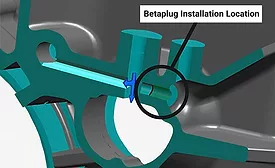
An automatic transmission case is a complex casting that includes a sophisticated valve body with many channels and passages. These channels and passages must be precisely connected to ensure smooth, accurate shifting.
Rarely does a major spending bill in Washington draw bipartisan support and yield immediate results. Behold the CHIPS and Science Act, which was signed into law by President Joe Biden Aug. 9. The act provides more than $52 billion in new funding to boost domestic research and manufacturing of semiconductors in the U.S.