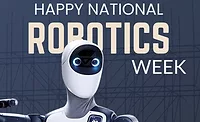
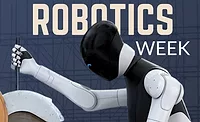
National Robotics Week
Where Robotics Is Headed: AI, Humanoids and the Rise of Physical Intelligence
BIRMINGHAM, Mich. — As National Robotics Week highlights the rapid evolution of automation, manufacturers are beginning to deploy a new generation of intelligent robotic systems capable of adapting to real-world production environments. Robotics is no longer defined by motion alone. The next phase of automation is being driven by intelligence — systems that can perceive, decide and adapt in real time on the factory floor.
That shift is often described as “physical AI,” where machines combine sensing, computing and control to operate in dynamic environments. Instead of following fixed instructions, robots are beginning to respond to changing conditions, interact with human workers and take on more complex tasks.
This transition is already visible across manufacturing. Automotive companies are beginning to deploy humanoid robots inside production environments, not as experimental platforms but as working systems designed to handle assembly tasks. Facilities in Europe and North America are testing how these robots can operate in existing production spaces, using tools and workstations originally built for human workers.
At the same time, major manufacturers and equipment suppliers are increasing investment in humanoid robotics, with companies such as Deere and Mercedes-Benz exploring how these systems can support assembly and material handling in production environments.
Beyond assembly, humanoid robots are also being tested in industrial logistics. In one example, a proof-of-concept deployment at a Siemens facility used a humanoid system to autonomously pick, transport and place totes within a production workflow, demonstrating how robots can take on repetitive material handling tasks in real-world operations.
The common thread across these efforts is flexibility. Unlike earlier generations of industrial robots, which required structured environments and repeatable inputs, newer systems are being designed to adapt to variation. Advances in sensing, edge computing and AI models are enabling robots to respond to differences in parts, positioning and workflow — a shift that expands the range of tasks that can be automated.
This is also changing the role of human workers. Rather than replacing labor, many of these systems are being deployed to support collaboration. Robots are increasingly handling physically demanding or precision-driven tasks, while workers focus on problem-solving, oversight and process improvement. In practice, that means new roles emerging on the factory floor — from managing robotic systems to integrating AI into production workflows. As robotics becomes more adaptable, the boundary between automation and human work is becoming less defined.
Looking for quick answers on assembly and manufacturing topics? Try Ask ASM, our new smart AI search tool. Ask ASM
At the same time, manufacturers are testing how humanoid systems can fit into real production environments without requiring major changes to plant layouts. The ability to operate in human-designed spaces remains one of the key advantages of humanoid robots, particularly for high-mix, high-variability assembly.
Taken together, these developments point to a clear direction. Robotics is evolving from isolated automation to integrated systems that combine intelligence, mobility and dexterity. The focus is shifting from replacing individual tasks to supporting entire production processes.
As this trend continues, the question for manufacturers is no longer whether robots can be deployed — but how far their capabilities will extend across the factory floor.
Looking for a reprint of this article?
From high-res PDFs to custom plaques, order your copy today!