Assembly Magazine logo
search
Ask ASSEMBLY AI
cart
facebook twitter linkedin youtube
  • Sign In
  • Create Account
  • Sign Out
  • My Account
Assembly Magazine logo
  • TRENDS
    • Ask ASSEMBLY AI
    • Trends
    • News
    • New Products
  • INDUSTRIES
    • Aerospace
    • Appliance
    • DFMA Assembly
    • Medical Devices
    • Green Manufacturing
    • Lean Manufacturing
    • Machinery Assembly
    • Electronics Assembly
    • Automotive
  • TECHNOLOGIES
    • Adhesives & Dispensing
    • Assembly Presses
    • Automated Assembly Systems
    • Manufacturing Management
    • Manufacturing Software
    • Motion Control
    • Screwdriving & Riveting
    • Robotics
    • Test & Inspection
    • Plastics & Metal Welding
    • Wire Processing
    • Workstations
  • AUTONOMOUS & ELECTRIC MOBILITY
    • AEM Magazine Archives
    • Autonomy
    • Electrification
    • Mobility Services
    • Assembly & Testing
    • AV/EM News
  • MEDIA
    • Ask ASSEMBLY AI
    • Podcasts
    • Assembly News Now
    • Assembly TV
    • Webinars
    • eBooks
  • EVENTS
    • Calendar
    • The ASSEMBLY Show
  • MORE
    • Exclusives >
      • Plant of the Year
      • Capital Spending
    • Buyers Guide >
      • Supplier Insights
    • Classifieds
    • Featured Products
    • Newsletters
    • Store
    • White Papers
    • Columns
    • Sponsor Insights
  • INFOCENTER
    • Assembly & Test Solutions
  • EMAGAZINE
    • eMagazine
    • Archive Issues
    • Advertise
    • Contact Us
    • Sign Up
Adhesives & Dispensing Assembly

Dispensing Shines in Solar Assembly


By John Sprovieri
solar panel mfg
December 22, 2010


Solar cells and panels require some unique and highly technical manufacturing processes that have more in common with making microchips than mechanical assemblies. And yet, these engineering wonders also share an assembly process with more pedestrian products, like air filters and oil pans.

That process is dispensing. Whether it’s needed for flux, solder paste, dopant, adhesive, ink, potting compound or gasketing material, dispensing technology plays a vital role in the assembly of solar cells and panels. Dispensing equipment is employed at virtually every step in the process, from the very start, when wafers are sliced from a silicon ingot, to the very end, when finished solar panels are assembled into frames.

And that’s just for crystalline and polycrystalline solar cells. Dispensing technology plays a role in manufacturing amorphous or thin-film solar cells, too. In addition, dispensing technology is used to assemble a host of products related to solar power generation, including batteries, inverters and transformers.
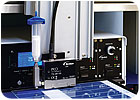


Piezoelectric jet valves are a fast, accurate way to apply flux, conductive adhesives and other materials used in photovoltaic assembly processes. Photo courtesy Nordson EFD


Front-End Processes

At the beginning of the process, wafers for solar cells are rapidly and precisely sliced out of silicon ingots with a wire saw. To ensure reliable processing, the entire ingot is bonded to a glass plate and the workpiece holder with a fast-curing, two-component, water-soluble epoxy. Available from Henkel Corp. and other suppliers, the epoxy is dispensed by a robot equipped with a standard valve and static mixer.

After slicing, the edges of the wafer are still fixed to the glass plate. A bath in hot water frees the wafer from the glass without leaving residues behind.

Once photovoltaic circuits have been etched into the wafer, a conductive grid must be superimposed on the surface to collect the electrons produced when light strikes the cell. Traditionally, solar cell manufacturers have created this grid using conductive ink applied with a screen printer. However, as wafers get thinner and more fragile, screen printing is becoming less viable. Instead, some manufacturers are creating the grid by dispensing a network of thin lines of conductive ink. The lines could be less than 100 microns wide.

“You want to make those lines as narrow as possible, because you don’t want to take up light-gathering real estate,” says Terry Dunbar, global key account manager at Nordson Corp. “At the same time, you want the lines to have a high aspect ratio for low resistance.”

Another front-end process that requires dispensing technology is doping. Impurities, called dopants, are applied to the silicon wafer with a spray valve. In a solar cell, two differently doped silicon wafers are sandwiched together to create the one-way flow of electrons necessary to produce electricity. One wafer is doped with phosphorus; the other with boron.
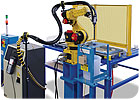
A six-axis robot equipped with a high-pressure valve can dispense a bead of gasketing material around the rim of a junction box for a solar panel. Photo courtesy Sealant Equipment & Engineering Inc.

Connecting Cells

To create a solar panel, individual solar cells are linked together in a process called tabbing or stringing. In this process, cells are electrically connected with a solder-coated copper ribbon. Before the ribbon is soldered in place with a heated tool, an alcohol-based flux is applied with a precision spray valve. Thick or tacky fluxes are dispensed with a piezoelectric jetting valve.

“Traditionally, manufacturers pulled the ribbon through a flux bath and then removed the excess,” explains Dunbar. “The problem with that is you can apply too much flux, which can run off the cell and get into the back sheet, creating discoloration.”

Not all manufacturers use a heated tool to solder the ribbon. To avoid the risk of stress fractures from the concentrated heat, some manufacturers apply solder paste to the ribbon and reflow it.

“We dispense the solder paste with an augur valve, because it can achieve a much higher process capability than a syringe-based system,” says Dunbar. “Some people will dispense a bead of paste. Others will just dispense dots, to save material.”

A third option for connecting the ribbon to the cells is an electrically conductive, silver-filled epoxy, which cures at a much lower temperature than needed to reflow solder paste. This option is particularly good for thin wafers, which are more susceptible to thermal shock.

A piezoelectric jetting valve is used to dispense dots of epoxy approximately 1 millimeter in diameter. For jetting applications, “you can’t just grab any conductive adhesive off the shelf,” warns Dunbar. “There are adhesives specifically formulated for jetting. They have less than 70 percent fill, and the plate sizes are smaller so they don’t clog the nozzle orifice.”
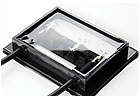
 

Once the junction box has been assembled, some manufacturers will pot the enclosure to protect the electronics from moisture. Photo courtesy Wacker Chemical Corp.

At the Junction

The strings connecting the solar cells terminate at the back of the panel in a junction box. Inside the box, the strings are soldered to terminals or inserted into compression fittings. There are three applications for dispensing technology here.

First, a bead of formed-in-place gasketing material is dispensed around the edge of the box. A silicone material, such as Elastosil 1100 from Wacker Chemical Corp. or PV-8030 from Dow Corning Corp., is dispensed with a high-pressure valve fed by a gear pump. The valve is mounted to a Cartesian or six-axis robot.

“They’re not petite beads,” notes Dunbar. “You’re looking at 0.25-inch or even 0.5-inch beads, because you want to make sure there’s a hermetic seal.”

Robots are often used for dispensing adhesives and other materials in solar panel production. A six-axis robot or a gantry robot can be programmed for many different sizes of panel. If you have to apply sealant to a large solar panel, it’s very difficult to reach over and place a bead of material on all four sides.

Diodes are installed inside the junction box to prevent current from flowing backward through the module. These diodes are attached with solder paste dispensed from an augur valve.

Once the junction box has been assembled, some manufacturers will pot the enclosure to protect the electronics from moisture, especially if the panel has a long-term warranty. A two-part silicone encapsulant, such as Elastosil 2202 from Wacker Chemical, is dispensed with a piston pump or gear pump feeding a standard two-component valve and static mixer.

With the junction box in place, the final step in the process is to place the finished panel in a frame, which is typically assembled from glass and aluminum extrusions. A silicone sealant or hot-melt adhesive is dispensed inside the frame and around the glass prior to assembly for added strength and protection against moisture. A few screws are then installed to keep the frame in place.
 

ASSEMBLY ONLINE

For more information on dispensing, visit www.assemblymag.com to read these articles:

* How to Improve Dispensing Processes and Quality With Robotic Dispensing Technology.

* Better From the Benchtop.

* Dispensing Cyanoacrylates.

Looking for quick answers on assembly and manufacturing topics? Try Ask ASM, our new smart AI search tool. Ask ASM →

KEYWORDS: electronics potting solar panel manufacturing solar power

Share This Story

Looking for a reprint of this article?
From high-res PDFs to custom plaques, order your copy today!

John has been with ASSEMBLY magazine since February 1997. John was formerly with a national medical news magazine, and has written for Pathology Today and the Green Bay Press-Gazette. John holds a B.A. in journalism from Northwestern University, Medill School of Journalism.

Recommended Content

JOIN TODAY
To unlock your recommendations.

Already have an account? Sign In

  • Made in the U.S.A.

    Consumer Products Manufacturing: Made in the USA

    Supply chain lessons learned during the coronavirus...
    Automated Assembly Systems
    By: Austin Weber
  • Best Practices for Press-Fit Assembly

    Best Practices for Press-Fit Assembly

    In manufacturing, ironclad formulas for success are hard...
    Assembly Presses
    By: Jim Camillo
  • aem0523leader-tesla1.jpg

    Tesla Rethinks the Assembly Line

    Engineers at Tesla Inc. have developed a new process that...
    Industries
    By: Austin Weber
Manage My Account
  • eMagazine Subscription
  • Assembly Newsletters
  • Online Registration
  • Subscription Customer Service
  • Manage My Preferences

More Videos

Sponsored Content

Sponsored Content is a special paid section where industry companies provide high quality, objective, non-commercial content around topics of interest to the ASSEMBLY audience. All Sponsored Content is supplied by the advertising company and any opinions expressed in this article are those of the author and not necessarily reflect the views of ASSEMBLY or its parent company, BNP Media. Interested in participating in our Sponsored Content section? Contact your local rep!

close
  • ultrasonic welding
    Sponsored bySonobond Ultrasonics

    Engineering Efficiency in High-Performance Assembly: How Ultrasonic Welding Enhances Throughput, Reliability and Quality

  • UV curing system
    Sponsored byDymax

    Why UV Intensity Alone Doesn’t Define Curing Performance

  • wooden pallets
    Sponsored byLEAN Manufacturing Products

    Eliminating Waste on the Shop Floor: Applying Lean Principles to Improve Manufacturing Efficiency

Popular Stories

ASSEMBLY News Now, episode-30: Volvo Redesigns EV Manufacturing

Volvo Redesigns EV Manufacturing

Boeing CEO Kelly Ortberg announces 1 billion investment

Boeing Plans $1 Billion Wichita Investment, Workforce Training Center

GE Appliances Worker on Line

GE Appliances Expands Factory AI With 800 Gemini Enterprise Agents

Watch the latest episode of ANN now!

Events

July 24, 2025

From Shop Floor to CFO: How Manufacturers Are Closing the Loop Between Operations and Finance

On Demand Learn how manufacturers are bridging the gap between the shop floor and ERP systems to gain real-time visibility, streamline operations, and kick-start digital transformation—without waiting years.

Sponsored by:

PicoStratusGreen
July 30, 2025

Buffer Analysis and Design Fundamentals for Manufacturing Excellence

On Demand In this presentation, Dr. Herman Tang shares practical insights from his industry experience and research on buffer management in manufacturing operations.

View All Submit An Event

Poll

Difficult Assembly Processes

Which assembly process gives you the most difficulty?
View Results Poll Archive

Products

Manufacturing Cost Policy Deployment (MCPD) Profitability Scenarios: Systematic and Systemic Improvement of Manufacturing Costs

Manufacturing Cost Policy Deployment (MCPD) Profitability Scenarios: Systematic and Systemic Improvement of Manufacturing Costs

See More Products
Register for webinar - Modernizing Automotive Assembly: Why Upgrading Legacy MES is a Business Imperative

Related Articles

  • Suniva to Invest $100 Million in Solar Cell Assembly Plant

    See More
  • Integrator Wins Two Contracts for Solar Assembly Systems

    See More
  • McCune to Acquire Schott Solar Assembly Plant

    See More

Related Products

See More Products
  • digital.jpg

    Digital Manufacturing and Assembly Systems in Industry 4.0

  • Kaizen Assembly: Designing, Constructing, and Managing a Lean Assembly Line

  • Collaborative Product Assembly Design and Assembly Planning, 1st Edition

See More Products

Events

View AllSubmit An Event
  • August 14, 2025

    Adhesives, Dispensing and Curing Technology Panel Discussion

    On Demand Get ready for The ASSEMBLY Show happening October 21 – 23 at the Donald E. Stephens Convention Center in Rosemont, Illinois. Join us for an exclusive pre-show webinar to learn about the pros and cons of major adhesive chemistries and how to choose the best dispensing method for your application.
View AllSubmit An Event

Related Directories

  • Melink Solar

  • Dispense Works Inc.

    Dispense Works Inc. is a full-service manufacturer specializing in robotic dispensing and automated assembly systems, including advanced robotic capping and filling machines. All of our products are proudly designed and manufactured in-house at our McHenry, Illinois facility. Made in the USA
  • EXACT Dispensing Systems

    DistributorsMAINEEXACT Dispensing Systems1130 Rt.1Newcastle,  ME(207) 563-2299  www.exactdispensing.commarketing@exactdispensing.com
×

Never miss the latest news and trends driving the manufacturing industry

Stay in the know on the latest assembly trends.

JOIN TODAY!
  • RESOURCES
    • Advertise
    • Contact Us
    • Directories
    • Manufacturing Division
    • Store
    • Want More?
  • SIGN UP TODAY
    • Create Account
    • eMagazine
    • Newsletters
    • Customer Service
    • Manage Preferences
  • SERVICES
    • Marketing Services
    • Reprints
    • Market Research
    • List Rental
    • Survey/Respondent Access
  • STAY CONNECTED
    • LinkedIn
    • Facebook
    • Instagram
    • YouTube
    • X (Twitter)
  • PRIVACY
    • PRIVACY POLICY
    • TERMS & CONDITIONS
    • DO NOT SELL MY PERSONAL INFORMATION
    • PRIVACY REQUEST
    • ACCESSIBILITY

Copyright ©2026. All Rights Reserved BNP Media, Inc. and BNP Media II, LLC.

Design, CMS, Hosting & Web Development :: ePublishing