Test and Inspection
New Leak Tester Can Use Argon or Air
The instrument represents a less expensive alternative to helium-based testers.
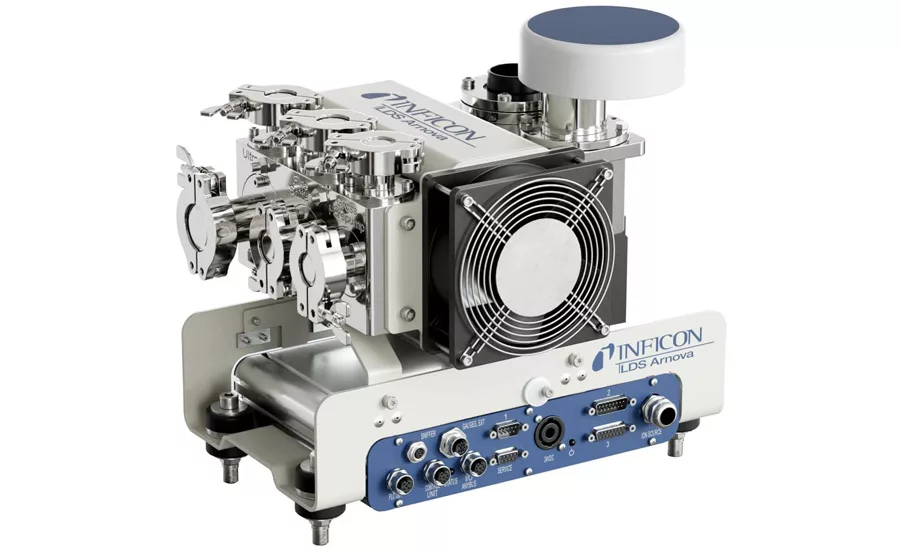
The LDS Arnova leak test instrument can use low-cost argon gas or even ambient air to deliver comparable results to helium-based technology.
If you assemble a product that absolutely, positively cannot leak, helium is a key ingredient of your quality control process. A helium leak detector can find a leak the size of one champagne bubble over 24 hours.
Unfortunately, helium gas prices have risen significantly. Global prices have spiked by 50 to 100 percent in recent months, due to the ongoing conflicts in the Middle East and soaring demand from semiconductor manufacturing.
Now, a new technology from Inficon promises to eliminate the trade‑off between cost and performance in leak testing. The company’s new LDS Arnova leak test instrument can use low-cost argon gas or even ambient air in a vacuum chamber to deliver comparable results to helium-based technology.
Built on the company’s proven LDS3000 platform, LDS Arnova offers the affordability of conventional pressure testing and the sensitivity of tracer-gas test methods. Fast and repeatable, it can detect leaks as small as 1 x 10⁻³ millibar-liter per second with air or 1 x 10‑6 millibar-liter per second with argon. This makes it ideal for replacing pressure testing systems that lack sufficient accuracy or helium systems, which are often too precise for many applications.
Vacuum measurement stays stable despite temperature changes, so there are fewer false readings and less downtime.
A naturally occurring component of the atmosphere, argon is widely available and unaffected by supply shortages or market volatility. It’s typically dozens of times cheaper than helium. Moreover, the gas is fully detectable by mass‑spectrometry. As a result, LDS Arnova can deliver tracer‑gas‑level sensitivity without the complexity of traditional helium systems. Argon‑based testing also simplifies infrastructure: There’s no need for complex recovery systems.
In addition, argon provides stable, repeatable measurements. Its larger molecular mass (40 atomic mass units vs. 4 atomic mass units for helium) contributes to consistent diffusion characteristics, supporting reliable leak detection in industrial environments.
Looking for quick answers on assembly and manufacturing topics? Try Ask ASM, our new smart AI search tool. Ask ASM
The instrument can also use ambient air as a tracer gas.
The LDS Arnova leverages the proven control technology of the LDS3000 platform, ensuring that system integrators can implement it quickly and confidently. With its flexible communication interfaces and modular connectivity, the instrument adapts naturally to existing production lines. Its durable design and long maintenance intervals help manufacturers achieve high uptime and stable long‑term operation.
The instrument’s high‑efficiency turbomolecular pump provides rapid pump-down for high-volume production. A versatile and precise connection block provides gross, fine, and ultra connections for a range of applications.
The instrument supports a variety of leak testing applications, including disposable and high-volume consumer products; non‑medical health products; temperature-sensitive heat exchangers; large components, such as tanks, battery housings and fire extinguishers; and flexible components, such as urea tanks and printer cartridges.
For more information on leak testing systems, click www.inficon.com or visit the company’s booth at The Assembly Show, which will be held Oct. 27-29 at the Donald E. Stephens Convention Center in Rosemont, IL.
Besides leak testing technology, you’ll find more than 200 suppliers of automation, fastening tools, robotics, software, presses, workstations, adhesives, dispensing and curing technology, and plastics joining equipment.
Looking for a reprint of this article?
From high-res PDFs to custom plaques, order your copy today!